Korach’s Question Is Still Ours-Who gave you the right?

“Rav lachem — you have gone too far. The entire congregation is holy, every one of them, and God is in their midst. So why do you raise yourselves above God’s assembly?” (Num. 16:3). It sounds almost democratic. Everyone is holy, and power should be distributed. Who appointed you?

The word Korach uses for “raise yourselves” is hitnassu, from the root nasa, meaning “to lift” or “to carry.” This is no accident. Throughout the Book of Numbers, nasa is precisely what leaders are called to do for others. The census begins seu et rosh, “lift the heads” of the Israelites (Num. 1:2). In the Torah’s own grammar, leadership is the elevation of people. Korach takes that same word and turns it reflexive: you have been lifting yourselves. What began as a vocation becomes, in his telling, a vanity.

He has a point. Jacob Milgrom, in his landmark JPS Torah Commentary on Numbers (1990), notes that Korach’s protest reflects a genuine theological tension: the democratization of holiness at Sinai (“a kingdom of priests,” Ex. 19:6) sits uneasily alongside the hierarchical priestly structure that follows. Rashi, commenting on the opening verse, is more direct: his eyes misled him (Rashi on Num. 16:7). Korach understands the letter of the law. His error is not theological ignorance. It is envy dressed as principle. He deploys a genuine grievance to serve personal ambition, thereby corroding the very community whose holiness he claims to champion.

This is where Korach becomes unsettlingly contemporary.

Robert Putnam’s Bowling Alone (2000) documented the collapse of social capital, the networks of trust, reciprocity, and civic engagement that hold communities together. Yuval Levin’s A Time to Build (2020) identified the specific pathology: our institutions have stopped forming people and have become platforms for individual performance. Leaders no longer serve the institution; they use it. The congregation becomes an audience. The office becomes a stage.

Korach doesn’t want to serve the assembly. He wants the assembly to confirm him.

A moment in the story is often overlooked. When Moses summons Datan and Aviram to speak, they refuse to come: lo na’aleh, “we will not come up” (Num. 16:12). The very men accusing Moses of inappropriate elevation refuse to engage. Their grievance has become more important to them than the community they claim to represent. This is how populism curdles: the aggrieved insist on the legitimacy of their anger while refusing the relational work that legitimate challenge requires.

What does legitimate challenge look like? Moses, for all his flaws, shows us something: he falls on his face (Num. 16:4). Not in capitulation, but in recognition of the stakes. He doesn’t reach for power. He keeps asking whether there is another way.

The erosion of trust in our moment is not simply the result of bad actors. It is the result of a culture that has learned to reward Korach’s move: mobilize grievance, claim to speak for everyone, and leverage that claim for personal advancement. It feels like democratic accountability, but it functions like its opposite.

The text poses a genuine question to us. Holding leaders accountable is an obligation. But how do we do it without Korach’s self-serving use of righteous language? How do we distinguish the prophet from the demagogue when both speak the language of liberation?

The Torah does not resolve this. It leaves us with it, deliberately.

Discernment is itself a form of holiness. And it has to be cultivated. It doesn’t arrive by earthquake or fire.

It comes, as it usually does, in relationship.


Key Citations

Rashi on Numbers 16:1 (s.v. va-yikach Korach).

Milgrom, Jacob. Numbers: The JPS Torah Commentary. Philadelphia: Jewish Publication Society, 1990.

Putnam, Robert D. Bowling Alone: The Collapse and Revival of American Community. New York: Simon & Schuster, 2000.

Levin, Yuval. A Time to Build: From Family and Community to Congress and the Campus. New York: Basic Books, 2020.

What Are We Willing to Believe?-Parashat Shelach

The ten spies weren’t lying. That’s what makes Parashat Shelach so difficult to sit with.

They went. They looked. They came back and reported exactly what they saw: a land flowing with milk and honey, yes, and also giants and fortified cities. And as we so often feel, they add: we felt like grasshoppers in our own eyes, and so were we in theirs. Numbers 13:33.

This is not dishonesty. It is about perception.

It is also a deeply human thing. The spies were not weak people. They were the chosen leaders of their tribes, sent precisely because they were capable. And yet standing before the walls of Canaan, something in them collapsed inward. The text doesn’t tell us why. It doesn’t need to. We know why. We have felt it ourselves. Fear has a way of shrinking our self-image before we have had a chance to act. We look at what is in front of us and conclude, before taking the first step, that we are not enough. The journey’s end is determined. Before they ever walk into Canaan.

The word for spies in the Torah is meraglim, from the root regel, foot. They were sent to walk the land. To touch it. To feel its soil. But what the ten spies brought back wasn’t the earth. It was their terror, projected onto the landscape. They looked at the land through the lens of their own smallness and concluded that the smallness was the land’s fault.

This is not a report on Canaan. It is a teaching about how fear shapes what we are capable of seeing.

Caleb and Joshua walked the same hills and tasted the same grapes. They came back with a different report, not because they were braver or stronger, or had seen something the others had not. They came back differently because they remembered differently. They carried with them the sea splitting, the manna falling, the cloud by day and the fire by night. They understood that they had not arrived at this border by their own strength alone. That memory, of miracle, of deliverance, of promise fulfilled along the way, gave them a self-image the ten could not sustain. They looked at what stood before them and saw not the size of the obstacle but the fullness of what they were capable of becoming.

Fear doesn’t lie to us about what’s in front of us. It lies to us about what we’re capable of.

B’nai Yisrael. In their fear, they condemned themselves to forty more years of wandering. Not as divine punishment but as the consequence of having decided before the battle was joined that they had already lost. You cannot enter a land you have already surrendered in your imagination.

We have all stood at the edge of a promise, one made to us, or one we made. And the voice insisting the battle is already lost before it has begun is most often our own.

We each carry more proof of what we have survived than fear would have us remember.

The giants are real. That was never the question.

The question is whether you are willing to believe in yourself enough to walk through your fear anyway.

Starting All Over Again -Bereishit

There is an old joke that goes something like this:

The rabbi sees Mrs. Schwartz in the grocery store just before the High Holidays. He greets her as most rabbis would, “Mrs. Schwartz, it’s so good to see you. I look forward to seeing you in the synagogue for the High Holidays.”

She replies, “It’s good to see you, too, rabbi. But I don’t think I’ll be coming.”

“Oh,” said the rabbi, “I hope everything is alright. Why won’t you be there?”

“Well, rabbi,” she responds, “Every year, it’s the same old thing. We even read the same Torah portion.”

Although the joke isn’t particularly funny, it notes an essential part of our wisdom tradition; every time we read “Bereishit Bara Elohim” or any part of the Torah, it is different because we are different. Every time we engage in a text, our understanding differs from the last time. Our experiences shape and influence us and, therefore, also affect how we grasp the text. Our lives have evolved, and likely, the questions on our minds do, too. All of us have experienced the same thing differently. Let me explain.

Think about returning to a place you’d been before. Despite our expectations, we experience it differently this time around. The river is not the same water; our favorite book or movie reveals different secrets. Even my beloved childhood Twinkies do not taste the same.

A teacher of mine shared that the answers you get depend on the questions you ask. Our texts are treasure troves, just waiting for us to uncover the precious jewels they contain. The questions I ask in middle age are very different from the ones I asked as a young person. The issues I confront today in our current climate have me seeking answers to deeply troubling questions about meaning, seeking wisdom from this insightful tradition.
We begin again with the first words of the Torah. But what does it mean? How does the message resonate with you now?

This has been a challenging year for Jews. The Oct. 7 invasion of Israel, the war starting in Gaza and expanding into Lebanon, threats from Iran, deep political unrest, antisemitism cloaked as anti-Zionism/anti-Israel and unvarnished Jew-hatred appearing across this country and the world have most of us reeling. We are shaken to our core and struggling to figure out how we move forward. Our texts are compelling and filled with timeless wisdom, and we grapple with them this year in ways that we didn’t expect.

During the High Holidays, we are reminded that God understood the need to create a world that balanced Din and Rachamim, law and compassion. Midrashim share stories that this world was not God’s first attempt. Previous creations failed due to the heavy reliance on one or the other trait. Our stories also tell us that the Torah existed even before creation.

This leads me to an interesting thought. Perhaps even the divine approaches the Torah differently, learning from each encounter. Even the almighty learns from the Torah.

Moses once asked the eternal one what would happen to the wisdom once Moses was gone. God sweeps him into a class taught by the sage Rabbi Akiva. Moses is perplexed as nothing Akiva says seems familiar to him as he listens. And then, as if on cue, Akiva closes with, “And all of this comes from the Torah of Moses, our teacher. One of the fantastic parts of our tradition is the messages of core values that remain timeless even if the way they are practiced or understood evolves with the generations.

Our mystical stories talk of black fire and white fire, describing our sacred scrolls.
The words, the letters of the words and even the white spaces on the sacred text are opportunities for us to learn, using the holy text as a timeless source of knowledge, bounded only by our ability to comprehend it.

So, Mrs. Schwartz didn’t get it quite right. As we read the story of God’s creating, let us use this as a chance to see not an old story but as one of a new beginning, reading with fresh eyes, engaging it and asking the essential personal questions as the story of the world and the Jewish people continues to unfold.

Rabbi David Levin is the founder of the Jewish Relationships Initiative, which aims to help seekers of meaning through Jewish Wisdom in human relationships and end-of-life challenges. He is also vice president of the Board of Rabbis of Greater Philadelphia. The Board of Rabbis of Greater Philadelphia is proud to provide diverse perspectives on Torah commentary for the Jewish Exponent. The opinions expressed in this column are the author’s own and do not necessarily reflect the view of the Board of Rabbis.


Ki Tisa- Trust and Fear

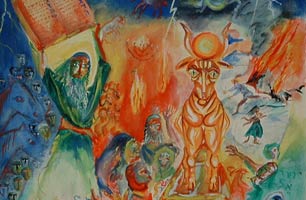
golden calf The relationship between Trust and Fear is very close. They are locked in a dualistic battle for supremacy.

Ki Tisa contains the story of the Golden Calf. Ex 32:1, When the people saw that Moses was late in coming down from the mountain, the people gathered against Aaron, and they said to him: “Come on! Make us gods that will go before us, because this man Moses, who brought us up from the land of Egypt we don’t know what has become of him.”

 Rashi explains that the people expected Moses to return in 40 days. He was delayed according to Rashi’s reading of the texts by 6 hours. 6 hours delayed after a 40-day encounter with God, and the people rebel. What an extraordinary level of fear that possessed the people to turn against the trust of God and Moses, the covenantal relationship that took the people out of Egypt, crossed the Red Sea and brought them to the moment of revelation, all the Trust undermined by a six-hour delay.

 We learn how difficult trust is to build, how important it is and how quickly it can disappear. We embrace trust as a foundation. We speak of trusting in ourselves so that we can make decisions along our way. We believe trust is the basis for any intimate relationship, that we will be cared for and held securely and safely by another and create a deep meaningful relationship permitting ourselves to be vulnerable because we feel protected. And it is precisely in this place that Fear can exercise its damaging power. In a moment, in a blink of an eye, or in this case six hours, Fear can take all we thought we had and burn it down. Rashi suggests that it is Satan who acts to confound the people. Satan is the fear we each carry inside.

 It is in the realization that we carry Fear as a primal instinct that we can understand its place. Fear resides inside, maybe a protector from an earlier era in human development. It may have helped us survive certain threats, but it shackles us and keeps us down. Only when we consciously use Trust to defeat it, can we overcome Fear and permit ourselves to be vulnerable, creating bonds and relationships with others upon which we can build. However, these two things need to coexist. Fear continues to protect us from threats and tempers Trust. Trust likewise keeps us from becoming paralyzed by Fear. Each is a part of us and we need both to be whole. But when one takes over the other things fall apart.

 Arguably we could say that the people should have trusted in God absolutely.   But we know that for most of us that is not true. God had yet to reveal, that was why they were at Sinai and Moses was the man they followed, making God even further removed. Their trust was tested and the relationships were not strong enough. The fear was able to creep in and crush this new relationship.

 Trust needs to be nurtured and reinforced to withstand the tests fear makes it endure. The story of the Golden Calf is the story of all of us.

Torah and the NFL- Nitzavim and Domestic Violence

This week’s Parasha opens with an extraordinary statement: “Atem nitzavim hayom culchem lifnay Adonai.” (Deut. 29:9) You are all standing here this day before the Eternal your God; the leaders of your tribes, your elders and your officers, every man of Israel, your young children, your women, and your convert who is within your camp both your woodcutters and your water drawers that you may enter the covenant, the Brit, of the Eternal your God and His oath which the Eternal your God is making with you this day. (Deut. 29:9-11)

Everyone from the highest of stature to the lowliest is included. We each and every one of us are to be included. The statement is actually twofold. It has an element that sometimes we overlook. Usually we focus on how each is obligated to enter into the covenant. But there is a form of reciprocity implied in the Brit. As each of us is obligated to enter into it, then by extension so too is each of us protected by it. No matter what your stature from the lowliest to the highest, we are all sheltered by the very same covenant of laws. No one is above the law and all are subject to the same law.

A nation of laws has been birthed for the first time in human history. This is one of the singularly great gifts of Judaism to humankind. It is the bedrock upon which we have built the United States of America.

And that is precisely why it is so deeply offensive and disturbing to witness the ongoing saga of domestic violence play out within the National Football League and within our culture. The Allstate Foundation and its affiliate, The Purple Purse, a center to combat domestic violence, published that an astounding 1 woman in 4 in this country will report experiencing domestic violence in their lifetimes. 1 in 4. Here in the United States of America. Furthermore, the number of victims that find they are unable to remove themselves from the cycle of violence is equally staggering. And sadly many victims come to believe that the cycle of violence is acceptable or even the norm and then tragically perpetuate the behavior.

 The stories of Ray Rice, the now former running back for the Baltimore Ravens, and Adrian Peterson of the Minnesota Vikings continues. Around the country many people are proclaiming that domestic violence simply is not acceptable. The simple truth is: A brute cannot assault a woman; child discipline cannot devolve into battery leaving physical injury. We do not permit domestic violence. Period— End of Story.

 But it is so much easier to turn a blind eye. After all, we are talking about Football. Football is more than a game; Football is our national quasi-religion. Its sacrament is offered by the grand church known as the National Football League in cathedrals around the country and live-cast into our homes.  Almost everyone loves to watch the game on Sunday, and on Monday and on Tuesday and on Wednesday and on Thursday. (If only we could get people to our services so often!). It is quite a spectacle and these players are great athletes.

 Some people ask, can’t we just kick back and enjoy the show? I mean cold cocking your fiancé is not the most admirable thing to do, but come on- have you watched this guy run? Many would rather watch the game rather and turn a blind eye to what happens off the field.

But the answer remains no. When we choose to turn a blind eye, we choose to condone domestic violence. We facilitate and even encourage this behavior because there are no consequences if we turn away. We cannot turn away. We are all responsible for one another.

 As public figures these athletes have a responsibility. And as people who make their money from our participation, we have a responsibility. These competitors embody the celebrity and the financial success that our country glorifies as well as their athleticism, the result of fierce training and discipline. We admire these qualities and aspire to be like those who possess them.

 These people are role models for our kids and for us as well. This is substantiated by the fact that the star performers all have major endorsement contracts to promote everything under the sun- from shoes to hats, to anti-fungal foot powder and almost anything else imaginable. It is only because of their influence on us that they hawk products. So whether or not they aspire to be, they are our role models and the endorsement deals create income streams and a lavish lifestyle.

 What I find distressing however is that the sponsors are reacting faster than the general public. Endorsement contracts are being reviewed and many pulled in response to the culture of unbridled violence that permeates Football. But the fan base, the American “amcha” if you will, remains by in large wildly devoted participants in the spectacle.

 What does it say about us when we encourage or condone or even tolerate this kind of behavior? What are the values that truly matter to us? How do we act as individuals, even when no one else is supposed to be looking? And what do we do in greater society as a whole? If we shirk our responsibilities, we create a culture that accepts and promotes Domestic Violence.

 Our Parasha this week admonishes us that we are united in our obligations. “You stand here today, all of you, before the Eternal your God,” And if we do not adhere to these principles, there will be exile and devastation in the land. Further, it is incumbent upon each of us. Each and every individual is responsible. And this is not an impossible task. “For the mitzvah I command you this day it is not beyond you, nor is it remote from you. “Lo Bashamayim Hi.” It is not in Heaven, it is not across the sea. Rather it is very close to you, in your mouth, in your heart that you may do it.” (Deut. 30:14)

 All of us are called upon to be involved and to require good and decent behavior from ourselves and from others. So much of Torah is given to us for precisely this purpose. This is not some matter of politically correct civility; it is a foundation upon which our society is built.  A free and democratic system cannot tolerate the brute to rule. To borrow from Socrates rebuke of Thrasymachus in Plato’s Republic, Justice is not the will of the stronger. The prophetic call to action of Isaiah, which we will read during the High Holidays and which we echo at every prayer service, admonishes us to feed the hungry, clothe the naked, shelter the homeless and provide for the widow and orphan. Society is strong only when it protects those unable to protect themselves. The seeds of this understanding are to be found here in Parasha Nitzavim.

 We are extraordinary and unique in that we are a nation of laws. This is not only a fundamental value of Judaism, but also a cornerstone of Western Culture and these United States. Without it, the very fabric of our society begins to fray and the domestic peace is threatened. It is both our inheritance and our legacy.

For this covenant extends beyond us to all of “those who are not here with us this day,” (Deut. v14) the future generations, our children and our children’s children.

 We are compelled therefore to demand better. The Eternal explains in Torah “I have set before you life and goodness, and death and evil. I command you to love God, to walk in His ways and to keep His commandments.” God admonishes us to live with our eyes wide open.

 For if we do not live respecting the laws of decency and civility a cancer growing inside, threatens our society, one that will eventually kill, or to use the language of Nitzavim, “a root that produces hemlock and wormwood.” (Deut. 19:17)  We can put a stop to it now, by not tolerating such abusive behavior.

 We can act and we can have an effect. Truly it is close to us in our hearts and mouths. Nitzavim cautions that if someone thinks that he or she “can have peace even if I follow my heart’s desires,” “The Eternal will not forgive…but rather God’s zeal will fume against that person.” (Deut. 19:18) And so, each of us is obliged and challenged to act.

 It can start with something as simple as not watching the football game, sending an email to a sponsor or to the NFL demanding a change before agreeing to patronize one of the worlds most successful business enterprises, and actively supporting campaigns against domestic violence such as Purple Purse.

 The month of Elul is a time of reflection in preparation for the High Holidays; we look to where we have fallen short and how we might do better in the year to come. This is one place where we can all do better.

 ”Life and Death I have set before you, blessing and curse.” (Deut. 30:15) “Choose Life and live.”(Deut. 30:19)

Shabbat Shalom
A Psalm for Elul- Psalm 27

Tradition asks us to recite Psalm 27 during the month of Elul as we prepare for the High Holidays.

I share the following beautiful translation of the psalm by Rabbi Yael Levy, on Congregation Mishkan Shalom, Philadelphia


TO THE BELOVED,


THE INFINITE PRESENCE is my light and expanse, whom should I fear?

The Infinite Presence is the strength of my life, what shall I dread?

When forces come close

Seeming to devour me

When narrowness threatens

And opposition attacks

All that is menacing stumbles and falls


EVEN AS AN ARMY of mistrust besieges me

My heart does not fear

Even as thoughts and desires rise up against me

I still have trust


ONE THING I ASK of the Infinite, One thing I seek

To dwell in the Presence all the days of my life

To awaken to the beauty of each moment as I pass through this world


THE INFINITE shelters me as I encounter difficulty and pain

The Infinite holds me close in deep and hidden places

And lifts me high upon a rock. Now I can see through to what is true

And I will offer my gifts of thanks

And I will sing and make music to the Eternal

Please, Infinite One, Listen to my voice, hear my call


BE GRACIOUS WITH ME

Answer me

You call to my heart, “Seek my presence”

Your presence I seek


Please don’t hide from me

Please don’t let me turn away in anger

I long to serve

You are my help

Do not let me feel abandoned

Do not let me turn away

In You I am safe

For my Mother and father have left me

And it is you who gathers me in

Teach me Your ways. Guide me on the path of integrity


THERE IS SO MUCH to lead me astray

Don’t let me give in to all that torments me:

the lies, the illusions, the menacing threats


I MUST HAVE FAITH that I can see through all of this

I can see the good, the blessings, the ways of life


CULTIVATE HOPE in the Infinite Presence

Let your heart be strong and filled with courage

CULTIVATE HOPE

– Translation by Rabbi Yael Levy


Ps27

Finding Relevance in Eikev

Robin Williams’ untimely passing touched the hearts of many of us.  He touched our hearts because we had a personal connection.  His gifts of comedy and acting his brilliant artistry found a way into each of us.  And now we lament his passing on a personal level.

My father died about the time that Debbie Friedman passed away. Debbie was an iconic figure. Her passing created a tragic sense of personal loss in the Jewish community.  And as deeply as I cared for Debbie, I was more focused on the loss of my dad.  It was then that I noticed how we routinely find some losses to deeply affect us and others devolve from a human connection to a mere statistic.  

This approach to death is a coping mechanism;  If each death affected us deeply, we would be overwhelmed by the emotions and paralyzed.  The mind and heart do what they need to do in order for us to move on about our lives.  But beneath this, for those who are lost, what do they leave behind?  

This is the question I find myself asking about Moses in the Torah portion Eikev.  Moses is the iconic humble servant.  And yet, in this portion, Moses repeats several times that it was because of what he did that saved the people from oblivion.  Moses’ humility moves to the background as the need to be relevant takes over.  

Might Moses be scared?  He is the last of his generation, the generation that was to completely perish before the people would enter the Promised Land.  Might Moses be scared that he would fade into oblivion, and be a simple footnote to history?  The extraordinary experiences of creating a nation over the past 40 years might be obscured while the people are so focused on moving forward into the promise that the future holds.  

History and our entire tradition holds Moses up as the great leader and teacher.  We still recall Moshe Rabeinu with awe as we retell the stories of his life inextricably bound to the unfolding of our people’s destiny. But Moses did not know that at the time.  In this, his second discourse, Moses knows the end is drawing near.  In the remaining time left to him, Moses struggles to share the highlights of forging of a rag-tag group of slaves into B’nei Israel, about to enter and conquer the Land.  He can hope that his entire life’s work means something to those he has shepherded.  But it is only his hope that they will remember him, embraced his teachings and teach the generations to come; that they will become the people who God has offered as possible.  Yes Moses, we did hear and we did learn and we are still struggling to achieve the vision set before us.  

For our elders, this might explain the strident moments in your conversations with your children.  For our children, this might offer insight into the motivations of your parents.    Knowing this might help us to better understand the personal connection between parent and child.  We will feel the loss when our parents are gone.  But we can share and appreciate the wisdom of our elders now, while they are present in our lives.

A Quest for Meaning

 In Naso, we are introduced to the Nazir. A Nazir is one who purposefully separates himself or herself of the community by abstaining from certain luxuries or conventions, taking a vow as part of a spiritual search. This is the issue of the individual’s quest for meaning.

 We see the idea of a vow as a chance to be in closer communion with God. It is an extraordinary commitment as the individual, man or woman, commits to refraining from some basic of things. This particular vow seems to contradict the idea that we are in community; the Nazir does things that by their nature separates him/her from societal norms: The Nazir does not drink, does not cut his/her hair, not to be near the dead, even including those for whom even a Kohen would. At the end of the vow’s timeframe, the Nazir brings a sacrifice as a Sin offering and a second as an offering of well-being signaling the vow is now concluded and fulfilled.

 Once the Nazir has made the appropriate sacrifices, Aaron blesses the people with the Priestly blessing. This is as though through the process the Nazir endures in the sacred separating and the sacred re-joining, the whole people become worthy of God’s blessings.

 Like the Nazir we too try to find meaning in our lives. We reflect and act to give life purpose. The path we walk in that process can be difficult and often lonesome. We might find a need to separate ourselves from those we love or things that are familiar in order learn and grapple with the hard questions we confront in our lives. We do things that set us apart, not unlike the Nazir. However, our tradition teaches are not hermits or ascetics.   Parashah Naso teaches that our path needs to lead us back to the community. When we return, we are changed and, we pray, better off for the journey. When we return and again become a participant in our community, we enrich our community as well.

 We see this understanding of the Nazir play itself out all the time in our modern lives as well. Our young people for example, venture out from the family in their quest to find their paths, to challenge the paradigms they have learned in their youth and as they seek wisdom and growth. We call this going off to college. Our children leave us as adolescents and hopefully return as thoughtful young adults. In other even more noble pursuits, many of our best and brightest make a vow in the form of enlisting in the military to serve their country. The ideals they embrace they are willing to defend with their lives.

 We give our young the best we can. And then they leave. We pray that they will be safe on the journey and return to us whole. Then we know that indeed The Eternal has blessed us and protected us and caused The Divine Countenance to shine upon us.