Category: Uncategorized
-
Devarim-The Stories We Need to Tell
What do we owe the generation that comes after us, and what do they owe us?
That is the question Moses forces on us in Devarim. He stands before a people about to cross the Jordan and does what dying leaders do: tells it one more time. But if you hold Devarim next to Numbers and Exodus, you notice the edits. Whose fault was the spy disaster? In Numbers, Moses was swept into the panic with everyone else. In Devarim, the people faltered while Moses stood firm. And why will he not enter the land? In Numbers, God was explicit: Moses struck the rock at Meribah when told to speak to it. In Devarim, Moses tells the people: “God was angry with me because of you.”
Because of you.
This is not a minor discrepancy. This is a man revising the record while the witnesses are still alive.
The book’s name, Devarim, means words and shares the root d-v-r with midbar, wilderness. Moses speaks from the same wilderness where the spies lost their nerve, where the people built the golden calf, and where he struck the rock in anger, costing him everything. The wilderness is the site of every failure he is retelling. His words carry it within them, shaped by that ground, imperfect in exactly the ways the wilderness made him.
Moses is not perfect. Never has been. At Meribah, the rupture was public and irreversible, not a forgivable lapse but a break between who he was called to be and who he was in that moment. We can only imagine what he carried from that day forward. Now he stands before people who never stood at Sinai, most of them born after it, and tells them, in his edited, self-protective, nonetheless true way: I was here. I tried. This is what happened.
You are not wrong to hear that and flinch. You inherited a version of events shaped by someone protecting himself — but not every leader who failed you was protecting himself. Some are genuinely trying to get you there; some are only serving themselves and leave you with the wreckage. Moses was the first kind, and collapsing him into the second is its own dishonesty. The temptation is still to make it simple: the man who split the sea or the man who blamed you for his failure at the rock. Devarim will not let you choose. Both happened. The same hand struck the rock and held back the sea.
That is the discernment the text is asking for, and it is harder than judgment. Not “was he great or was he a fraud,” but: which of what he is handing you is the wilderness talking, and which is Moses himself? He blamed the people for Meribah — wrongly. He also stood between them and destruction more times than the text bothers to count. You do not get to keep the second fact and discard the first, or vice versa. You have to hold the rock in one hand and the sea in the other and cross the river anyway.
No one who has stood where you stand, receiving a world someone else built, cracked in places, saved in others, has figured out how to sort it cleanly. Moses hasn’t, not even now, not even in his own retelling. He is still standing at the water’s edge, revising the story, unable to cross with them. That, too, he is handing you: not the finished account, but the work of finishing it yourself.
This is not only Moses’s problem. Look at what you are sorting through — institutions you no longer trust the way you once did, leaders whose flaws you can name in the same breath as their gifts, a communal story that reads differently than when you first heard it. The instinct is to pick a side: keep it whole or throw it out. Devarim asks the slower question instead: was this person, this institution, or this piece of what you inherited trying to get you here, or only ever serving itself? What you carry forward should follow from the answer. What are you still carrying that never answered yes?
-
Freedom’s just another word…
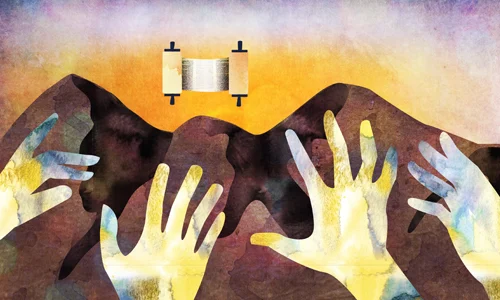
This week we celebrate Shavuot, the moment at Sinai when God gave us the
 Torah, z’man matan Torah. “We left Egypt to be free. So why did we go straight to a mountain and accept a set of obligations?”
What did we say yes to? And why does it feel like freedom?
These are the questions our tradition asks us to ask ourselves.
“The only free person is one who engages in Torah,” says Pirkei Avot (6:2). And the proof? The tablets: “charut al haluchot” — engraved upon the tablets.
“The rabbis do something audacious here. They look at the word charut, meaning ‘engraved,’ and say: ‘Don’t read charut. Read cherut. Freedom.’ The words for ‘engraved’ and ‘freedom’ are nearly identical in Hebrew, differing by a single letter. That’s not an accident — that’s an argument. The rabbis are saying: the engraving is the freedom. The law is the liberation.”
“Most of us were raised with the opposite assumption. We think of freedom as the absence of constraint — freedom from something. But the rabbis point elsewhere. They point toward freedom for something.”
The Israelites didn’t wander out of Egypt into a void. They walked from one kind of constriction into something that gave them shape. The Hebrew for Egypt, Mitzrayim, comes from metzar, meaning a narrow place. This new place is not a cage. It is a form. The way a riverbank doesn’t imprison the water, it gives it somewhere to go.
Receiving the Torah wasn’t the end of freedom. It was the answer to freedom’s hardest question: now that you’re out — what are you for?
-
The Architecture of Tomorrow: A Legacy of Connection
We often speak of stewardship in terms of the planet—the air, the water, and the soil that we leave behind. While we must face the fact that we are leaving the world more fragile than when we found it, our greatest responsibility isn’t just to the land; it’s to the human foundations we establish for our children.
Our children deserve a world that is whole, but more importantly, they deserve a guide on how to stay whole within it.
Moving Beyond Isolation
Many of us feel a deep sense of Karet, being cut off—not as a punishment imposed by an external authority, but as self-imposed isolation. We have drifted from our communities, our neighbors, and even our own sense of purpose. But the beauty of recognizing that we broke these connections is the realization that we are the ones who can repair them.
We don’t need to “change the world” in a grand, sweeping gesture. Instead, we simply need to care for our own universe—those concentric circles of influence that start with ourselves, extend to our family, and eventually reach into the broader community.
The Practice of Repair
To leave a meaningful legacy, we must first address the architecture of our own lives:
-
- Self-Dignity: We cannot model respect for others if we do not honor ourselves. This requires Teshuva—a sincere turning away from past guilt. Maimonides teaches us that true healing occurs when we acknowledge past temptations but choose a new, nobler path.
- Relational Integrity: Hillel’s ancient wisdom remains our clearest guide: “What is hateful to you, do not do to another.” By applying this to every small encounter, we begin rebuilding the social fabric. It’s not about grandiose schemes; it is about building one relationship at a time.
- Intentional Stewardship: We should view our life lessons as an ethical inheritance. Our pain shouldn’t feel like a haunting ghost from the past; it should serve as a springboard toward the future. By openly sharing our struggles and growth, we equip our children with the tools to navigate their own life transitions. In this way, we are laying the groundwork or planting the seeds for a better tomorrow.
A Final Invitation
Our time is passing quickly, but it hasn’t gone yet. We have the tools, the wisdom, and the capacity for deep empathy. Our tradition teaches us that, to save a single life — to repair even one fractured relationship — is to save the world.
Let us stop dwelling in the place of pain and start intentionally planning our path forward. By healing ourselves and strengthening our connections today, we give the next generation the most loving gift possible: a solid foundation of meaning and a society that treats every person with dignity.
-
-
Who Gets to Stand at the Altar? Emor
SPIRITUAL ARCHITECTURE
Parsha Emor • 5786
Who Gets to Stand at the Altar?
On Inclusion, Sacred Roles, and the Architecture of Belonging
The Uncomfortable Blueprint
Parsha Emor opens with a disquieting set of instructions. The kohanim, the priests entrusted with Israel’s sacred service, must be without physical blemish. The blind, the lame, and the disfigured may eat the sacred food and belong fully to the priestly family, but they may not approach the altar to offer sacrifice. The Torah offers no apology. It draws a line between full membership in the community and access to the central sacred role.
It is a distinction that has never stopped being uncomfortable. It should not be.
The Tradition’s Own Revision
What is remarkable is that Torah’s own trajectory refuses to let the blueprint remain frozen. When the Temple fell, and Rabbi Yochanan ben Zakkai rebuilt Jewish life from the ruins, he did something architecturally audacious: he democratized the sacred. Prayer replaced sacrifice, and Torah study replaced priestly service. The altar came down from Jerusalem and rose again in every home, every synagogue, and every learning circle where two or three gathered with intention.
The physical requirements of Emor did not follow the altar into exile. When the structure changed, the restrictions that belonged to it faded quietly from halachic life, not by formal repeal but by the Rabbinic instinct that sacred roles must serve the living community rather than merely replicate a blueprint that no longer stood. This is not an abandonment of Torah. It is Torah reasoning at its most honest and most alive.
Modern Insight: The Line We Are Always Redrawing
Every generation of the Jewish community has inherited some version of Emor’s central question: who may stand fully in the sacred space? Every generation has drawn the line somewhere, and every generation, looking back, has found that its line was drawn too narrowly.
As a rabbi and Spiritual Architect, I do not pretend that Emor says anything other than what it says. But the Spiritual Architect also reads the whole tradition, the Torah and its living interpretation across centuries, and notices a persistent, restless movement toward greater inclusion. The question is not whether the line moves. History has settled that. The question is whether we are humble enough to ask, in our own moment, who stands just outside the circle of full belonging our community has drawn, and why.
The Torah’s term for the festival gatherings, a few chapters later in Emor, is mikra’ei Kodesh, holy callings or holy convocations. Sacred community is not a building with fixed walls. It is a calling, an ongoing act of summoning people toward the center. The architecture is never quite finished. That is not a flaw in the design. That is the design.
-

Shabbat Shalom
Matisyahu and Alex Clare team up to share the words of the Lubuvitcher Rebbe.

The words are simple, the thought profound:
Spread Out
Spread light
Spread Love
All Around the world.
Its never been more critical to Spread Light.
Shabbat Shalom
#BringThemHomeNow
-
A Tochecha
Donald Trump words must be rebuked.
The dark rantings and ravings, the calls for violence, and the hatred of others is unacceptable. It has no place in civil society and needs to be condemned.
-
Shabbat Shalom
Shabbat is not the same. As we welcome the Shabbat Bride, too many of us feel the absence of loved ones lost in the carnage and war.
Idan Raichal, an extraordinary poet/singer/songwriter, shares this sad longing for those we only wish could “Return”
#bringthemhome
Wishing you Shabbat Shalom
The tired hours that don’t let time run
The heavy legs that find no reason to walk
The days and nights like the faces in the pictures
Everything stops when you’re not here
And waking up from a dream and feeling you close
Then calling you out of the night
Come back! Come back today!
I so wanted you to come!
I wish you would come without announcing today
I am a tower of light.
From distances that will reappear
I wish you would come without announcing today.