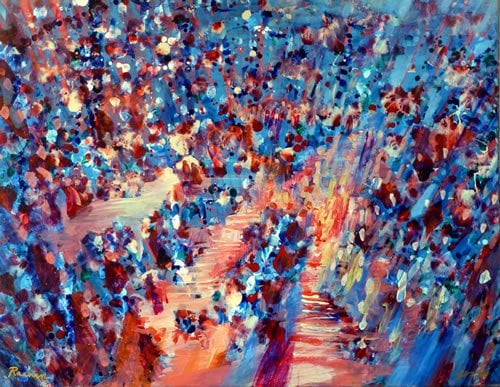
And Our Flag Was Still There…

This weekend marked two important, deeply related yet profoundly different events: a Military Parade at the Washington Mall and a No Kings protest across the country.

Democracy endures. Many were deeply moved to celebrate the 250th anniversary of the Army. Most Americans are genuinely proud of our country and the Army, which has fought to keep us free since before the nation was established. They are patriots who eagerly watched the troops march and the extraordinary weaponry that has upheld our status as the leader of the world.

The No Kings marches were equally patriotic. Our right to assemble and peacefully protest against our government was clearly demonstrated in over 2,000 locations across the United States. Thousands opposing the current administration gathered to express their grievances.

This should be encouraging for all of us. Both things can be true at the same time. We celebrate and protest, and both are deeply patriotic expressions of commitment and love for this nation. Many are concerned that our rights to free speech are under attack. This past weekend shows us that we still have our voices. Dissent may be under assault, but it will not be taken away.

The challenge is to find ways to advance an agenda and, importantly, recognize that even when we disagree profoundly on so many issues, there must be a way to communicate with one another. We need to identify civil means of expressing our grievances and refrain from resorting to violence. The tragedy in Minnesota seems to be the act of a lone wolf. However, that is not reassuring. There appears to be an ever-increasing number of lone wolves willing to take matters into their own hands through violence.  We must reject that.

We are a nation of laws. We do not murder those we oppose politically. We fight our battles in the streets through peaceful protest, in the courts, and at the ballot box.

This past weekend demonstrates that our fundamental principles as a free people under the rule of law endure. As in the Star-Spangled Banner from the War of 1812, our flag remains. We must not fail her.

Lean In

I am reeling from the attacks on my fellow Jews here in the United States. I struggle to understand the apparent fight against anti-Semitism by targeting institutions like Harvard, which seems to provoke a backlash. It appears that Jew-hatred has been normalized enough for these miscreants to heed the words that sanction violent acts. Recent horrific attacks on Jews leave us wondering if we are safe. What should we do?

LEAN IN

I take pride in my heritage, the values of my tradition, and the prophetic call to make the world a better place. I connect with people who share my beliefs, and I also reach out to those who do not. I stand up for what I believe and engage in conversation with others.

I will proudly defend my identity, including that of an American who upholds the aspirations of our founding documents and the struggle for equality, justice, and liberty.

Now is not the time to cower in fear but to realize that many others are like me, seeking a safe and secure world for our children, believing in something greater than myself, and understanding that the “other” is not a threat; they are just someone I have yet to know. It can be scary and difficult to do.

I attend my synagogue.  If you haven’t done so recently, now is a great time to find community.  And there are so many causes that demand our attention, for our charge is to make the world a better place.  It is more important than ever to fulfill our mission.  There is strength in numbers, and besides our Jewish community, we have many allies.

I am a Jew; I am an American.  I fight for the causes I believe in because they are righteous and good.  Join me and Lean In.

at the Cusp of Shabbat and Pesach

Shabbat is approaching and Pesach follows immediately thereafter.  I am taking a moment from the preparations to share the beautiful rendition of Stand By Me.  It is a fitting prayer seeking Divine connection.  Enjoy Music Travel Love as they share their beautiful rendition.

Shabbat Shalom

#BringThemHome

Why is this Passover different from all others?

As we gather around the Seder table, we find ourselves in a moment that feels uniquely challenging. While previous generations have confronted serious issues, the current landscape is unlike anything we’ve encountered in recent memory. The ongoing war is relentless, with no end in sight and no plan for what follows. Hostages remain trapped, seemingly without hope for redemption. Furthermore, we are witnessing a rise in anti-Israel sentiment, along with a resurgence of Antisemitism not just abroad but right here in the United States. Fear and anxiety permeate our lives, and rather than coming together to confront these threats, we often find ourselves at odds with each other. This moment in time is fraught with tension.

However, we have the power to respond constructively, with unity and compassion.

By gathering at the Seder table, we embody the spirit of inclusion with our declaration: “Whoever is hungry, come and eat!” This Passover, our hunger for spiritual and emotional support is palpable. Let us set aside our differences to share and celebrate the profound story of our people’s redemption, recognizing that each of us connects to this narrative in our own distinctive way. Our tradition highlights four individuals asking different questions—a reflection of our diverse perspectives. We ought to welcome one another, fostering an environment of understanding even amidst spirited discussions. The Shalom Bayit, the peace of the Seder table, and our unity must prevail. Now, more than ever, we need each other. This Passover, let us cherish our time with family and community, share the powerful story of redemption and freedom, and be grateful that we have one another in these trying times.

Wishing you a Zissen Pesach!


How do you deal with an enemy that won’t capitulate?

The end of World War 2 came at a significant human cost.  Eisenhower continued to bomb cities in Germany so that the Germans knew with certainty they had lost.  Not one, but two atomic bombs were dropped on Japanese cities, unleashing their death and destruction.  And yet many did not put down their arms.  5,000 Japanese soldiers refused to surrender at the war’s conclusion, remaining loyal to their oath to the Emperor, the deeply ingrained values of Bushido, emphasis on honor, and self-sacrifice at their core.

Shouichi Yokoi courtesy of Wikipedia

The most famous among them was Shoichi Yokoi, who returned to Japan from Guam in 1972, 27 years after the war’s end.  He is quoted as saying, “It is with much embarrassment that I return.” (Smithsonian Magazine; https://www.smithsonianmag.com/history/the-japanese-wwii-soldier-who-refused-to-surrender-for-27-years-180979431/)

There may be invaluable lessons from the Japanese fighters who held out even after the war ended when dealing with Hamas.

To understand the fighters loyal to Hamas, we must understand the profound philosophical, existential commitment to the idea of fighting to regain the land perceived as stolen.  Leaders with bona fides that these Hamas fighters will respect must arise and offer a different path forward.  This can initiate a process where, eventually, those committed to Israel’s obliteration will be overcome by those committed to a peace wherein both sides live in safety and security, side by side.

The sheer brutality of the current war in Gaza would, under normal circumstances, make any leader want to stop the suffering of the people and compromise in the name of peace.  However, Hamas is not normal circumstances.  The human suffering they use in the service of their ideology is perfectly acceptable to them and is, in point of fact, one of the weapons they have employed in dealing with the Palestinians and the hostages.

Similarly, the hatred on the Israeli side of the equation is equally brutal.  The invasion of October 7 was viscerally felt as an existential moment.  Hatred and the desire for revenge only build with the cynical bargaining chip that is the hostages.  As those lives hang in the balance, Israelis must also find courageous leaders to lead their people to peace.

One of the few things made clear is the current situation is a meat grinder consuming human victims with impunity.  This is morally and ethically reprehensible.  Moderating voices must arise to quell this war machine and find a better path forward.

There will be those who see victory only as the destruction and capitulation of the enemy. It is an unrealistic goal.  The price is astronomically high in lives lost and is ultimately unachievable.  These ideologues and zealots must be marginalized.  It may take generations for this view of the world to fade away, and only with perseverance and strength can we support those seeking a way forward that can permit a peaceful coexistence to form.


Shabbat Shalom

The traveler’s prayer is shared as we embark on a journey hoping:

May it be Your will that You should lead us in peace and direct our steps in peace, and guide us in peace, and support us in peace, and cause us to reach our destination in life, joy, and peace.

This Shabbat lets pray that our journey might be so and that our destination itself is Peace.

Shabbat Shalom

Thanks to the gifted Marni Loffman.


The Masks We Wear

Courtesy of Vlad Hilitanu

As we approach Purim, I began thinking about our holiday and our celebration, which includes costumes.

I’ve always thought that Reform Jews needed better uniforms.

In our desire to embrace modernity, we’ve adopted the clothing commonly worn by others, rendering us indistinguishable as we blend into the broader culture.

Our more traditional brethren have uniforms—items that set them apart and make them easily recognizable: payot, kippot, shtreimel, sheitels, long black coats, and other garments depending on the particular denomination. Many of us will dress in costumes to celebrate Purim, but we wear masks as part of a wardrobe that reflects aspects of who we are all the time.

The truth is, we all wear uniforms.  It is easy to identify a firefighter, a police officer, or a member of the military; their uniforms indicate that they are part of an elite group with a specific purpose. Those of us who are slaves to fashion publicly claim we are au courant, while those of us who deliberately choose to rebel against such norms wear uniforms that proclaim we are iconoclasts.  These public displays of identity convey that we are part of a group motivated by pride, belonging, or sometimes even fear.  Are these masks, reflections, or projections?

Does our outward appearance reflect who we are inside, who we aspire to be, or how we want the world to perceive us?  When these aspects do not align, it’s essential to pause and reflect on why.  Why do we present ourselves in ways that do not match our true selves?  Sometimes this discrepancy is aspirational, while at other times it may stem from feelings of inadequacy or a fear of revealing our authentic selves to the world.

I hope my mask is revealing. It shares my identity and signals that I am approachable, an authority, and a source of comfort in whatever way my intended audience needs to see me, while remaining authentic to my true self on Purim and every day.  May we all find the space to be the best version of ourselves.  May we be unafraid to be who we are and grateful for that, even if we aspire to more.


Shabbat Shalom

Playing for Change brings musicians from around the world together to perform songs of unity, peace, and love. Amazing Grace is not usually on the Kabbalat Shabbat Playlist for most of us, but if you watch and listen, the singers in Jerusalem and the lyrics convey hope and faith, which is what we need as we enter Shabbat.

Shabbat Shalom

Parshah Terumah- A deeper timely meaning

Yoram RanaanThe key to a deeper message in Terumah, or Offering, is the phrase:

“They shall make for me a sanctuary that I shall dwell among them.”

The people bring contributions, or offerings, of precious items, Gold, Silver, copper, spices and gems, wool, animal skins, olive wood- precious materials- they bring so much that Moses needs to ask them to stop bringing any more.  And then, they proceed to build an elaborate Mishkan, a Home for God to dwell amongst the people.  This comes after two previous Parshiot discussions on the Ten Commandments and the Mishpatim, the details of the laws, and notably the application of Law without bias, that create a civil society as the people coalesce into a nation.

This has modern implications—not that any of you need to bring some olive wood to work or offer your wedding bands for ornamentation.

It IS about embracing the idea that this was to be a nation of Laws sanctified by God’s presence. People actively accepted this covenantal relationship with God and the law’s central importance so they could live together.  The idea that the Mishkan could be readily moved from one location to another– that there was portability means that the law went wherever the people were.  And it was the same law whether they lived in the desert of the Midbar or the Promised Land.

We are currently struggling with the notion that we are a nation of laws.  For some, the law is just only when it rules favorably for them and unjust when it does not or even limits what they want to do.  Trust in the system has been the bedrock of the national and local judiciary. The dedication to the ideal of serving justice, although not always lived up to it, was still the notion that kept our faith in the judicial institutions.   This is evidenced by the enforcement of rulings of law by another branch of government operating in support of this institution.  The erosion of trust, the questioning of authority, and the attack on judges and institutions all seriously undermine the capacity of the courts to hold civil society together.  The other branches of government have been held in check in a system expressly set up to keep guardrails in place when other branches of government step too far outside their lanes.

The system is flawed and has much room for improvement. Equitable application of the law for all is not a practical reality. An overwhelmed court system struggles to seek and deliver justice. Although “efficient,” Plea deals often deny justice for the poor, and outcomes are too frequently based on the accused’s ability to hire the best legal representation. The jury system is under pressure since serving is often seen as a burden rather than a responsibility and privilege of citizenship.

As Lady Justice depicts, the court should be a special and sacred place where justice is dispensed based on the merits. However, the system seems to be abused by the wealthy and against the poor. A lack of civics education contributes to a population that is unappreciative of its importance in maintaining civil society.

We need capable courts that enjoy the full support of the people. Although our system is resilient, it can only tolerate so much stress. As the new nation birthed at Sinai, our nation and government require its people from which to derive its legitimacy and also shine as a beacon to the world.  Our challenge is to imbue society with the embrace of the courts as a foundation for our way of life.  We must ensure jurists are seen as above reproach and incorruptible and that the dispensing of justice and the enforcement of the court’s rulings is done so that a nation of laws believes in this sacred covenant, maintaining a vibrant, healthy society.