You Knew What You Were Getting Into with Mamdani

Years ago, a friend came to me frustrated that his child’s Quaker school wasn’t fully observing Jewish holidays. He wanted to vent — and then wanted to know what we could do about it.

My answer was simple: you knew what you were getting into. The Quaker school system serves many communities, cultures, and traditions. Its mission isn’t to support any one of them; it’s to instill the values it considers foundational. That’s not a failure. That’s what you signed up for.

We are having a Quaker School moment with New York’s new mayor, Zohran Mamdani.

A portion of the Jewish community is outraged that Mamdani has declined to participate in the Israel Day Parade. But Mamdani was never unclear about where he stood. He is a self-described democratic socialist, and his views on Israel were not hidden — they were part of his appeal. To have seen him marching as a parade marshal would have looked exactly like what it would have been: a cheap attempt to curry favor.

This is who New Yorkers elected.

Elections have consequences. Whether or not I agree with Mamdani, the ballot box was where I could register my view. That moment has passed. Expressing outrage now is a day late and a dollar short. New York got what it voted for.

If the outcome feels wrong, the answer isn’t to spit into the wind. It’s to find better candidates — people who reflect the critical values at stake. The machinery of Democratic politics in New York needs a serious post-mortem: how did this happen, what forces converged, and what will it take to do things differently next time?

Don’t complain that the person elected isn’t delivering what you wanted when what he’s delivering is exactly what he promised.

The Empty Chair at the Chessboard: Why the Influence Narrative Fails


The persistent claim that American foreign policy is being dictated by Israeli pressure regarding the Iranian regime is as common as it is misguided. However, my frustration with this narrative isn’t rooted in a defense of the special relationship of the United States and Israel. Rather, it stems from a refusal to acknowledge a much more uncomfortable truth: the current chaos in the Middle East is not the result of a Jewish conspiracy, but a symptom of Donald Trump’s reckless, superficial, and dangerously transactional leadership.

To suggest that an ally can force the United States into a conflict against its own will is a profound admission of American weakness. It paints a picture of a superpower without a rudder. If the administration is being led into a fight, it isn’t because of the strength of the lobby in Washington; it is because of a vacuum of leadership in the Oval Office.

There are legitimate reasons to debate the extent of U.S. involvement in this region. Many of us remain deeply ambivalent—caught between a sincere desire for peace and a cold-eyed recognition of the threat the Iranian regime poses to Western stability. How imminent that threat is remains a valid question for debate. Israel, facing an existential threat on its doorstep, has its own compelling reasons to seek regime change—a position Benjamin Netanyahu has held for three decades. He is a leader seizing a strategic opportunity for his nation’s survival.

While the United States and Israel may share the broad goal of a neutralized Iran, their specific national interests are not identical. A strong American president would recognize these overlapping interests while maintaining a firm grip on the U.S. strategic compass. Instead, we see a Commander-in-Chief who has consistently approached a high-stakes geopolitical chess match with the mindset of a checkers player.

The tragedy here isn’t that we’re being bullied into a fight we didn’t choose. The real tragedy is that we have a leader who is fundamentally unqualified to operate in a world where the U.S. has historically been the stabilizing superpower. By acting on impulse and self-interest instead of broad strategy, the administration has created havoc that our allies must endure and our enemies can exploit.

If we believe another country can truly force the United States to do its bidding, it confirms our worst fears: that the most powerful man in the world is also the most impulsive and easily swayed. We deserve more than a presidency that acts as a series of erratic transactions. We deserve leadership that understands the weight of its authority and the complexities of the world it aims to lead.

NB. I do not normally write about politics, however, given the current conspiracy claims regarding Israel and the war, I thought this was necessary. ~ Rabbi David Levin


Thoughts on our current War-A War of Choice vs. a War of Necessity

The distinction between a war of choice and a war of necessity can be ambiguous. Most individuals fall into one of three categories: support, opposition, or uncertainty.

I find myself in the third category. War is a profoundly destructive force that aims to annihilate and devastate. Beyond the immediate destruction, the future remains shrouded in uncertainty. Which threats are imminent? The question defies a straightforward answer.

The First World War was a precursor to the Second World War, which in turn led to the reconstruction of Europe and the onset of the Cold War.

Explanations justifying the actions of the United States and Israel in the present context are imperative. Congress should have been adequately informed in advance and must exercise its constitutional authority to authorize war. The support of allies is crucial, though not indispensable. However, without their consultation, the partnership’s strength is significantly diminished.

Once the initial damage is done, it is time to transition to the next phase. If a complete repair is not undertaken, we risk fomenting another round of dissatisfaction and hatred, perpetuating the cycle indefinitely.

I earnestly desire peace, not merely the cessation of war but the capacity to coexist harmoniously despite our differences, marked by empathy, respect, and mutual understanding. Then, might the path forward be hopeful.


Shabbat Shalom

I find myself drawn to the folk music and protest songs of an earlier tumultuous time in this nation’s history and some of the current balladeers singing about the need for justice in a time of injustice.

As Black History month draws to a close, and the work of civil rights seems more urgent than ever, I wanted to welcome Shabbat with Teach Your Children, the classic from Crosby Stills and Nash.

Wishing everyone Shabbat Shalom

Parshat Tetzaveh-Responsible Governing for the People

Parshat Tetzaveh marks a pivotal shift in the wilderness narrative of the Jewish people. While previous portions focused on the physical Tabernacle, Tetzaveh focuses on the human element: the inauguration of the Kohanim (priests). By establishing this dedicated class, the Torah ensures a disciplined bridge between the Divine Presence and B’nei Israel.

The transition from building structures to preparing “human vessels” reminds us that even the holiest space requires empathetic leadership to come to life. The priesthood was not an elite social hierarchy but a role of “functional holiness.” In Exodus 28:1, God commands Moses to “bring near” Aaron and his sons to serve, separating them to manage the meticulous maintenance of the Mishkan, which the general population could not sustain.

The priestly garments are a physical manifestation of this duty. The Choshen (Breastplate) bore the names of the twelve tribes, ensuring that the Kohen Gadol (High Priest) literally carried the nation’s weight “on his heart” (Exodus 28:29). This teaches that a leader’s primary function is representation and empathy, not merely ritual performance.

Faithfulness among the Kohanim was measured by adherence to strict protocols. The Milu’im (consecration process) involved smearing blood on the right ear, thumb, and big toe (Exodus 29:20), symbolizing a total commitment to:

  • Hearing: Attuning oneself to Divine instruction.
  • Action: Performing service with precision.
  • Movement: Walking a righteous path.

The Ner Tamid (Eternal Flame) serves as the ultimate metaphor for this duty. Commanded to kindle the lamps “from evening to morning” (Exodus 27:21), the priests maintained a consistency that transcended personal fatigue. Their faithfulness was embodied in the Tamid—the “always.”

The discipline required to keep the light burning is a powerful metaphor for contemporary society. Capricious or arbitrary leadership undermines the sacred role of those dedicated to preserving institutions. Just as the Kohanim served the Mishkan, today’s dedicated bureaucrats and elected leaders play a critical role in upholding the rule of law.

Long before democracy took its modern form, our tradition recognized that power is a sacred responsibility to the people. This value remains central to the rule of law and equal protection. Like the Kohanim, we are entrusted with preserving these “eternal flames” for generations to come.


Terumah-Power to the People

In Parshat Terumah, the transition from Sinai’s abstract thunder to the Mishkan‘s detailed blueprints offers the ultimate master class in institution-building. It suggests that while revelation provides the “why,” the institution provides the “how”—transforming a fleeting spiritual moment into a sustainable communal reality.

At Sinai, the relationship with the Divine was a “top-down” event—overwhelming and temporary. In Terumah, this is reversed by the command: “And let them make Me a sanctuary, that I may dwell among them” (Exodus 25:8). The shift here is profound, creating sustainability. Inspiration was found at Sinai. It is a spark; an institution becomes the hearth that keeps the fire burning. The text then speaks of a dwelling, with an interesting word choice: it doesn’t say God will dwell in it (the building), but among them (the people). The institution is not the goal; it is the vessel that allows the communal presence to persist. The idea is further elucidated as the focus shifts to the people’s action.

The word Terumah means “to lift up” or “set aside.” Crucially, the materials for the sanctuary were not collected through a flat tax but from “every person whose heart prompts them to give.” This reveals two core principles of healthy institutions. The first is shared ownership; when people contribute their own “gold, silver, and copper,” they are no longer spectators; they are stakeholders. The second is the diversity of people’s contributions. The Mishkan required everything from precious metals to goat hair. This teaches that an institution is only robust when it integrates the varying capacities of its members—from the wealthy benefactor to the skilled artisan.

This Parsha is known for its precise measurements—cubits of gold, rings of silver, and specific wood types. These details serve a vital purpose. They instill discipline and consistency. Without a structured “sanctuary,” collective energy dissipates. The Mishkan’s physical boundaries protected the sanctity of the community’s mission. This consistency ensured that the institution’s values of justice and holiness weren’t subject to the leader’s capricious mood or the crowd’s whims, but were anchored in a permanent, repeatable structure.

Our times test our understanding of what it means to live in community, bound together by the rule of law, freedom, dignity, and respect for all people. We need each other, and together we are stronger and less susceptible to those impulses. To ensure our country and its institutions endure, we must give of ourselves, investing in its care and championing the values at our core.


Shabbat Shalom

Bruce Springsteen’s Minneapolis is a battle cry for us to uphold the values we hold dear, the rule of law, the constitutional rights each of us is entitled to, and the dignity and respect for all people.

As we enter Shabbat, we pray for each other and vow to fight for our precious values.  We must be better than this.

Shabbat Shalom

Thoughts on the Tu B’Shvat

I write this, it is Groundhog Day and Tu B’Shvat!

The American Sage, Punxsutawney Phil, has predicted another 6 weeks of winter. It is incredible where we get our news!

More importantly, I would argue that this is the 15th day of the month of Shvat, Tu b’Shvat. This day marks the beginning of the new year for trees.

It is about the rebirth that will come from life that has gone dormant during the winter within the greater cycle of the year. We could not have a more apt metaphor for what is happening in our lives. The brutal and violent transgressions of the Federal Government through ICE and the Border Patrol, as well as the multiple assaults on human dignity and respect, seem to have seeded the birth of a popular uprising against these violations of our rights.

As spring approaches, the trees will blossom, and warmth will fill the air. But the rededication to our ideals requires us to act. Our tradition teaches that we are partners with God in the ongoing work of creation. Now is our time to commit to this sacred task. We must each ask ourselves what we are able or willing to do, and get to work.

In the harshest, coldest, and darkest times, hope arises that something better is coming. The Jewish tradition and the founding principles of our country require us, in the words of Abraham Lincoln, to work to ensure “a government of the people, by the people and for the people shall not perish from the face of the earth.”

Wishing you a happy Tu b’Shvat.

Rabbi David

History should be Embraced

Trying to rewrite history cannot deny its truth.

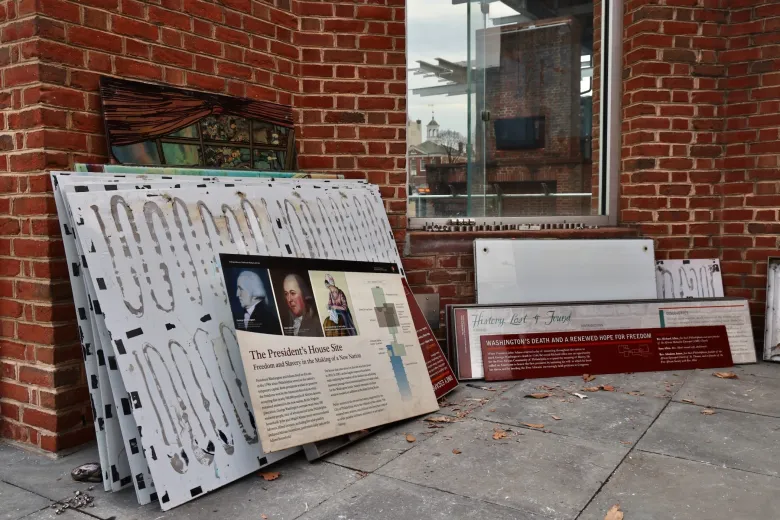
Slavery is a moral stain on the United States. No matter how much bleach we use, we cannot scrub it out, nor can we pretend the stain doesn’t exist. Removing historically accurate plaques that teach the fullness of our history at the President’s House exhibit on Constitution Mall, the paradox of Freedom and Slavery, does not make the events they depict any less true. The attempt to deny our past keeps us from learning and growing from it. Our challenge is to rise above it, not to define ourselves by it and remain mired in it.

The fear of some who see this as an attack on our country and turn a blind eye is baseless. I am ashamed of slavery and the hatred it embodies, while remaining proud of the aspirations our vision embodies. We have a long journey ahead of us to right the wrongs and heal the lingering pain and injustice. But we are better off when all are better off. When every person is treated with justice, dignity, and respect. These are the principles of this nation, principles we must remain dedicated to championing.

When we hide from things that make us uncomfortable, we miss the chance to engage with and learn from them.  We are better than slavery.  It is our history.  But it does not have to be our legacy.  We are better than that.


Shabbat Shalom

The Shvesters share their rendition of a poignant Yiddish song Vi Iz Dus Gesele, Where is the little street? A song of longing, nostalgia, and lost love.

It is a way to help us perhaps enter this Shabbat.  Given the current turmoil, we seek a better time.  May we work to see that time come soon.

Wishing you Shabbat Shalom.