Tag: Rabbi David Levin

  • Come Back As Yourself

    “I could have been a contender.”

    These are the words of Terry Malloy, the boxer turned longshoreman in On the Waterfront, and they mean more once you know how he gets there. He had real promise, before he let his brother talk him into throwing a fight so the men running his union could collect on a bet. Years later, in the back of a cab, that same brother is sent to keep him in line, and the whole debt comes due at once: “I coulda had class. I coulda been a contender. I coulda been somebody, instead of a bum, which is what I am.” It isn’t about boxing. It’s a man naming, out loud, the exact moment his life turned away from what it might have been.

    That’s why it lands. It names the gap between who we thought we’d become and who we actually are, the gap that middle age stops letting you pretend is theoretical. The road not taken closes. Not with drama. Just with time.

    Usually we do one of two things in response: mourn it, or pretend it isn’t there. I want to try something different.

    My family had a textile business, two generations deep—the unglamorous kind that a life gets built around, until cheaper labor and faster shipping made forty-five years of our name stop mattering. Dad tried to reinvent himself: retail, then real estate. I pushed him to keep trying because that’s what a son does: You believe your father’s capacity is inexhaustible because you need it to be. Then his illness took hold, and I understood, later than I should have, that the well he was reaching into had gone dry. I reinvented myself too, into finance and real estate, the sensible things, unfulfilling not because I did them badly but because they weren’t mine. So I did something my mother could not have imagined and would not have chosen: I left it all behind to become a rabbi. (My mom always hoped I’d become a doctor and go to Harvard.) But I’d be lying if I said the question closed. It just changed shape as I got older.

    A lot of us have a romantic notion, seductive because it flatters us, that somewhere inside us was a fuller, truer version of our life—and that everything we did diminished it. That notion requires imagining a version of yourself untouched by a father’s illness, unaffected by untaken or unsuccessful risks, and unshaped by every constraint of the life you actually had.

    That person never existed. No road not taken, just a fiction. Mourning a fiction is a strange way to spend the only life you get.

    Mine is not a story about a promise unkept. It is a story about what grows in the actual soil I was given, the only soil there ever was.

    There is a Hasidic story about Reb Zusya of Hanipol, who came to his students one morning, trembling after dreaming of his own death and the judgment awaiting him. They expected him to say he feared being asked why he hadn’t been more like Moses, why he hadn’t parted a sea. That wasn’t what frightened him. The question was: Why weren’t you Zusya? Not why didn’t you become the figure some other soul was built to become. Why didn’t you become, completely, the one thing only you could ever have been?

    I did not expect to find the same teaching from the American businessman Mark Cuban, but when he was once asked about reincarnation, he said that if he came back, he’d like to come back as himself. Not younger, not richer, not luckier. Himself. A life that had been entirely his, imperfections included, was the thing worth having again.

    But I don’t want to let myself off the hook that easily. There’s a second question beneath the first, and it might be the harder one.

    Anyone who has raised children knows something philosophy took centuries to catch up to: Personality doesn’t start as a blank canvas. It shows up. Before language and before nurture has time to work, a child is already themselves. Torah knew this before we had a word for temperament. Rebecca feels her twins struggling inside her, vayitrotzetzu habanim b’kirbah, and is told, before either has drawn breath, that she carries two already divided nations. Jacob and Esau don’t become different men through different parenting. They arrive different.

    If that’s true, the question isn’t only whether I became what I could have been. It’s whether I did right by the person already there, in the people I was given to raise, teach, and sit with. Did I recognize what was already present, or spend those years trying to instill in them the shape I’d privately hoped for for myself?

    I pushed my father to become something his illness had already made impossible, because I loved him and couldn’t accept the alternative. I have had to unlearn that same instinct with the people I love now, when I keep choosing to will potential into being rather than stewarding it toward where it already wants to grow.

    So I leave the question where I found it. Not whether I could have been a contender. Not even Zusya’s question, exactly, because that one was his to ask. Mine is smaller: What did I do with what was mine: the business that collapsed, the father whose strength ran out, and the people I was given to raise, teach, and sit with, already formed and asking only to be seen? Am I what I should be for them?


  • A Roof You Can See Through- A Reflection on Sukkot

    On Leviticus 22:26–23:44 and the architecture of Sukkot

    I have never been sure what to do with a roof I can see through.

    That is what the sukkah asks of you, and the text is specific. Leviticus 23:42 says teishvu, you shall sit in booths seven days, and the roof covering has to come from what grew and was cut down, branches and leaves, laid loosely enough that starlight and rain get in. The root of the sukkah is skhakh, to cover or weave together, and the covering, unlike a thatched roof, was never meant to seal you off from the sky. It was meant to let you feel the sky while still being inside.

    The reason for this is in the next verse: So that your descendants will know I had the people of Israel dwell in booths when I brought them out of Egypt. The sukkah is not a shelter you build because you need one. We build it from memory, with our own hands, concretizing the story for our children.

    The timing of this is important. Four days earlier, on Yom Kippur, we stood fully exposed and vulnerable, asking to be seen and forgiven. The Torah’s answer to that kind of exposure is not to hand you back your walls and their security; it shouldn’t be back to business as usual; it marks a change and a fresh start. We build a weaker version of our home on purpose, and then we are commanded, more explicitly than anywhere else in the text, to be joyful inside it. U’smachta lifnei Hashem Elokecha shivat yamim (Lev 23:40), you shall rejoice before your God seven days. Not despite the thin roof. Inside it.

    This understanding challenges a common assumption: joy comes only after you are safe. The Torah seems to argue something very different. The joy the Torah commands does not come after vulnerability is resolved. It comes while vulnerability remains, literally overhead, with stars and the moon peeking through.

    Sukkot is also called Chag Ha’Asif, the festival of the ingathering, the harvest at its fullest. The same seven days celebrate the year’s greatest abundance and the temporary dwelling you build to remind you how little you actually control. The text wants to hold these in tension. You can have enough, even abundance, and still go outside and sleep under branches, because fullness was never what made you truly secure to begin with.

    Secure space is different from sacred space. The text doesn’t offer a simple answer to that question here. The sukkah doesn’t keep out the weather. It keeps you sitting with people who chose to sit with you, under a flimsy roof that offers no protection. The shelter isn’t in the structure; it is in the people who showed up to dwell in the sukkah with you. Quoting my own tagline: “God’s miracle isn’t in the thunder and lightning but in people sheltering others from the storm.”

    Most of what we build in our lives, including our institutions, our homes, even our religious practice, is built for permanence. We reinforce it and want it to hold. And once a year, our tradition asks us to build the opposite on purpose, something that cannot hold, and to call that the dwelling place of joy.

    So, my conclusion isn’t a conclusion at all.  Instead, I am left with a couple of questions: Where in your life this year is the sturdiest structure, and where is the one with the roof you can see through, the one that only stands because people chose to sit inside it with you?  And which one, if you are honest, has actually made you feel safe?

    Wishing you a sweet good 5787!

    Rabbi David Levin is the president of the Board of Rabbis of Greater Philadelphia and founder of the Jewish Relationships Initiative.


  • Mission to Israel Countdown t-2

    Are you pro-Israel or not?

    This is a moment of truth.  Which side are you on?

    I am pro-Israel.  I believe in the State and its right to exist. I believe in its right to defend itself.  I believe Hamas is intent on Israel’s destruction; as such, it must be treated as an irreconcilable enemy that must be fought. But this battle comes at a price.

    I grieve for the suffering of the Palestinians and pray that they, too, might find peace, dignity, and self-determination with a government that serves them.  And I am offended by the violence in the West Bank against Palestinians that seemingly slips under the radar but is no less egregious.

    I disagree with Israel’s government and its policies.  But I set these aside for the time being.  Our focus must be on the current crisis.

    I’m not too fond of reductionist thinking, but this is a simple binary decision.  You stand with Israel, which is now conflated with the Jewish people, or you do not.  This doesn’t mean we agree on everything (that will require the Messiah’s intervention), but world events have made it clear that the rest of the world has grouped the Jews with Israel.  We, therefore, must stand together.

    We must stand for our values and deeply consider how those values are understood, especially in these challenging times.

    Which side are you on?

  • Our lives are changed

    All of our lives have been irrevocably changed as a result of October 7. The lives we thought we enjoyed before have had the veneer ripped away, and we are in a new and strangely familiar place as a people of history.

    As many of you know, I am planning a trip to Israel with a few of my colleagues from the Philadelphia region through the generous support of the Jewish Federation of Greater Philadelphia. Our purpose is to learn, bear witness, and bring home the stories of what is happening to the people of Israel. We will start in Tel Aviv, and we will move South, meeting with families of the kidnapped, hostages, and others whose lives around the envelope have been changed forever.

    I do not know what I will encounter. And I say that as someone who is struggling here in the Diaspora and as someone committed to the Jewish state. We have complex and conflicting moral issues to try and understand. It is like threading the eye of a tiny needle. Our tradition is well-versed in parsing, probing, and understanding how we maintain our values even when those values are challenged in the most extraordinary ways. But we have enjoyed the opportunity to study those texts, not live them in real-time, and here in lies the real challenge of what it means to understand what is going on Jewishly.

    I will share the lessons I will learn and some wisdom that I hope will come from these experiences. But I will at least bear witness.

    I have been asked repeatedly if I am nervous or scared about my trip to Israel, and I do have trepidation, but it’s not the trepidation of being physically hurt. It is the trepidation of everything that I have held dear, of everything that I have worked for, of everything that I believe in, being tested in a way that I never thought would be imaginable today.

    The virulent Jew-hatred we believed was part of our history is now being expressed publicly and shamelessly; that is frightening.

    I am privileged to know many people of Goodwill, and so many of them have reached out in this fraught time to offer their support and love. But there are so many others who have remained silent and too many others who have let their antisemitism erupt into the public space. We can no longer pretend that Jew-hatred does not affect us. It does, and we must now decide whether we stand for what we claim to believe and fight for those values and ideals.

    I pray for the people of Israel, I pray for my Jewish brothers and sisters both there and here, and I pray for peace. Perhaps these things may come more quickly than the all-too-elusive Messiah. It is up to us to hasten their coming.


  • Off To Israel

    I am pleased to share that I am traveling to Israel. The Jewish Federation of Greater Philadelphia is sponsoring a small group of rabbis to witness the situation first-hand.  I look forward to sharing with you what I learn so we can better understand the issues and how we constructively engage. Stay safe and secure; find ways to support our people here and in Israel.  Let us pray for peace.

    L’Shalom,

    Rabbi David

  • In the Midbar

    I am excited to present at the upcoming Ohala Conference on Jan 10,

    UKRAINE, POLAND, AND THE JEWS- Our VALUES AND HISTORY IN TENSION, WRESTLING WITH THE COMPLICATED

    A complicated subject that every Jew needs to think about.

  • Did I Make a Difference?

    Parshat Devarim

    Did I make a difference?
    This timeless question is in Moses’ heart as Devarim, the first parsha of Deuteronomy, as he recounts the trials and tribulations from Egypt to the edge of the Promised Land.
    He has led the people faithfully, but the old generation is gone. Moses prepares for his death, Joshua is appointed the new leader and a new generation of people formed and steeled in the crucible of the Midbar prepares to move forward, leaving Moses behind.
    Moses’ recollections are slightly different than what we read as things occurred along the journey. Despite pushback from the people and God, he places himself in the spotlight as the true champion in every circumstance.
    Elie Weisel suggests, “Some stories are true that never happened.” Indeed, memories often are the recalling of experiences based on the values that helped us understand those experiences and shaped us.
    It has been an often-fraught relationship, with the people wanting to rebel and turn back, factions acting out against Moses and Moses saving the people from God’s wrath. Moses recounts things through the filter of his memory and the desire to be remembered for his accomplishments as the person who brought B’nei Israel into nationhood and to the Promised Land, following God’s direction. But now, it is Joshua’s turn as God’s chosen successor.
    We sense the tension in the transition as Moses recounts the extraordinary experiences thus far under his tutelage. Although we consider Moses most humble, even he needs to see that his time has meaning, his life was for a purpose and the people he served appreciate all he has done.
    We are on the verge of a new chapter. At the edge of the Promised Land, the needs are different. New and fresh leadership is required to meet the new tests, the challenges of a new generation and the new enterprise of taking the land and dwelling in it. But this transition is often abrupt and dismissive, without the respect the elders have earned.
    Can we elevate the process by offering sincere gratitude and recognizing this as a “shehecheyanu” moment? Can we maintain a respectful place for those soon-to-be former leaders as curators of wisdom and institutional memory? This kind of transition is a process, not a moment. And the lessons of the Torah are timely. Change a name and the setting, and we are talking about us.
    The pandemic accelerated many changes already underway in our culture and society. Legacy institutions have struggled with membership and age; leaders are finding they do not speak a language that resonates with the next generation to engage them successfully; identity is more fluid than ever.
    For many clergy leaders, the time has come to leave the pulpit and make way for the new group of leaders. Can we find ways to usher this change along, honoring the past while looking to the future? I suggest that although the methods may differ, the Torah’s enduring values remain constant.
    We will lose much if we cannot embrace the old while turning toward the new. It is about giving our people both roots and wings, to liken it to parenting.
    It validates who we as parents are, the nurturers and teachers. The values they learn are the values we taught. The ability to find meaning is grounded in the world in which we raised them. This is a moment of extraordinary challenge, and the opportunities are practically unlimited. We brought them along on this remarkable journey to this particular point.
    Now they, the next generation, must move forward, leaving us behind, but carrying us in their hearts and minds. This is the underlying message of the phrase, Zichronam Livracha, may their memories be for a blessing.
    May we live our lives to bring honor to a tradition grounded in morals and ethics and understand that we live in service to something greater. And may the next generation honor us by doing the same.
    This piece was originally published by the Jewish Exponent. 
  • Name Tag for the Hineini Mission

    Name Tag for the Hineini Mission

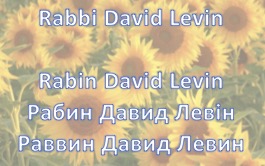
    My nametag in English, Polish, Ukrainian, Russian.

    Preparing for a very special visit.

    Please support the people in need by giving to these or other humanitarian aid groups.

    Friends of the JCC Krakow

    World Central Kitchen

    Doctors without Borders

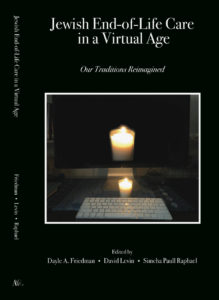
  • Jewish End Of Life Care In A Virtual Age: Our Traditions Reimagined

    Excited to share that our new book is now available on Kindle and in paperback!

    https://amzn.to/316sYV4