Knowing who we are and the values we believe in is the first part of a critical two-step process. The second step is knowing what you will do to realize them.
Sadly, we have grown accustomed to thinking we have done our part by voicing our opinions in public spaces. We have also shifted responsibility to the government without demanding accountability. However, only by engaging in the work can our opinions become a constructive force.
If you believe in feeding the hungry, for example, giving to a food bank in both time and money will help bring food to those in need. Advocating for them by reaching out to those in power over the public funds is another. Merely Saying you are against hunger on social media is a hollow gesture and a waste of time.
Decide what issues are significant enough that you will engage. Most of us only have enough time to work on one or maybe two. But in focusing and doing the work, you become a change agent. We are empowered to champion the values we believe in only if we are willing to commit in tangible ways to them.
The Maccabeats and Naturally 7 will join forces to sing a James Taylor classic, Shed A Litte Light, as we welcome Shabat this Martin Luther King Day weekend.
The manger scene of the Baby Jesus swaddled in a Keffiyeh has created much commotion and attention. Even though the Vatican has removed the display, the consciousness-raising alone means that the image has had the intended effect.
We are talking front and center through religion about the plight of the Palestinian people.
This is not the first time someone has reinterpreted something for their own purpose. I have seen many iterations of Jesus: white, very white, swarthy, black. Many religions that have Jesus at the center of their theology have him displayed realistically on the cross, his body cradled in his mother’s arms, lovingly gazing down upon us in a portrait or looking upwards in an icon. As a babe in mother’s arms, as a man spreading the Word, at a bountiful supper, and as a martyr. And now swaddled in a keffiyeh. We use religious symbols to motivate the audience toward a vision or narrative. This is frequently for good and exemplary purposes and too often for malicious purposes.
The charge that this current manger display is Antisemitic is a particular, not universally shared Jewish perspective. Some deliberately embrace that evil message. I am sure that was not the intent of the Pope or the Church. And if the manger is allowed to be a message of hatred, it will have failed miserably in its mission.
Raising awareness of the plight of the Palestinians is important. Christmas is an essential Christian symbol of God’s love and our hope. Peace on Earth and Goodwill towards men is the universal message of the extraordinary celebration.
Can this awareness-raising symbol be channeled into constructive forces to promote the welfare of the Palestinian people, who have been victimized for too long? It is time for the people of goodwill to lay down their arms and reach out across the divide to each other. May love supplant the hatred that has kept both sides at war for too long. May the promise of Christmas resound in that troubled place of Jesus’ birth so that two people learn to live together in peace and security.
Although there is not a Genocide happening in Gaza, there is devastating suffering and death.
It can be stopped immediately. Declare peace. Accept the existence of Israel and Return the hostages. You can immediately focus on building a State of Palestine, and most of the world’s nations, including Israel, will support the enterprise. Outside forces of hegemony and oppression (Hamas, Iran, Hezbollah) that have imposed themselves are back on their heels, allowing Palestinians an opportunity for self-determination that has not been seen since 2000 at Camp David.
This is a pragmatic solution. Israel exists. Whether you question Israel’s legitimacy will not make the nation go away. Remaining belligerent only continues the harm to both Israelis and Palestinians. Negotiations are fraught. Negotiating requires leaving some things behind in exchange for other things we determine are more critical. Peace and a Sovereign State would be two extraordinary wins for the Palestinians. Peace is the only way for our children to know something beyond hatred and death.
Our God and God of our ancestors, with hope and humility we approach Election Day, the day on which We the People will choose the individuals who will govern our nation, our states, and our communities.
You have abundantly blessed the United States of America with freedom, security, prosperity, and the right to democratic self-government. You made it possible for the founders of our country to fulfill the command of Your Torah, to “proclaim liberty throughout the land, and unto all the inhabitants thereof.”
Daily we pray to You to restore our leaders as in former times. On this Election Day, help us to remember that in America we are responsible for choosing our own leaders, and that the survival of our democracy, and the well-being of generations of Americans to come, depend upon the care we take in those choices.
Daily we pray to You for knowledge, discernment and wisdom. On this Election Day grant us those blessings in full, so that we may consider our choices with knowledge and vote with discernment and wisdom, with the best interests of our country and our communities in mind.
Daily we pray to You to subdue the arrogant in our time. On Election Day, and every day, help us to subdue the arrogance within ourselves. Open our hearts and minds to consider the opinions of our fellow citizens, as we call upon them to consider ours.
Strengthen our will to fulfill our duties to our country and to one another. To exercise our precious right to vote. And to do all we can to ensure that every legal vote is counted, regardless of the candidate or party for whom it is cast.
May it be Your will that our decisions this Election Day preserve this country as a wellspring of liberty and a beacon of tolerance and democracy for the entire world.
As we approach this time of year, a recurring debate arises about allowing our children to partake in Halloween. Some Individuals express concerns that Halloween promotes devil worship. However, Halloween has its roots in a Celtic festival that celebrated the harvest with bonfires to ward off ghosts and evil spirits and mourn the dead. This tradition is not unique to Halloween and is found in various cultures. Black Cats and Witches emerged much later, in the Middle Ages.
It’s a time for children to don their favorite costumes, explore their neighborhoods, gather sweet treats, and revel in the joy of being outdoors. The sheer excitement and happiness on their faces is a sight to behold.
Something is enchanting about bringing the imagination to bear on costumes and needing to go through the ritual of sorting out the candy as loot candies will be eaten, what candies will be discarded, and how much can be consumed less our children get a bellyache. Of course, that says nothing of the sugar high they will get as they gorge themselves on candy bars. It also says nothing for all of the food they consume between the time they end their trick-or-treating and return home to share the spoils.
Amidst all the real horrors and evils in the world, a night of innocent fun for our children seems like a harmless and enjoyable way to spend some time. Instead of dwelling on Halloween’s potential dark origins or superstitions, let’s embrace it as a moment to unleash our imaginations, step out, and have a good time.
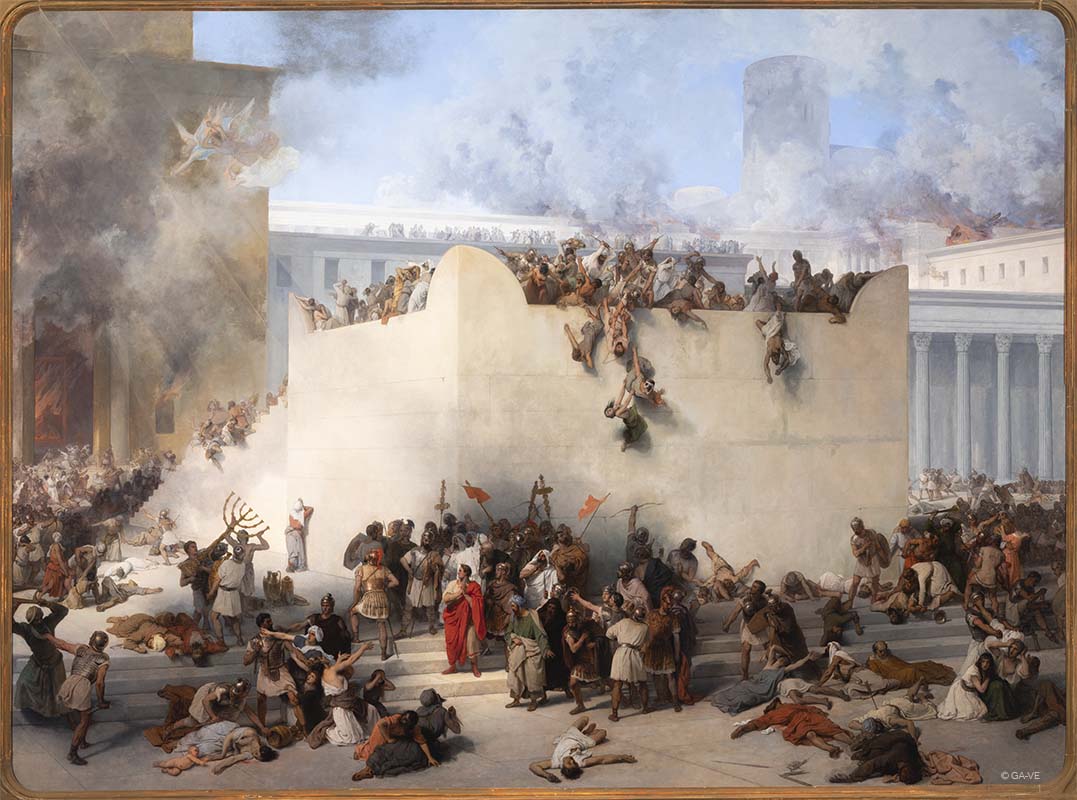
The Destruction of the Temple in Jerusalem by Francesco Hayez
We spend a lot of time talking about Clal Yisrael or Am Israel, the unity of the Jewish people, the fantastic idea that we are all one. However, it’s never seemed to be the case that everyone who claims Jewish identity considers themselves part of this group. We seem to be very easily swayed into looking at denominations and other forms of Jewish practice as false or authentic and often just plain old wrong.
We don’t have a creed; we have something called Halacha. We practice and interpret the law very differently. This is, historically, a source of strength, allowing our tradition to evolve and be organic, but it’s also been the source of a lot of fighting. It creates a very fractious “people.” Indeed, I wonder if Clal Yisrael is a misnomer. However, from the outside, it is a different story.
When others on the outside look, they see Jews. They do not make distinctions between religious Jews, secular Jews, Zionist Jews, orthodox Jews, and the like; to them, it’s just Jews. We’ve seen that mainly through the world’s antisemitism, the Jew-hatred that unites us from the outside.
This brings me to the idea of Sinat Chinam, the concept of “baseless hatred” that we often use as the reason for the internal friction leading to the downfalls of the first and the second temple. It sounds lofty, radical, and extreme. It’s easy for most of us to talk about it as a foreign object and disclaim any connection to it. We believe we are not so strident while at the same time criticizing those who do not practice Judaism as we do. But that is precisely what our sages were talking about when discussing the concept. It’s not some deeply ingrained hatred of another denomination but our inability to accept that your Judaism is as authentic and valid as my Judaism. Your practice is a true expression of your understanding of our faith tradition. As is mine.
So it’s about the annoyance. It’s about the intolerance. It’s about the inflexibility. It’s about the idea that because I am right, you must be wrong. This concept was developed by a teacher and friend, Rabbi Brad Hirshfield, in his book “You Don’t Have to Be Wrong for Me to Be Right.” It’s the idea that we can look at each other with understanding and appreciation, even if it’s not how we practice Judaism.
We must find a way to move past our judgment of each other and our intolerance of what we see when it doesn’t comport with what we believe is our tradition’s “proper” practice. The Jewish tent is broad enough to encompass us all.