Elul and Mercury in Retrograde- what happens when Astrology and Judaism collide?

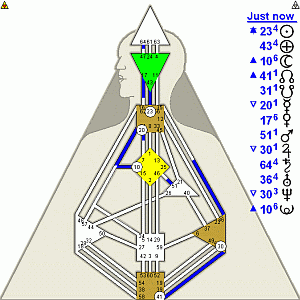
MercuryRetrogradeMercury is in retrograde. From August 30 through September 22, Mercury is moving backward in the sky from our perspective. This is the third of four such occurrences this year according to the Old Farmer’s Almanac. Astrologers say this event is supposed to mark a time for reflection rather than new action. This is not a time for decision-making. Instead, we are to assess priorities and plan to move forward by reviewing projects and determining where to appropriately focus energy.

 Elul is the month preceding Rosh Hashanah. It is our Jewish time for deep reflection and repentance as we prepare for the High Holidays. For many of us, this is our period of Teshuva, the “return to God” that requires seeking and granting forgiveness as we strive to understand where we went astray and how we can get back on the path of living a meaningful righteous life.

 I’m not suggesting that there is some equivalence between Astrology and Judaism or that the early astrologers were Jews. But I believe that making time to take stock of whom we are is of utmost importance to finding fulfillment. The unexamined life is not worth living, so teaches Socrates in Plato’s Apology. So many of us are consumed by the day-to-day issues of living, sometimes, it is all but impossible to step back and assess where we are and where we are going.

 In life we often awake to find we have been blown off course. Anyone who has ever piloted a plane or a boat knows navigation is an ongoing process of course corrections, so too life. Currents and tides constantly push us off course and our aim has to compensate if we are ever to arrive at our destination. For some of us, we don’t even take the time to determine what our destination might be. For all of us Elul is an appointed time to engage in the process.

 As we approach these High Holidays may you find forgiveness for those who have offended you, be forgiven by those whom you have offended and find your true path of meaning, relationships, and fulfillment.

 L’Shana tova
What does forgiveness look like for me?

What does forgiveness look like for me?

 Many Jews were amazed by the forgiveness offered by the survivors of the Charleston Church massacre. This Christian understanding of forgiveness is an extraordinarily powerful display of love but alien to many Jews. So what does it look like to offer forgiveness to another?

 How many of us carry a hurt and cannot let it go. How many of us feel that someone’s poor treatment of us gives us license to treat them similarly? Or perhaps many of us want to extract a retribution or punishment before we will entertain forgiving another?

 What might we look like if we could find a way to get past the hurt and find a way to repair a broken relationship? Can we set our egos aside or do we need to carry the hurt as a validation?

 I wonder about these questions this Elul due to my particular perspective as a rabbi. As a rabbi, I am someone who has the sacred privilege of serving at funerals. I find it very sad that many people leave things unresolved until it is too late. The pain and the guilt that survives death becomes an even greater burden than the hurt that caused the rift between the two.

 As we prepare for the High Holidays, let us examine our own motives and realize that even when the hurts are real, when we cannot forgive, these hurts become walls separating us from people we care about.

 As we come to the end of the 6th day of Elul,

 Shabbat Shalom

Forgiveness

Forgiveness

 What does forgiveness look like?  We speak of forgiveness during the High Holidays. We are told to ask for forgiveness from others. Our tradition says we cannot approach God to ask for forgiveness until we have done so with the people in our lives.

 This is the time to consider what it means to be forgiven. What must we do to make our request for forgiveness one that is full, with merit and true? How do we convey the sincerity of our Teshuva that makes the request of another we have wronged compelling?

 Are we willing to do all those things that transform us from someone who wronged another to someone who is sorry and has become someone who will not inflict that kind of hurt again? Even if our apologies are not accepted, think of what better people we have become.

 A thought to ponder this 5th day of Elul~connection

Welcome to Elul

 The month of Elul precedes the High Holidays.  We use it to prepare for these Days of Awe. It can be a magical time.

 The preparation is the mental and spiritual “getting ready” so that the holidays take on deeper significance. Almost anything we do is done better if we are prepared for it. So how do we prepare?

 Traditionally each day starts with the blowing of the Shofar at the conclusion of morning prayers. The awesome penetrating sound is called a “wake up call” by one of our great sages Maimonides. For those of us without ram’s horns, each day still can have moments where we weave emotions and thoughts, heart and mind, and contemplate who we are. It could be formal learning like reading a Psalm, I will share some ideas going forward. Try Psalm 27 (read it at the end of this essay) or maybe Psalms 4, 5 and 6 if you would like to follow our Hasidic friends tradition. For others a moment in front of the mirror might work.

 A quiet conversation with ourselves might work better for many. Where are we in our life? Is it where we expected? What is our unfinished business and what do we need to do to complete the task? What about our personal relationships? Who do we need to forgive and, at least as important, who needs to forgive us? This introspective process during Elul leads to the “Day of Judgment.”

 The Day of Judgment we know from our childhood stories is a time when the ledger book is opened up in Heaven and the Almighty determines who will live and who will die. But let me offer another interpretation:

 If we are given the gift of life for another year, how will we use it? If life is truly a precious gift, how will we cherish it and make the most out of it? What can we do this year that will permit us to look back upon it and say it was time well spent?

 Let’s spend the time now preparing for an awesome year to come.

Psalm 27 (JPS Translation)

The LORD is my light and my salvation; whom shall I fear? The LORD is the strength of my life; of whom shall I be afraid?

When the wicked, even mine enemies and my foes, came upon me to eat up my flesh, they stumbled and fell.

Though an host should encamp against me, my heart shall not fear: though war should rise against me, in this will I be confident.

One thing have I desired of the LORD, that will I seek after; that I may dwell in the house of the LORD all the days of my life, to behold the beauty of the LORD, and to enquire in his temple.

For in the time of trouble he shall hide me in his pavilion: in the secret of his tabernacle shall he hide me; he shall set me up upon a rock.

And now shall mine head be lifted up above mine enemies round about me: therefore will I offer in his tabernacle sacrifices of joy; I will sing, yea, I will sing praises unto the LORD.

Hear, O LORD, when I cry with my voice: have mercy also upon me, and answer me.

When thou saidst, Seek ye my face; my heart said unto thee, Thy face, LORD, will I seek.

Hide not thy face far from me; put not thy servant away in anger: thou hast been my help; leave me not, neither forsake me, O God of my salvation.

When my father and my mother forsake me, then the LORD will take me up.

Teach me thy way, O LORD, and lead me in a plain path, because of mine enemies.

Deliver me not over unto the will of mine enemies: for false witnesses are risen up against me, and such as breathe out cruelty.

I had fainted, unless I had believed to see the goodness of the LORD in the land of the living.

Wait on the LORD: be of good courage, and he shall strengthen thine heart: wait, I say, on the LORD.

Looking in the mirror- an Elul Reflection

“They hate us,” “they want to hurt us” are two often heard refrains in the Jewish community.  Sadly this view of “the other” has had basis in truth.  Our history has too many incidents of another seeking our persecution or our annihilation.  From this comes a certain wariness of the other.  Xenophobia has roots and fertile soil. But when we view others through this lens, we too can become the very perpetrators of the animosity we find repugnant and threatening in the other.  Instead of searching for ways to coexist, we look for ways to protect ourselves from them.  We isolate them hoping to insulate us.  But instead, we isolate us and foreclose the possibility of building a bridge that might somehow connect us.

So during this time of Elul, the month of introspection leading up to the sacred Yamim Noraim, the High Holidays, let us take the time to look in the mirror at ourselves.  Let us dare to look our own faces in the mirror and see what really is staring back.  The opportunity for peace can exist only if we are first willing to take the risk of learning the truth in ourselves.  Then we can see the truth in the other.  And only then is there a prospect to build together.

On the international stage, we have witnessed in the ongoing Gaza conflict the perpetuating cycle of hatred.  It is very difficult indeed to sit and have a coffee with someone who is dedicated to your eradication.  And certainly there those who are so dedicated.  But has such hatred created in us the belief that everyone on the other side is dedicated to our destruction?  What happens when we begin to speak in sweeping terms that everyone is the implacable enemy?  Arab devolves into an epithet used to describe the enemy, the modern-day Amelek of our Torah, the embodiment of evil.  We lose sight that there are many on the other side also seeking to live their lives peacefully and with hope for a brighter tomorrow for their children.  We lose the ability to reach out and seek a peace for all.

The children can teach us so very much.  Hand-in-Hand schools, Seeds of Peace, Project Harmony-Israel and The Galilee Circus show us how Jew and Non-Jew can live together peacefully sharing and building.  We also see Arab children taught the canards of Anti-Semitism in the public schools of Gaza and other Arab Countries.  And sadly, we see the Jewish Israeli children taught the canards of animus and distrust of Arab neighbors, viewing them as second class citizens without legitimate voice or aspiration.  Hatred is often taught and hatred is a learned response to the world around us. But there is another perspective.   Elul is the time for us to look in the mirror and see ourselves.

Closer to home, these words of introspection apply to our daily lives as well.  So often we find ourselves at odds with family or friends, cross words lead to harsh actions and harsher words and crosser actions in response.  We can be estranged from the very ones with whom we should be closest because of what they said or what they did or what we perceived.  But their actions might be a response to what we have said or done. Pride keeps us apart and the passing time only builds the walls separating us higher and wider.  Might a close look in the mirror reveal something about our true selves that could be the bridge toward understanding?  What could we have said that precipitated their reaction?  And even more importantly, is the lost relationship worth the stand on principles or protected ego?

Things do not change by themselves or even quickly.  We can only hope that both sides will put aside the vitriol to seek another way. If even if they cannot, we still can.  We can control our actions.  We can understand that protracted animosity only perpetuates the status quo, a status quo that leaves us living in anger or fear of brother or neighbor, fear of each moment, paralyzed and unable to more forward.  For our brethren in Israel, the status quo requires the periodic sacrifice of their children in defense of their home; And for us, that we are alienated from others when it is precisely their relationship that we need.  Maybe there is a better way.  Maybe there is a brighter tomorrow for our children and us.  And maybe we can be the ones to begin that process of change so that we all might someday live in peace.

Elul is the time to look in the mirror and see our stark reality and also to realize that today can be the new beginning if we are willing.

It’s Time to Free Jonathan Pollard

For a long time, I resisted calls to free Jonathan Pollard.  He was convicted of treason, spying against the United States of America.  Although his punishment was more severe and although he spied on behalf of the State of Israel, an ally of the United States, his sentence seemed acceptable to me. He was a convicted spy serving a life sentence for betraying his country-that was okay in my book.

However, it is clear from the latest round of Middle East negotiations that Jonathan Pollard became little more than a political pawn, to be played in order to achieve a settlement.  If our own government admits that Pollard’s punishment can be overlooked to achieve a political end, then the reason for his original punishment seems to have run its course, and he has paid the price.  I do not believe a pardon is in order but it seems reasonable that we permit the time served be sufficient punishment for his treasonous acts.

 Notwithstanding the collapse of the complicated formula that included his release to bring an agreement to the Middle East peace talks, Pollard appears to be merely taking up space in a prison as far as the US Government is concerned.  So therefore, it seems appropriate to release and deport him to Israel.  Pollard does not matter to the United States anymore as evidenced by our willingness to release him. Dangling Pollard in front of those who might believe he matters, only serves to distract the two directly affected parties from the important and hard decisions they need to make.   So let us now take the only reasonable course of action, release Jonathan Pollard now.

I will not let you go until you have blessed me.

In the dark solitude of night Jacob wrestles with an unidentified man until dawn, but would not let him go, even after he appears to vanquish his opponent. Although the text says it was a man, the figure is mysterious and might have been an angel of God or possibly a demon from Jacob’s psyche.

 This remarkable story speaks to how we might make something good come from the troublesome or even the tragic event; for Jacob would not let go until he received a blessing.  Instead of fleeing, as Jacob has in the past, Jacob only grapples with it. Acknowledging this event is now a part of him, Jacob holds on.  Jacob emerges from the scuffle physically injured, forever changed. But he still insists that something good comes of the encounter a blessing.

 So many of us confront tragedy in our lives.  And despite the pain and the suffering tragedy causes, people often turn it in order to make something good as a result.  For example, the founders of Mothers Against Drunk Driving, MADD, were able to take the unspeakable horror of losing their children and create a crusade to save the children of others. Veronique Pozner, recently named as one of the Forward 50, lost her 6-year-old son Noah in Newtown and transformed her personal tragedy and grief into a rallying cry for gun control legislation in Connecticut.

 We are forever changed as a result of the harsh tests in our lives.  For Jacob, his hip was damaged and his name changed to always reflect that the event had irrevocably altered him.  Nothing will bring the lost children back to their mothers. Noah will never return to Veronique, but she celebrates his brief life, by working to create a better world.  May we all find the strength to do so.

~Thoughts on Vayishlach

What is prayer? Lessons from Channah

Why do we pray?

The Haftarah portion for today is taken from the Book of Samuel.  This is the story of a barren woman, Channah,  one of two wives of a man named Elkanah.  Elkanah loves Channah and tries to show her affection.  But this is insufficient for Channah and she goes to Shiloh to pray for a son who she would dedicate to God’s service.

What is it to Pray?

Is it asking for something?

God I want a pony.

I have a vision akin to sitting on the lap of a giant Santa Claus asking for stuff-

A new iPhone, maybe a new Audi convertible or

if you like cooking gadgets as I do,

a new Vitamix 7500.

Stuff that makes us feel good on the surface- But this is a rather pediatric view of how God fits into our lives.


A more sophisticated version of prayer is to seek connection;

to reach out,  wishing someone you love will be healthy,

that the distance we often feel from another person will be bridged

and we are reconciled.

Prayer is to admit a feeling of emptiness or a void and a yearning for it to be filled.

Channah’s story is fascinating.  She yearns for a child.  The void is in her life is both spiritual and physical.  Her husband, clueless, as many of us are, tries to assuage her with baubles.  He even lavishes attention on her.  But none of this can penetrate beyond the surface and is essentially meaningless to Channah. She turns to prayer.


Prayer is actually difficult, it is uncomfortable because it requires of us to be vulnerable.

We must bare our soul- to God and to ourselves.

We must look into the mirror, as it were,

and see that in the cold harsh light of reality,

the reflection we see is not as beautiful or perfect as we pretend.

That new vitamix is a great toy, but if I do not have someone to cook for

it is just another expensive gadget collecting dust on the countertop.


So Channah prays a fervent prayer.  And as if to emphasize the point, our great prophet Eli mistakes this woman for a drunkard and harshly rebukes her.

But the prayer Channah prays gives her strength,

she becomes resolute enough, comfortable enough in her own skin, not to accept the scorn of the Prophet and speak in his presence explaining herself.  It turns Eli’s heart.


Prayer is powerful it can be awesome and even frightening.

Do we have the courage and inner strength

to look honestly inside ourselves and see truth,

our unvarnished reality with its shortcomings and desires unfulfilled?

It is hard and scary,

but if we are willing to try,

the results can be extraordinary.

And now we read the story of Channah.