Thoughts on our current War-A War of Choice vs. a War of Necessity

The distinction between a war of choice and a war of necessity can be ambiguous. Most individuals fall into one of three categories: support, opposition, or uncertainty.

I find myself in the third category. War is a profoundly destructive force that aims to annihilate and devastate. Beyond the immediate destruction, the future remains shrouded in uncertainty. Which threats are imminent? The question defies a straightforward answer.

The First World War was a precursor to the Second World War, which in turn led to the reconstruction of Europe and the onset of the Cold War.

Explanations justifying the actions of the United States and Israel in the present context are imperative. Congress should have been adequately informed in advance and must exercise its constitutional authority to authorize war. The support of allies is crucial, though not indispensable. However, without their consultation, the partnership’s strength is significantly diminished.

Once the initial damage is done, it is time to transition to the next phase. If a complete repair is not undertaken, we risk fomenting another round of dissatisfaction and hatred, perpetuating the cycle indefinitely.

I earnestly desire peace, not merely the cessation of war but the capacity to coexist harmoniously despite our differences, marked by empathy, respect, and mutual understanding. Then, might the path forward be hopeful.
 

Mishpatim and the Modern State

Ra'anan
Ra’Anan

In Parashat Mishpatim, we move from the heights of Sinai and the grand laws given by God to Moses to the granular details of civil law. The shift teaches that a righteous society is built not on abstract ideals but on the daily, impartial application of the Rule of Law.

Mishpatim introduces three pillars essential to our current struggles:

  • Resistance to Tribalism: Exodus 23:2 warns, “You shall not follow the multitude (the mighty) to do evil.” In an era of “mob justice,” strongman tactics, and polarized echo chambers, this mandate requires that truth must supersede the pressures of the crowd.
  • Absolute Impartiality: The text prohibits favoring the wealthy or the poor in judgment. Legitimacy and order collapse when the law is seen as a tool for the powerful or a shield for the ideologically aligned. The blindfolded Lady Justice proclaims that all should be treated equally under the law.
  • Protection of the Vulnerable: By repeatedly centering the “stranger,” the Torah insists that legal structures are only as strong as the protections they afford the marginalized. A society’s greatness is defined by how it protects its most vulnerable.

Our institutions are threatened as society’s trust in them erodes. Mishpatim reminds us that an orderly society is a deliberate choice, one that requires our involvement and confidence. Our future as a nation and world leader depends on upholding a system in which the rule of law anchors us against the storms of political passion

Do You Care?

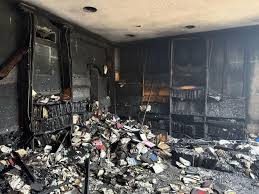
We are horrified that Temple Beth Israel in Jackson, MS, was firebombed. It is a violent act of hatred targeting Jews. As antisemitism continues, we find ourselves vulnerable and seeking support.

The community of Jackson, MS, has rallied around its Jewish community in wonderful ways. Many of us, however, feel abandoned by others across the country who have not expressed support for their local Jewish communities amid escalating threats. This is counterproductive, creating divisions and exacerbating tensions where they should not be.

Sadly, there is too much violence and hatred. It is impossible to respond to every incident. The Jewish communities could not meet that standard either. We would spend substantial time issuing statements of outrage and comfort instead of devoting ourselves to the important work of uniting against these blights and working toward changes in our society to create a safer space for all.

Too many understand the pain, often through lived experience. We need solidarity and action, not just words.


New Year 2026

We celebrate two things—the end of the old year and the beginning of the new year. The new year is filled with hope and anticipation of what might be. Last year showed us yet again that things don’t always go as planned—there is good, there is bad—it is a mix. But whatever has happened is now in our past. Those things cannot be changed, but we might learn from them as we move forward.

I am not much for resolutions unless they are real commitments. This is a time to reflect on what is truly important to us, the values at our core, and how they are challenged or reinforced by our life lessons and experiences. What are they, and how can we live them out more fully? If a relationship is important to you, what can you do to nurture it? If being healthier is important to you, what can you do to support the process?

These questions help us identify our commitments, and then we can take the steps to make them a reality. The truth is, life often gets in the way, as we learned from years past. Busy schedules or tiffs can keep us from calling our friend, and the temptation of that cake slice can overwhelm the desire to maintain a diet. Our commitments can help us pick up the phone or put down the fork.

May the coming year be one of fulfillment and meaning, however you may define it. And may you find the power to make it so.

Wishing you a Happy, Healthy New Year.


Share your Blessings

Giving Tuesday flooded my email inbox. However, my inbox has been filled with so many “asks” that I now delete messages without even reading beyond the subject line. It may sound like cynicism and a bah-humbug attitude that could prevent us from giving tzedakah, but that is not the case. We are required to give and support others in need—clothing the naked, feeding the hungry, sheltering the homeless, and caring for the widow and orphan—these are at the heart of Jewish responsibilities.

Our great teacher and sage, Maimonides, taught us that we must give. It is clearly an obligation. But he asks: do we give our money to one cause or distribute it among many? Maimonides favors giving to many, even though the impact is smaller; it helps us to become more charitable if we make it a regular part of our practice.

Michael and Susan Dell recently announced a $6 billion gift to aid 25 million children. Inspired by the Save America plan to give $1,000 to each child born over the next two years, the Dells also aimed to support already born children up to age 10 with a savings fund. If you do the math, this amounts to about $250 per child invested in an S&P index fund. It might not seem like much, but it’s more than these children had before. It’s about instilling hope and providing a link to a system many of these kids aren’t connected to. Hopefully, other billionaires will follow suit and use some of their vast wealth to help those who are among the have-nots.

Now, for the billionaires among us this evening, I am confident you have already put these plans into action. Thank you. But the rest of us (who aren’t billionaires) can follow suit. A small contribution may not change the world, but it could help someone when they need it most. Chanukah is a time for Jewish renewal and rededication. Our commitment to helping others is central to our tradition. Support the causes you believe in. And by giving, we not only help others but also enrich ourselves by gaining a sense of purpose.

I fondly remember the Jerry Lewis Telethon. As a kid, I couldn’t wait to call in. I saved my allowance and made a $10 donation. I eagerly watched to see my name scroll across the bottom of the TV screen as donors were announced. I felt a rush of excitement as I waited for the moment it became official. And in that moment, I knew I had done something good.

We are taught ‘Kol Arevim zeh bah zeh,’ meaning we are all responsible for each other. When Cain questions God at the very start of our story, asking, “Am I my brother’s keeper?” God responds loudly and clearly, yes.

This holiday season,  make sure you give what you can to help others and yourself as well.

Psalm 27 is added to our prayers during Elul and through the chagim.

We prepare ourselves for this special time with the prayer that we might dwell in the house of the Divine.  May your experience this season be meaningful, filled with reflection, repentance, and renewal.

Thanks to Chava Mirel for this beautiful rendition of Psalm 27:4.

Shabbat Shalom

#BringThemHomeNow