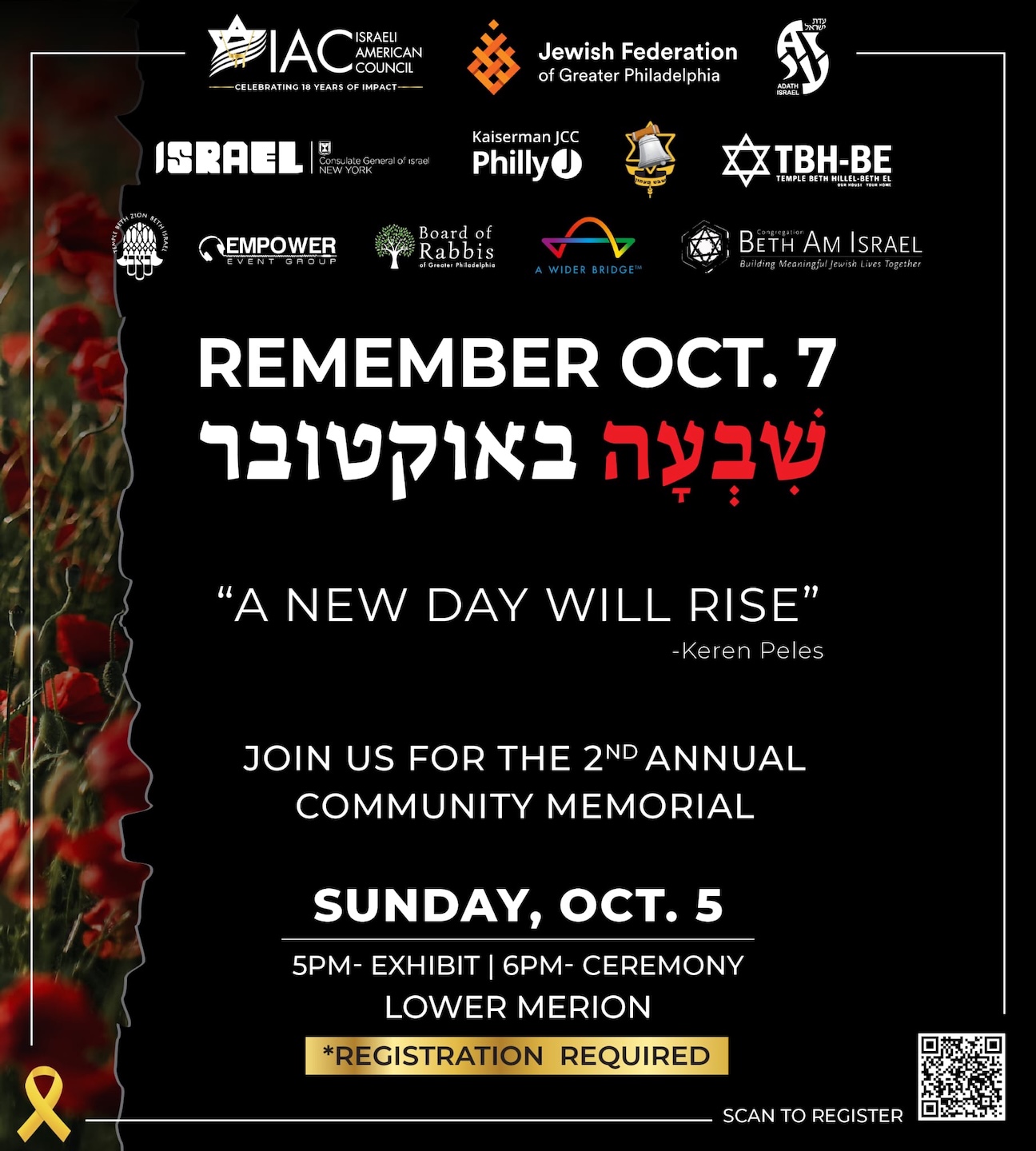
The Dead Child- a prayer from the ashes of October 7

As we remember the horror of October 7 and the aftermath, the words of Menachem Rosensaft bring us a somber resonance. Let this day of remembrance stir us to mercy for the child, not because we doubt our cause, but because we cherish our conscience.

“the dead child

in gaza city

khan younis

rafah

is cried over

with the same tears

by the same God

the same Allah

the same Adonai

as the dead child

in kfar aza

nahal oz

be’eri

and it is

for the not yet dead child

palestinian child

israeli child

muslim child

jewish child

that the killing must end

the war must end

the terror must end

the hatred must end”

—Menachem Rosensaft, from Burning Psalms: Confronting Adonai after Auschwitz (Ben Yehuda Press, 2025)


Does the kippah on my head place a target on my back?

With the increasing violence in public spaces, maybe the answer is yes. What should I do about it? I could cower; many people have said they remove their Jewish symbols, like a Chai or Magen David, because they fear being targeted.

I have been wearing a kippah for many years, and since the war started, I wear a kippah with the Israeli flag and the words “Am Yisrael Chai” stenciled inside. I am proud to show who I am and what I stand for. But does it come with any risks?

My kippah has actually been an invitation for people from all walks of life to approach me. At a Costco, on a turnpike rest stop, or while walking on the street, people offer words of encouragement and support. Most people are decent folks. Most are not looking to harm others; they are living their lives and caring for their loved ones, just as I strive to do.

We must not allow acts of violence from uncontrolled radicals to control us. Those responsible for protecting us face a significant challenge, and a system based on freedom rather than repression often leaves them a step behind in safeguarding our rights and safety. They require additional support to perform this vital work. We can help.

We need to get out, gather, socialize, and connect with others. We don’t have to agree, but we must show we care. We need each other. The hateful rhetoric shouldn’t be fought with more hate, but by reaching out, creating, and living in the society we believe in.

My kippah is a symbol and a call to the people I meet that our humanity continues to thrive. That is the kind of target I strive to be.


What am I entitled to?

What can I or any member of society reasonably expect? What is it that each of us deserves, and who provides it? This is a question to ask of our society and the communities in which we live. I think it’s fair to say that most of us want to be valued, seen, heard, and shown a modicum of respect and dignity. Our Jewish tradition offers us “rules of the road” to guide proper behavior, including how we treat others and how others treat us. Our government has also set certain expectations. According to our founding documents, we are entitled to life, liberty, and the pursuit of happiness. Of course, understanding what these mean and how to provide them to each citizen is a very complex task. Sometimes we handle it well, but often we fall short as a country. This creates the core tension and highlights the need for ongoing conversation to truly understand what these rights mean.

The lack of conversation and understanding that there are multiple ways to achieve solutions creates problems in our society. Both the left and the right become more entrenched in political arguments instead of engaging in meaningful discussions about what these issues truly mean. For example, regardless of politics, most people of goodwill would agree that allowing children to go hungry should not happen in this country. But how do we feed the hungry children?

This is a process argument, not about the underlying value, and here is where our faith tradition becomes a vital guide.

One of our core wisdom texts, known as the Talmud, provides a roadmap for understanding. A fundamental value is introduced, followed by a series of discussions, debates, and disagreements. “Makhloket L’Shem Shamayim,” an argument for the sake of heaven, seeks to understand how the underlying value manifests itself in various circumstances. The arguments, including both the majority and minority views, are presented in this book. The reason is that even the winning argument may not always be correct. In the future, the dissenting opinion that was once preserved may be proven right if cultural or societal norms change.

In the debate about feeding hungry children, parents are primarily responsible, but if they are unable to do so, the community should step in and provide food. But how does the community feed the hungry child? That raises an important question about the process. There is also legitimate disagreement about how to deliver food to hungry children. It can be through a government program. It can be achieved by providing money so that others can obtain food, or by helping parents improve their living standards, enabling them to afford to feed their children. And to make things even more complex, what does alleviating hunger actually mean?

Are we required to feed children according to a specific nutritional standard? How much influence should outside forces have over family decisions? What happens when parents are incompetent, and what occurs when nutritional standards are set or changed—something we’ve seen happen many times in the past? All of this assumes that well-meaning people are committed to preventing children from going hungry.

Some people only care about themselves, ignoring everyone else. Others realize that society should be judged on whether all who are hungry are fed. Still, others believe it is simply the morally right and ethical thing to do.

Questions like these are fundamental, which is why today’s tribal politics are counterproductive. These politics don’t help us address our societal obligations or what I am entitled to; instead, they emphasize power and control and vilify the opposing side. We must ask the right questions, engage in meaningful conversations, reach a conclusion, and then act on that decision. This presents both a significant challenge and a valuable opportunity for building a thriving, vibrant, and just society. Let’s start discussing what truly matters.
 

Psalm 27 is added to our prayers during Elul and through the chagim.

We prepare ourselves for this special time with the prayer that we might dwell in the house of the Divine.  May your experience this season be meaningful, filled with reflection, repentance, and renewal.

Thanks to Chava Mirel for this beautiful rendition of Psalm 27:4.

Shabbat Shalom

#BringThemHomeNow


Shabbat Shalom

This song caught my heart today.  Thanks to the Maccabeats for Minyan Man.

With so much divisiveness, it’s good to remember Kol Arevim Zeh laZeh, All Israel is responsible for one another.  Each of us is important. Each of us can make a difference.  Together, let’s welcome Shabbat and welcome God’s peace.

Shabbat Shalom

#BringThemHomeNow

What’s in a name?

Genocide is a highly charged word.

In Shakespeare’s Romeo and Juliet, Juliet asks, ‘What’s in a name?’ Names are simply labels we use to identify things, but the true nature of those things exists regardless of what we call them. Genocide is a highly charged word. We get so caught up in the word and all of the intense emotional baggage it carries that we forget the underlying tragedy: it is an attempt to understand what is happening in Gaza.

One side calls it a genocide; the other disputes that term, accusing the accusers of deliberately misusing the word, targeting the victims of such an experience as if they were the perpetrators of that very same horror. We get caught up in definitions, a kind of territorialism, claiming ownership of that word, and in doing so, we completely miss the point.

The people suffering in the war in Gaza are truly experiencing pain. It’s not just about numbers—whether it’s one person or many—innocent victims of the Hamas-Israel conflict have died. They go hungry. They are homeless. They are victims. Although I do not trust the statistics from the Gaza Health Ministry, there’s no way to measure the full extent of the carnage accurately, and Hamas’s role in this is dehumanizing Palestinians, echoing what the Nazis did to Jews.

We must navigate this challenging space and find ways to offer humanity and hope that we were denied, and, sadly, to the Palestinians as well. From the ashes of Auschwitz, we proclaimed Never Again. Was this declaration meant only for us? Our Jewish duty to be a light to the nations requires that it not be. We must uphold our tradition’s promise by maintaining our humanity and embracing the virtues of Pirkei Avot (2:5); in a world that has no worthy men, strive to be a man.

Whatever you call it, the war and anguish must end.


What Story Do We Tell Ourselves- V’etchanan

What story do we tell ourselves? Our memory of events often differs from what actually happened. The deviation from the facts is not due to faulty memory; instead, it reveals a story that better meets deeper personal needs as we try to find meaning in the experience. This tendency to reshape narratives is a profoundly human trait, one that is powerfully explored in the Parsha V’Etchanan through Moses.

In the second Parsha of Deuteronomy, Moses recalls the Exodus and God’s giving of the Torah. The word V’Etchanan means “I pleaded.” Moses recounts his encounter with God, beseeching God to allow him to enter the Promised Land. Moses’s plea, filled with a heartbreaking sense of injustice, is denied.  He explains his fate to the people with an accusatory tone: “The Lord was angry with me on your account and would not listen to me.”

Taken at face value, Moses appears to be shifting the blame for his own mistake—striking the rock at Meribah—away from himself and onto the Children of Israel. He isn’t just holding them responsible for the act itself but also for his suffering caused by his unfair punishment for that act. After 40 years of leading often ungrateful and rebellious people, Moses was exhausted, broke down, and acted in a way that was uncharacteristic for him, but he is held fully accountable. Moses isn’t merely recounting a story but revealing a fundamental aspect of human nature: blaming others for our own actions.

We often face these situations. How do we respond when confronted with insult or injustice? Too often, we avoid taking responsibility for our actions and instead blame others. We react with harshness or indifference, rationalizing rather than owning up to the situation. The “whataboutism” mentality justifies bad behavior by claiming that if someone wrongs me, I am justified in doing something wrong too. However, our tradition teaches us that ultimate responsibility lies with the individual. The lesson is not that others’ actions can justify our own, but that we are accountable for our behavior, regardless of the circumstances. We cannot point fingers at others to absolve ourselves.

This theme of personal accountability is closely connected to Moses’s chilling prophecy. He warns the people that after they have lived in the land for some time, they will inevitably “deal corruptly” and turn away from God. This human weakness and tendency toward complacency lead to a future of exile. However, Moses offers a remedy for this bleak future: a return to the fundamental principles of their faith, sharing both the “Ten Commandments” and the Shema and V’ahavta.

Our tradition teaches that living by our values is non-negotiable. What we know as Derekh Eretz—the ethical “rules of the road”—must always be followed. We are only given dispensation when we are prevented from fulfilling our obligations. The strength and enduring nature of Judaism require that we respect others and live in a way that benefits both ourselves and our community.

We stand against all hatred—not just antisemitism.  We support the laws of the land and everyone’s rights to those protections. We believe in feeding the hungry, no matter who they are, housing the homeless, and upholding the dignity of work and the ability to support one’s family. Judaism teaches us to do these things because we understand what it means to be a stranger and to honor every person, since we are all created in God’s image.

A society is judged by how it cares for its most vulnerable. This is a core principle of Judaism. Especially during difficult times like these, we are called to reaffirm and champion our values. They are more than just guidelines; they ground us, giving us clarity, meaning, and purpose.