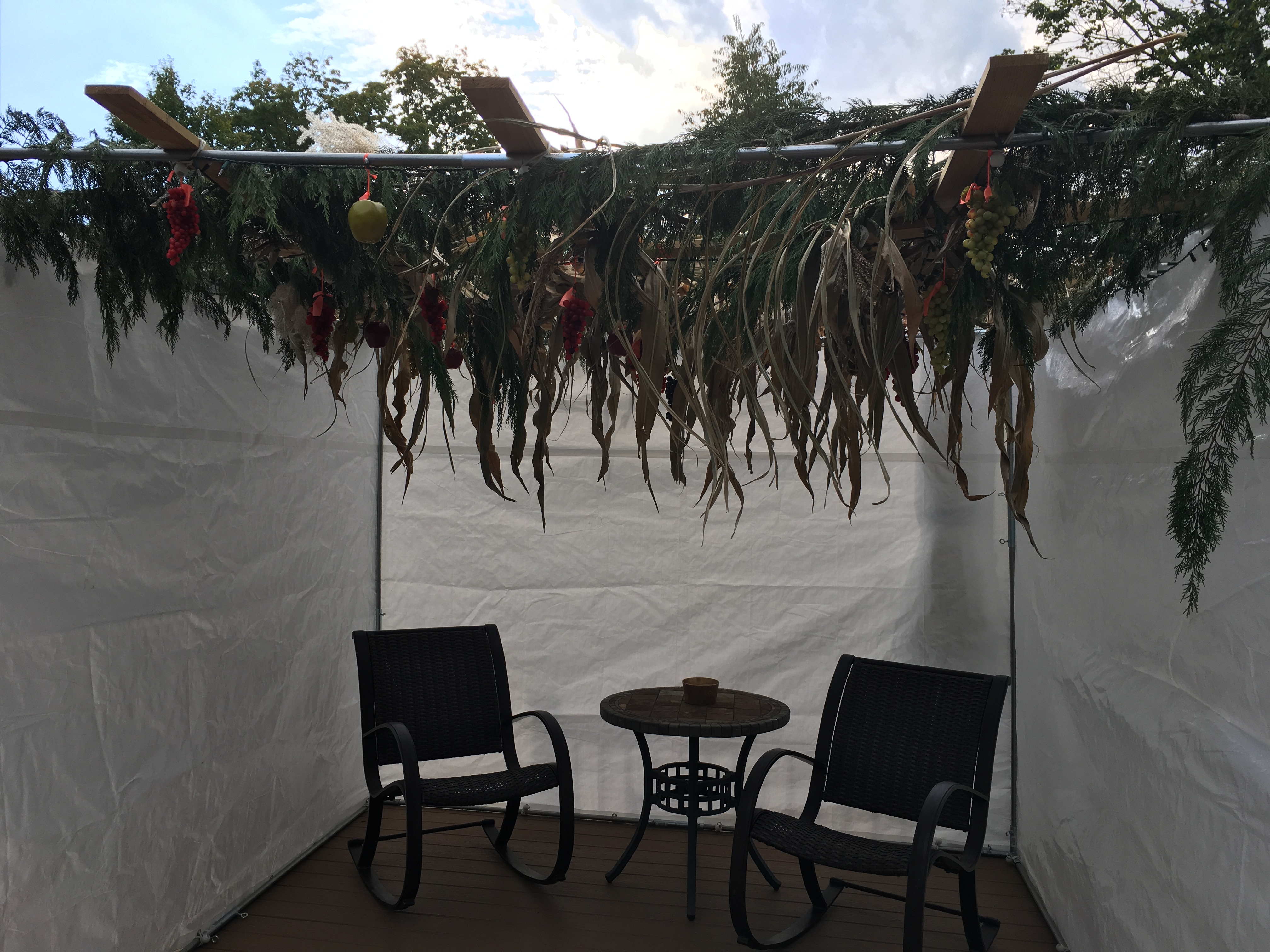
Tag: sukkot

  • Shabbat Shalom

    We welcome Shabbat and Sukkot this evening.  May the shelter of peace extend to all. Craig Taubman blends his music with Mattisyahu to help us set the mood.

    Shabbat Shalom. Chag Sukkot Sameach.

    עוֹשֶׂה שָׁלוֹם בִּמְרוֹמָיו הוּא יַעֲשֶׂה שָׁלוֹם עָלֵינוּ וְעַל כָּל יִשְׂרָאֵל וְעַל כָּל יוֺשְׁבֵי תֵבֶל

     וְאִמְרוּ אָמֵן

    Oseh shalom bimromav, hu ya’aseh shalom aleinu, v’al kol Yisrael, v’al kol yoshvei tevel v’imru amen.

    May the One who makes peace in the high places, bring peace upon us, and upon all Israel, and all humankind, and let us say: Amen.

  • A Roof You Can See Through- A Reflection on Sukkot

    On Leviticus 22:26–23:44 and the architecture of Sukkot

    I have never been sure what to do with a roof I can see through.

    That is what the sukkah asks of you, and the text is specific. Leviticus 23:42 says teishvu, you shall sit in booths seven days, and the roof covering has to come from what grew and was cut down, branches and leaves, laid loosely enough that starlight and rain get in. The root of the sukkah is skhakh, to cover or weave together, and the covering, unlike a thatched roof, was never meant to seal you off from the sky. It was meant to let you feel the sky while still being inside.

    The reason for this is in the next verse: So that your descendants will know I had the people of Israel dwell in booths when I brought them out of Egypt. The sukkah is not a shelter you build because you need one. We build it from memory, with our own hands, concretizing the story for our children.

    The timing of this is important. Four days earlier, on Yom Kippur, we stood fully exposed and vulnerable, asking to be seen and forgiven. The Torah’s answer to that kind of exposure is not to hand you back your walls and their security; it shouldn’t be back to business as usual; it marks a change and a fresh start. We build a weaker version of our home on purpose, and then we are commanded, more explicitly than anywhere else in the text, to be joyful inside it. U’smachta lifnei Hashem Elokecha shivat yamim (Lev 23:40), you shall rejoice before your God seven days. Not despite the thin roof. Inside it.

    This understanding challenges a common assumption: joy comes only after you are safe. The Torah seems to argue something very different. The joy the Torah commands does not come after vulnerability is resolved. It comes while vulnerability remains, literally overhead, with stars and the moon peeking through.

    Sukkot is also called Chag Ha’Asif, the festival of the ingathering, the harvest at its fullest. The same seven days celebrate the year’s greatest abundance and the temporary dwelling you build to remind you how little you actually control. The text wants to hold these in tension. You can have enough, even abundance, and still go outside and sleep under branches, because fullness was never what made you truly secure to begin with.

    Secure space is different from sacred space. The text doesn’t offer a simple answer to that question here. The sukkah doesn’t keep out the weather. It keeps you sitting with people who chose to sit with you, under a flimsy roof that offers no protection. The shelter isn’t in the structure; it is in the people who showed up to dwell in the sukkah with you. Quoting my own tagline: “God’s miracle isn’t in the thunder and lightning but in people sheltering others from the storm.”

    Most of what we build in our lives, including our institutions, our homes, even our religious practice, is built for permanence. We reinforce it and want it to hold. And once a year, our tradition asks us to build the opposite on purpose, something that cannot hold, and to call that the dwelling place of joy.

    So, my conclusion isn’t a conclusion at all.  Instead, I am left with a couple of questions: Where in your life this year is the sturdiest structure, and where is the one with the roof you can see through, the one that only stands because people chose to sit inside it with you?  And which one, if you are honest, has actually made you feel safe?

    Wishing you a sweet good 5787!

    Rabbi David Levin is the president of the Board of Rabbis of Greater Philadelphia and founder of the Jewish Relationships Initiative.


  • Shabbat Shalom

    This Shabbat is different.  The feelings of vulnerability evoked by Sukkot underscore October Rain.  Shulem Lemmer shares his rendition here.

    In these times, when we’re focused on not drowning in the hurricane of hatred and antisemitism, our personal feelings often take a backseat. Since that dreadful day in October, our hearts and minds have been solely focused on our land and people. From the moment I heard this song, I felt compelled to cover it, as it conveyed so much of what we’ve struggled to express in recent months. (continued below).

    Shabbat Shalom

    The original “October Rain” was deemed “too political” for the world stage, leading to the release of a more neutral version, “Hurricane.” I am sharing “October Rain” in its raw, authentic form to voice our nation’s true sentiments. May the floods dry up with the warm sunshine of Moshiach’s arrival!

    Lyrics: Writers of the history Stand with me Look into my eyes and see People go away but never say goodbye Someone stole the moon tonight Took my light Everything is black and white Who’s the fool who told you boys don’t cry? Hours and hours and flowers Life is no game for the cowards Why does the time go wild Every day I’m losing my mind Holding on in this mysterious ride Dancing in the storm We got nothing to hide Take me home And leave the world behind And I promise you that never again I’m still wet from this October rain October rain Living in a fantasy Ecstasy Everything is meant to be We shall pass but love will never die Hours and hours and flowers Life is no game for the cowards Why does the time go wild Every day I’m losing my mind Holding on in this mysterious ride Dancing in the storm We got nothing to hide Take me home And leave the world behind And I promise you that never again I’m still wet from this October rain October rain October rain

    לא צריך מילים גדולות רק תפילות אפילו כשקשה לראות תמיד אתה משאיר לי אור אחד קטן


  • Sukkot 5785


    We are about to begin the holiday of Sukkot.  From My Jewish Learning, this is an overview of the holiday:

    Beginning five days after Yom Kippur, Sukkot is named after the booths or huts (sukkot in Hebrew) in which Jews are supposed to dwell during this week-long celebration. According to rabbinic tradition, these flimsy sukkot represent the huts where the Israelites dwelt during their 40 years of wandering in the desert after escaping from slavery in Egypt. The festival of Sukkot is one of the three great pilgrimage festivals (chaggim or regalim) of the Jewish year.

    Here is the link to the full article: https://www.myjewishlearning.com/article/sukkot-101/

    By using the Sukkah, we glimpse the experience of our vulnerability.

    And this moment of vulnerability requires us to think of those held captive.  We pray for and demand the release of the hostages.

    We are told to eat at least one meal in the Sukkah.  On a lovely fall evening, you can see the stars through the Skach, covering the top.  But on cold or rainy evenings, it is another entirely different experience, and we certainly get the message of being vulnerable!  (By the way, our great sage, Maimonides, suggests strongly that when it’s rainy, go inside!)

    One of the interesting aspects of “dwelling in the Sukkah” is the ritual of inviting the Ushpizin.  These are our revered forebears with whom we’d love to talk and glean some of their wisdom.  It started with Abraham, Isaac, Jacob, Joseph, Moses, Aaron, and King David.  It is extended to include the great matriarchs Sarah, Miriam, Deborah, Hannah, Abigail, Huldah, and Esther. And it is a chance to broaden the guest list even further.  I have invited loved ones, particularly my great-grandfather.  Who is on your guest list?


  • Chag Sameach and Shabbat Shalom

    Celebrating Sukkot with Joy

    and welcoming Shabbat

    Shabbat Shalom

  • Shabbat Shalom and Chag Sukkot Sameach

    Shake your Lulav and

    Shabbat Shalom!

  • In the Sukkah Surrounded by Guests

    In a time of Pandemic, how do we surround ourselves with guests and Lashev BaSukkah?


  • Shabbat Shalom and Chag Sameach

    A couple of minutes of some parody to wish all Shabbat Shalom and Chag Sameach this Erev Sukkot.

    Enjoy

  • Life Lessons from my Sukkah

    Sukkot 5777

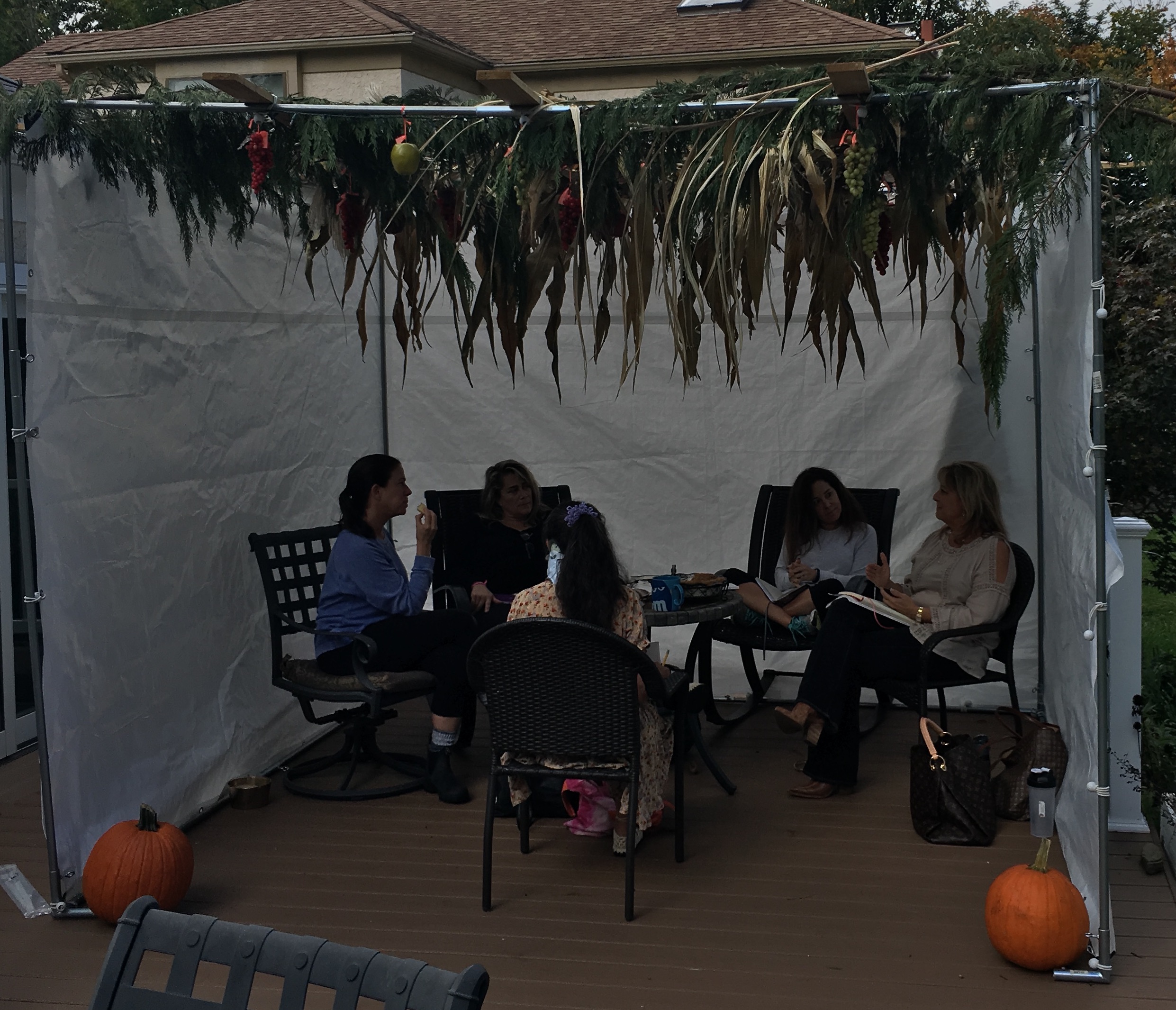
    sukkah5777I didn’t know it at the time, but Friday evening would be our last time in our sukkah this Sukkot. Our sukkah was beautiful. We decorated with branches from our trees and grasses in our yard, corn stalks from a farm, fruits, vegetables and string lights. We brought our guests into the Sukkah to welcome Shabbat, the wind was kicking up, it even blew out the Shabbat Candles after we lit them and said the blessing. Later in the evening, the wind picked up even more and the rain began. I loosened the straps on the sides to let the air to blow through, but that was not enough. In the morning I found the sukkah partially fallen, leaning against the house, metal support bars of the frame irreparably bent. Our sukkah succumbed to nature’s force and had collapsed.

    What an amazing metaphor. I pondered how the sukkah was like my body. Yes, I was beautiful once too- well maybe not. But I pulled my hamstring the other day at the gym trying to exercise and maintain my health. I realized that things don’t work the way they used to. Given also that a focus of my rabbinate is in the area of bereavement, it is only natural to ponder mortality.  I saw my sukkah as a representation of me.

    I like to think I am still vibrant both mind and body, however as noted, different from when I was younger. And although parts of my body have broken before, they have always healed. The bent poles of my sukkah remind me that this may not always be so. But like the walls and roof of a sukkah, I wonder how much of the world do I let in? Do the walls I have built during my life still permit the outside to enter like the Ushpizin we welcome each evening of The Chag (holiday)? Or perhaps have my openings shut, the walls and ceilings becoming thicker and less permeable, have I become less open to new experiences, learning, and growth?

    It is an important question as I do my work and live my life. For it is precisely these things that keep me progressing and figuring out how the new experiences,  with younger people, the unaffiliated or under-engaged Jews can be viewed using Jewish meaning to give them context and meaning. This lies at the heart of developing wisdom and sharing it with others to create meaning particularly when to do so is a challenge.

    The wisdom of Ecclesiastes runs through my mind. There is nothing new under the sun. All that is and all that was has already happened. Pushing this biblical wisdom even further wrapping it into Einstein’s theory of space and time, perhaps Ecclesiastes understood that the infinite God understood that everything, even my own life and death, has already occurred. The end that will come in my linear three-dimensional world has been in the realm of the Eternal One. A frightening thought perhaps that could lead to the despairing claim that “All is but Vanity!” Drawing from my economics background, “in the long run it doesn’t matter.”

    But we don’t live in the long run. We live in life’s moments. The day-by-day set of experiences that are our lives. My sukkah was destined to fall down perhaps and the Being of another dimension knew this to be (or maybe already to have been). But Naomi and I put up our sukkah, we invited guests inside and had wonderful times with our honored guests. We made meaning in the moments we had together and drew on another part of Solomon’s wisdom, to live each moment and infuse our lives with meaning, planning for tomorrow even if tomorrow is not a promise but only a hope.

    Sukkot has given me the chance to be in the moment appreciating the fragility of life while also celebrating the gift of life. Tomorrow the metaphor continues as we enter Simchat Torah and start the cycle all over again, although this time with the wisdom of another year’s worth of living.


  • Chag Sameach

    We Jews have been scramblingimg_7277 a bit. Yom Kippur just ended and last night was the start of Sukkot. We only had a few days to build the Sukkah. In addition to being busy, it is a fascinating time of year. The High Holidays are an intense period of introspection. As we commit to making this New Year a meaningful one, learning from the lessons both good and bad of the past year, we keep in mind the fragility of life. Like Yom Kippur, Sukkot continues to remind us that life is precious, it is a gift and we do our best when we live each day to its fullest. One way we do that is to sit in our Sukkah, that meager shelter with the partly open roof and only three sides.

    We dwell there and invite others to join us. But this invitation is more than Jewish hospitality for we invite not only friends and family but also the spirits of those who came before us, those who embodied the highest Jewish Values. These people include our Forebears, patriarchs and matriarchs of Judaism and perhaps of our own families. Abraham and my Zeyde, Sarah and my Bubbe, and the list goes on. Each soul is an exemplar of a particular virtue such as compassion, wisdom, and courage.

    These welcome guests represent the best of us. When we remember them and invite them to dwell in our Sukkah with us they come alive as a presence. We embrace them and realize indeed Zichronam Livrachah,  their memories are truly both a blessing and an inspiration for us.

    They enlighten us, inspire us, they connect us to the enduring nature of our people and the values that make being Jewish something so very special. May we embrace more than their presence, but may we embody the best of who they were so that we may become more than we are.

    Chag Sameach!