Thoughts on our current War-A War of Choice vs. a War of Necessity

The distinction between a war of choice and a war of necessity can be ambiguous. Most individuals fall into one of three categories: support, opposition, or uncertainty.

I find myself in the third category. War is a profoundly destructive force that aims to annihilate and devastate. Beyond the immediate destruction, the future remains shrouded in uncertainty. Which threats are imminent? The question defies a straightforward answer.

The First World War was a precursor to the Second World War, which in turn led to the reconstruction of Europe and the onset of the Cold War.

Explanations justifying the actions of the United States and Israel in the present context are imperative. Congress should have been adequately informed in advance and must exercise its constitutional authority to authorize war. The support of allies is crucial, though not indispensable. However, without their consultation, the partnership’s strength is significantly diminished.

Once the initial damage is done, it is time to transition to the next phase. If a complete repair is not undertaken, we risk fomenting another round of dissatisfaction and hatred, perpetuating the cycle indefinitely.

I earnestly desire peace, not merely the cessation of war but the capacity to coexist harmoniously despite our differences, marked by empathy, respect, and mutual understanding. Then, might the path forward be hopeful.


Shabbat Shalom

I find myself drawn to the folk music and protest songs of an earlier tumultuous time in this nation’s history and some of the current balladeers singing about the need for justice in a time of injustice.

As Black History month draws to a close, and the work of civil rights seems more urgent than ever, I wanted to welcome Shabbat with Teach Your Children, the classic from Crosby Stills and Nash.

Wishing everyone Shabbat Shalom

Parshat Tetzaveh-Responsible Governing for the People

Parshat Tetzaveh marks a pivotal shift in the wilderness narrative of the Jewish people. While previous portions focused on the physical Tabernacle, Tetzaveh focuses on the human element: the inauguration of the Kohanim (priests). By establishing this dedicated class, the Torah ensures a disciplined bridge between the Divine Presence and B’nei Israel.

The transition from building structures to preparing “human vessels” reminds us that even the holiest space requires empathetic leadership to come to life. The priesthood was not an elite social hierarchy but a role of “functional holiness.” In Exodus 28:1, God commands Moses to “bring near” Aaron and his sons to serve, separating them to manage the meticulous maintenance of the Mishkan, which the general population could not sustain.

The priestly garments are a physical manifestation of this duty. The Choshen (Breastplate) bore the names of the twelve tribes, ensuring that the Kohen Gadol (High Priest) literally carried the nation’s weight “on his heart” (Exodus 28:29). This teaches that a leader’s primary function is representation and empathy, not merely ritual performance.

Faithfulness among the Kohanim was measured by adherence to strict protocols. The Milu’im (consecration process) involved smearing blood on the right ear, thumb, and big toe (Exodus 29:20), symbolizing a total commitment to:

  • Hearing: Attuning oneself to Divine instruction.
  • Action: Performing service with precision.
  • Movement: Walking a righteous path.

The Ner Tamid (Eternal Flame) serves as the ultimate metaphor for this duty. Commanded to kindle the lamps “from evening to morning” (Exodus 27:21), the priests maintained a consistency that transcended personal fatigue. Their faithfulness was embodied in the Tamid—the “always.”

The discipline required to keep the light burning is a powerful metaphor for contemporary society. Capricious or arbitrary leadership undermines the sacred role of those dedicated to preserving institutions. Just as the Kohanim served the Mishkan, today’s dedicated bureaucrats and elected leaders play a critical role in upholding the rule of law.

Long before democracy took its modern form, our tradition recognized that power is a sacred responsibility to the people. This value remains central to the rule of law and equal protection. Like the Kohanim, we are entrusted with preserving these “eternal flames” for generations to come.


Terumah-Power to the People

In Parshat Terumah, the transition from Sinai’s abstract thunder to the Mishkan‘s detailed blueprints offers the ultimate master class in institution-building. It suggests that while revelation provides the “why,” the institution provides the “how”—transforming a fleeting spiritual moment into a sustainable communal reality.

At Sinai, the relationship with the Divine was a “top-down” event—overwhelming and temporary. In Terumah, this is reversed by the command: “And let them make Me a sanctuary, that I may dwell among them” (Exodus 25:8). The shift here is profound, creating sustainability. Inspiration was found at Sinai. It is a spark; an institution becomes the hearth that keeps the fire burning. The text then speaks of a dwelling, with an interesting word choice: it doesn’t say God will dwell in it (the building), but among them (the people). The institution is not the goal; it is the vessel that allows the communal presence to persist. The idea is further elucidated as the focus shifts to the people’s action.

The word Terumah means “to lift up” or “set aside.” Crucially, the materials for the sanctuary were not collected through a flat tax but from “every person whose heart prompts them to give.” This reveals two core principles of healthy institutions. The first is shared ownership; when people contribute their own “gold, silver, and copper,” they are no longer spectators; they are stakeholders. The second is the diversity of people’s contributions. The Mishkan required everything from precious metals to goat hair. This teaches that an institution is only robust when it integrates the varying capacities of its members—from the wealthy benefactor to the skilled artisan.

This Parsha is known for its precise measurements—cubits of gold, rings of silver, and specific wood types. These details serve a vital purpose. They instill discipline and consistency. Without a structured “sanctuary,” collective energy dissipates. The Mishkan’s physical boundaries protected the sanctity of the community’s mission. This consistency ensured that the institution’s values of justice and holiness weren’t subject to the leader’s capricious mood or the crowd’s whims, but were anchored in a permanent, repeatable structure.

Our times test our understanding of what it means to live in community, bound together by the rule of law, freedom, dignity, and respect for all people. We need each other, and together we are stronger and less susceptible to those impulses. To ensure our country and its institutions endure, we must give of ourselves, investing in its care and championing the values at our core.


Shabbat Shalom

Bruce Springsteen’s Minneapolis is a battle cry for us to uphold the values we hold dear, the rule of law, the constitutional rights each of us is entitled to, and the dignity and respect for all people.

As we enter Shabbat, we pray for each other and vow to fight for our precious values.  We must be better than this.

Shabbat Shalom

Thoughts on the Tu B’Shvat

I write this, it is Groundhog Day and Tu B’Shvat!

The American Sage, Punxsutawney Phil, has predicted another 6 weeks of winter. It is incredible where we get our news!

More importantly, I would argue that this is the 15th day of the month of Shvat, Tu b’Shvat. This day marks the beginning of the new year for trees.

It is about the rebirth that will come from life that has gone dormant during the winter within the greater cycle of the year. We could not have a more apt metaphor for what is happening in our lives. The brutal and violent transgressions of the Federal Government through ICE and the Border Patrol, as well as the multiple assaults on human dignity and respect, seem to have seeded the birth of a popular uprising against these violations of our rights.

As spring approaches, the trees will blossom, and warmth will fill the air. But the rededication to our ideals requires us to act. Our tradition teaches that we are partners with God in the ongoing work of creation. Now is our time to commit to this sacred task. We must each ask ourselves what we are able or willing to do, and get to work.

In the harshest, coldest, and darkest times, hope arises that something better is coming. The Jewish tradition and the founding principles of our country require us, in the words of Abraham Lincoln, to work to ensure “a government of the people, by the people and for the people shall not perish from the face of the earth.”

Wishing you a happy Tu b’Shvat.

Rabbi David

History should be Embraced

Trying to rewrite history cannot deny its truth.

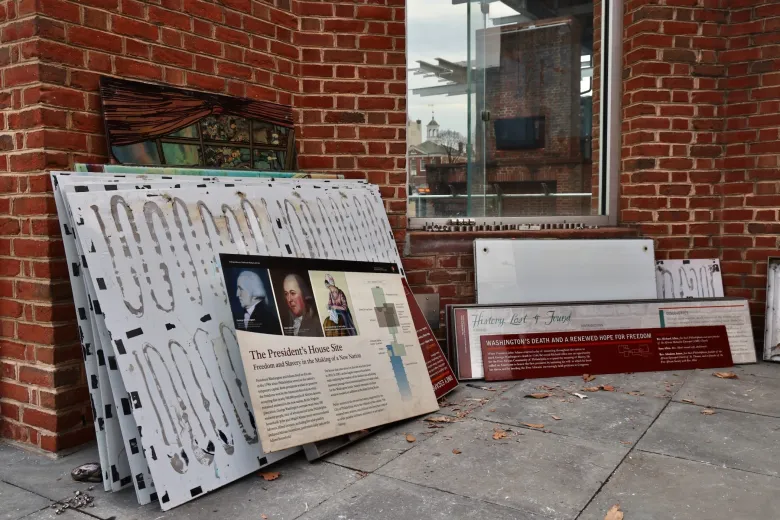
Slavery is a moral stain on the United States. No matter how much bleach we use, we cannot scrub it out, nor can we pretend the stain doesn’t exist. Removing historically accurate plaques that teach the fullness of our history at the President’s House exhibit on Constitution Mall, the paradox of Freedom and Slavery, does not make the events they depict any less true. The attempt to deny our past keeps us from learning and growing from it. Our challenge is to rise above it, not to define ourselves by it and remain mired in it.

The fear of some who see this as an attack on our country and turn a blind eye is baseless. I am ashamed of slavery and the hatred it embodies, while remaining proud of the aspirations our vision embodies. We have a long journey ahead of us to right the wrongs and heal the lingering pain and injustice. But we are better off when all are better off. When every person is treated with justice, dignity, and respect. These are the principles of this nation, principles we must remain dedicated to championing.

When we hide from things that make us uncomfortable, we miss the chance to engage with and learn from them.  We are better than slavery.  It is our history.  But it does not have to be our legacy.  We are better than that.


Shabbat Shalom

The Shvesters share their rendition of a poignant Yiddish song Vi Iz Dus Gesele, Where is the little street? A song of longing, nostalgia, and lost love.

It is a way to help us perhaps enter this Shabbat.  Given the current turmoil, we seek a better time.  May we work to see that time come soon.

Wishing you Shabbat Shalom.

Pharaoh’s Hardened Heart: How Power Becomes Incapable of Change

One of the most theologically challenging chapters of the Exodus narrative that Pharaoh’s heart is “hardened.” Where is the moral choice or free will that characterizes Torah? If God hardens Pharaoh’s heart, how can Pharaoh be held responsible for his refusal to free the Israelites? How can punishment be just if repentance has been removed as an option?

This reading loses sight of the metaphor at work and the timeliness of the teaching. This is not merely a portrayal of an obstinate ruler; it is about how entrenched systems of power function, how the primary focus becomes remaining in power, how moral authority is lost, and how meaningful change to the system that maintains that power is resisted, ultimately doomed to collapse under the weight of its own corruption.

Pharaoh is that political system.

As the plagues begin, Pharaoh himself refuses to change. As the plague of frogs subsided, Pharaoh’s heart hardened when relief came.  This was a political reflex, not Divine intervention. The system reasserted itself once the pressure on it was alleviated.  The relief was the excuse to revert to the status quo, a squandered opportunity for repentance.

When the text starts using the phrase that “God hardens Pharaoh’s heart, “ the Rambam comments that persistent injustice can erode and stop the capacity for repentance itself . As choices become character, character hardens into destiny.

Ibn Ezra reinforces this structural reading. Commenting on God’s declaration that Pharaoh’s heart will be hardened, he emphasizes that Pharaoh’s political role makes concession impossible. Releasing the Israelites would dismantle the economic foundations of Egypt. Pharaoh’s refusal is therefore systemic self-preservation rather than mere personal obstinacy.

Torah reinforces this interpretation through metaphor. Pharaoh’s heart is described not only as hard but as heavy (‘kaved’). Weight creates inertia. A system burdened by injustice loses its ability to pivot, respond, or change course.

This imagery reaches its climax at the Sea of Reeds. Pharaoh’s chariots sink “like lead in the mighty waters.” Collapsing under its own weight.   Egypt falls not because God waged war, but because the structures that sustained its dominance render it incapable of survival in a transformed moral landscape.

Midrash sharpens this idea through the principle of measure-for-measure. Shemot Rabbah teaches that just as Pharaoh hardened his heart, so God responded in kind. The plan to drown babies in the Nile creates the punishment of the drowning of the chariots and army in the Reed Sea.  Power collapses according to its own internal logic; the methods used to preserve control become the mechanisms of downfall.

The prophets later universalized Pharaoh into an archetype of political absolutism. Ezekiel depicts Pharaoh declaring, “The Nile is mine; I made myself.” This arrogance and pride further erode any legitimacy of that power. Once power views itself as self-originating, accountability disappears, and reform becomes inconceivable. Seen in this light, the hardening of Pharaoh’s heart is not a theological puzzle but an enduring warning, repeatedly ignored yet played out throughout human history and confronting us today.

The Torah does not ask why Pharaoh did not repent; it teaches that power becomes incapable of repentance. Redemption comes not because unjust systems change, but because they cannot endure and ultimately collapse. The Reed Sea does not defeat Egypt—it simply allows Egypt to sink beneath the weight it chose to carry. These stark lessons are warnings for all of us.


Shemot in our Times

Anthropologist Margaret Mead shared, “Never doubt that a small group of thoughtful, committed citizens can change the world; indeed, it’s the only thing that ever has”.

Shifrah, Puah, Miriam, and Yocheved embody the courage to defy brutality and embrace life.  It is our turn.

To those who value our democratic principles, most notably the rule of law, we applaud the courage to fight in the courts and to march in the streets. It is everyone’s responsibility to join and champion the aspirational values at the core of our country.