What is our Fight? Black Lives Matter

What is our fight and What happens when agendas do not align?
Jonah Lincoln 620by320I am deeply disappointed in the platform of the Movement for Black Lives Matter (MBLM). My refusal to sign on to their agenda does not deter me from the important work that I believe we are called to do as Jews. There may be times when we work together for a common purpose, but their values are not mine.

My fight is to champion the rights of all people. However, the fight for civil rights as envisioned here in the United States is not related to a fight for the Palestinian people. There are important differences; each has its own story and layers of complications that do not reduce themselves merely to a black or white issue (pun intended).

MBLM has declared themselves in intersectionality alignment with all oppressed people of the world. MBLM, however, singled out the Palestinians as particular victims and Israel a particular villain. Sweeping statements have nothing to do with advancing the cause of civil rights in the United States. It is, however, a shot across the bow of the American Jews who are important allies in the fight for the elimination of institutional racism and promotion of equal opportunity in our country.

As a pragmatist, I am intent on creating change not taking global political positions.

Dr. Martin Luther King’s “I have a dream” speech was particularly powerful because he had climbed to the mountaintop and saw over at the Promised Land.   His eloquent oratory was empowered by his dedicated work on the front lines of the civil rights movement.

America is the fulfillment of the Jewish dream in so many ways. As a people, we historically have been outsiders and persecuted. It appears that here we have been accepted into the mainstream culture. Despite the continued existence of anti-Semitism in some corners, we have been able to gain access to all that the United States has to offer from the corridors of power to places of prosperity. In the process, we struggled to find our voice. Rabbi Jeff Salkin, in his blog Martini Judaism, recently shared the understanding that we found our voice in part by watching the American Black experience and then by participating in the civil rights struggle.

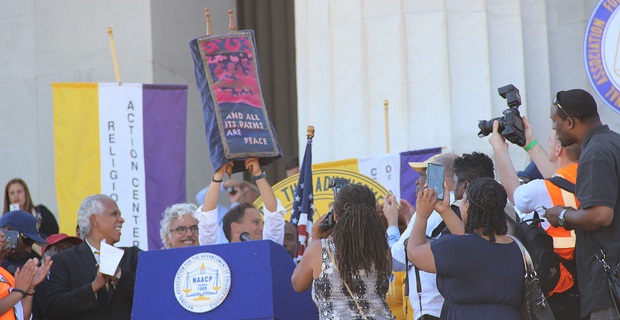
For the Jewish mainstream, many have forgotten how recently we attained this level of acceptance and we have not done enough to champion those who did not reach the level of success that we did. It is time to refresh our memory and commit again to a full-throated cry to help those who do not enjoy the benefits and blessings of our society. It is past time that we re-engage in the struggle for civil and human rights in this country. I will try to do my part. I urge all of us to roll up our sleeves and get to work to make this country all that it can and should be for all of its citizens. Today, the Religious Action Center of Reform Judaism launched Nitzavim in the state of North Carolina, the nationwide voter protection and participation program. May this be the first in our ongoing commitment to the future of our great country.FullSizeRender (1)

My engagement in this work will bring me into contact with people who are part of Black Lives Matter. My belief that MBLM is misguided at best in its pointed platform cannot be an excuse to refrain from working together for a common cause. I expect we will work together, shoulder to shoulder, in the important mission before us, for America to strive towards her ideals for all her people.


Selma- It is our story

This weekend marks the 50th anniversary of the march in Selma. As Americans and as Jews we are proud of this landmark achievement in our nation’s history and our part in it. Jewish Americans have been on the forefront of civil rights movement and we continue to champion civil rights and social justice for all. But the march in Selma is a seminal moment and we burst with pride, kvelling, at the sight of Rabbi Abraham Joshua Heschel along side of Dr. Martin Luther King Jr. We are deeply moved that so many American Jews stood bravely and fought during the struggle, most notably including those who gave their lives for these ideals.

This was our story. We Jews had found our place in American society and we found our voice. The prophetic ideals that are a foundation of our Jewishness galvanized us to support the civil rights movement because we believed that until all were free, none were free.   So Jews stood proudly along side the African-American community demanding change.

However, the movie Selma does not tell this story. In fact, unless you looked carefully and unblinkingly during the march across the Edmund Pettus Bridge, you probably missed the man in the kippah off to the side.   The story told in Selma, is moving, but it is not a story that includes us. It is told from the perspective of the African-American community and glorifies the struggle that was theirs. Although the time is the same, the march is the same and the facts are the same, the stories however are different. But that is okay.

The tellers of this story needed to share their perspective, which did not have room for us. Selma was about empowering their heroes to assert themselves. It is not an unreasonable thing to look through a different lens and tell a different story that has meaning even though it is not the telling of the story we might choose. That does not detract from the contribution that Jewish leaders made, nor does it lessen the pride that we might feel for their participation. It only shows that there are particular and more universal stories that might be told about the same unfolding of events.

As we approach the Pesach Seder, this gives us an opportunity to re-examine the telling of our quintessential freedom narrative. What do we emphasize and what do we leave out? Many different versions of the Exodus story will be told this night, each of them valid, each of them part of the larger story. The recollection of events only remains meaningful when we can make the connection to those events in a way that speaks to us. Only then is it more than a recounting of events, but rather a moving story that evokes emotion and prompts us to action. We share at our Seder tables the hope that “Next year may we all be free,” but until that time, may our stories keep the dream alive.


A Time for Somber Reflection

It is more than just bad policing

We are in the throes of mourning the death of two New York City Policemen, on the heels of the deaths of Michael Brown and Eric Garner. We are raw. Emotions have spilled like blood from deep wounds. We need time to process. We need time to grieve. We need to catch our collective breath.   We need time to come to grips with the tragic series of events that have shaken our country. What we do know is that the violence is overwhelming and somehow we must get it to stop.

The deaths of Michael Brown and Eric Garner have galvanized people across the country. Initial protests over the deaths of these two individuals increased dramatically in the wake of the Grand Juries not indicting the police officers involved. Uncovered a deep gulf between the police and the people they serve.

My concerns run deeper than whether indictments were handed down. There are other frankly more important issues that must be addressed. I am deeply troubled when a man repeatedly pleads 11 times that he cannot breathe and the police who have subdued him are unable to move from actively bringing him under control to actively engaging in the humanity of helping him once he was down. I am deeply troubled that a man’s body remained laying in the street for four hours rather than being treated with basic dignity. The lack of humanity is deeply distressing, and it goes far beyond bad actions of particular police.

Our problems are a deep divide separating whole segments of society from the institutions that are supposed to protect, defend and nurture them. Oppression is the result of the separating segments of society already prejudged as unsavory from the rest of “civil” society. It is more than a new approach to policing and re-examining the way our criminal justice system metes out punishment, as important as these changes are. It goes to the fabric of our country. It permeates our society and cannot be simply fixed by changes implemented at the top. All of us have responsibility to understand what is wrong and how we might change it.

Government can make the police of Ferguson look more like the people of Ferguson. But it is the people of Ferguson who must also invest in the infrastructure the schools and the families to build minds and to instill values. It is up to the locals and their police to be sensitive to each other. It is up to the broader society to bring economic opportunity and the possibility of upward mobility, the opportunity to aspire to become something more. It is up to us.

Marching is important if it serves as a first step to spur the people. Now the next step is to organize and develop goals and a strategy with political clout to effect change. And the rest of us need to support this work knowing that through this process we are all strengthened. This is the beginning of the next important phase of the Civil Rights movement in our great country.

The Attorney General of the United States seems as perplexed as many of us and has ordered a Federal Investigation into the death of Eric Garner. This might shed light on a process that many found disappointing to say the least. But this investigation cannot provide justice for Eric Garner; it is for our future. The civil rights advances of the past did not happen solely by new law or court order. The advances happen and endure only when there is sufficient will of the people to demand we overcome the status quo and demand better of our institutions and ourselves.

Our demonstrations proclaim “Black Lives Matter.” All lives matter. Everyone deserves to live. We are a nation of laws. And those laws must apply to all to protect the weak so that all may have the opportunity to pursue, free from violence and fear, the inalienable rights upon which our nation was founded.

But for now, let us take time to grieve and bury our dead. Then let us return and start the process of making change.