Finding Humanity in the Wilderness-Bamidbar

We are living in a wilderness. The landmarks we relied on — shared institutions, common ground, the assumption that the person across from us inhabits the same basic reality — have grown unfamiliar. We are between what was and whatever comes next. Disoriented. And tempted, as people always are in disorienting times, to cluster into tribes, to find safety in the familiar, and to stop seeing the people just outside our camp.

Into that disorientation, the Torah this week offers a name for where we are. Bamidbar — In the Wilderness. And the first thing it does, before laws, before strategy, before the long march begins, is this: God tells Moses to count the people.

Not manu otam — number them. S’u et rosh — lift the head. Every person, by name, by clan, by family. Not a tally. A seeing.

This is the question Bamidbar puts to us: What does it mean to count someone?

We know one answer. We live with it every day. We count people to manage them — to allocate resources, to measure outcomes, to track attendance. In that kind of counting, what matters is the number, not the person behind it. The individual disappears into the aggregate. A congregation becomes “membership numbers.” A person in grief becomes a “case.”

The Torah offers a different answer.

In the wilderness, where the Israelites have no city, no home, no fixed identity beyond the memory of slavery, God insists on counting each one by name. Before anything else can happen — before the camp is organized, before the march continues — every person has to be seen as a person.

The word midbar shares a root with davar — word, speech, the act of speaking. The wilderness is the place of speech. Not the speech of a crowded life, where we talk past each other in corridors and Shabbat kiddushes. The speech of the stripped-down encounter — where there is nothing left but the person in front of you and what is actually true. That is where the Torah is given. Not in a palace. In the midbar, where the distractions fall away, and the question becomes unavoidable: who is here, and do I actually see them?

The Levites are counted separately in this parsha. Every other tribe is counted for military service — men twenty years and older, those who can bear arms. The Levites are not. They are assigned to the Mishkan, the Tabernacle, the portable dwelling of the divine in the midst of the people. Their job is not to fight. Their job is to tend the place of meeting — to keep open the space where a genuine encounter is possible. The entire camp is arranged around that center. The whole organization of the Israelite community in the wilderness is structured around proximity to the place of real meeting.

This is not incidental to Judaism. It is the architecture of it.

Bamidbar does not let us retreat into our tribes. Before the march begins, before positions are taken, God says, “Lift the head.” Not of your group. Of every person. The census is not an invitation to count the people who look like you.

Here is the call: Find one person this week you have been counting but not truly seeing. Not a category. Not a face you pass in a corridor. A person, by name, by what they are actually carrying right now. Ask a real question and stay for the answer.

That is what it means to be in the wilderness together. That is this week’s work.
BaMidbar-In the Desert and Everywhere, Everyone counts

As social beings we seek relationships as a way of making meaning. We need to connect to other people’s lives, believing we have something to contribute, and through this validating our own self. We want to count. Each of us is busy, absorbed in our own world with scarce time to think of others. We often find ourselves shunted aside, neglected or forgotten, not because of anything malicious, but because each of us become so focused on the day to day challenges, we forget to reach out and are often left feeling alone. This can be discouraging and even make us doubt our own value. This week’s Torah portion BaMidbar reminds us however, that indeed we are important.

This first chapter of the book of Numbers has the Israelites out wandering in the desert, in the Midbar. But translating the word as desert is deceptive. We picture a desert as a vast place, devoid of life, empty, and forbidding. But the desert is actually a place teeming with life, a place of overwhelming beauty, and an awesome night sky filled with countless stars. It is the place where the children descended from Israel/Jacob become the People/nation of Israel. The Children of Israel are forged in this harsh climate, and preparing to enter the Promised Land. It is a time of growing where everyone is needed to build the nation. Everyone counts.

The idea that everyone counts is so important that God instructs Moses to conduct a census. God appoints leaders of each clan to do help in this important work of accounting for everyone so the greater task of building the nation can occur. As it says in Numbers 1:19, “As the Lord commanded Moses, so did he count them in the Sinai desert.” The desert is a place of accounting, revelation and building, and revealing that each of us has a critical role to play. At this time, nothing is of greater importance.

Even the word BaMidbar speaks to our significance and meaning. The word shares the same letters as the word for speaking or speaker, Midaber. The word BaMidbar that we translate as “in the desert,” could be, “ in the speaking”, or “in the speaker.” Each person has an important contribution to make to the whole. It was true in the Sinai, also it is also true now. The desert is far more than what it might seem on the surface. The Torah portion shares that the Midbar is an extraordinary place of discovery- finding our place, finding our purpose, and finding our connection to things greater than ourselves, our family and our people. BaMidbar teaches that I am worthy of being counted- that I do count!

Each of us counts. Each of us has something worthwhile to say and something important to give. Our life experiences have created a wealth of knowledge and wisdom. We are teachers and caregivers, learning, practicing, educating, and demonstrating what it means to be human, what it means to make meaning in the lives of others and in our own lives as well. That makes each of us significant.

Each of us counts.

Timelessness our Eternal Journey


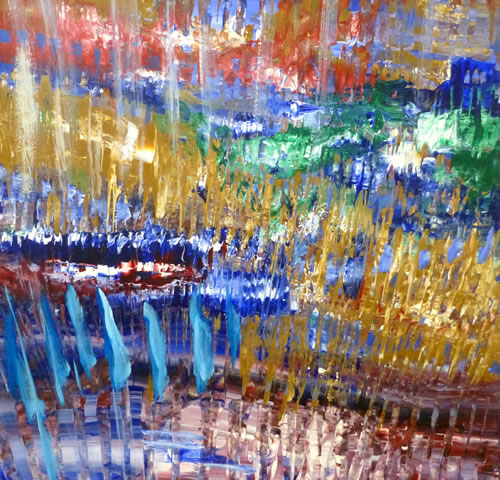
The Twelve Tribes by Yoram Raanan

The recent New York Times article We aren’t built to live in the moment by Martin Seligman and John Tierney proposes that it is humankind’s ability to contemplate the future that makes us unique as a species. This insightful article comes as we begin the book of BaMidbar. BaMidbar is our story in the Wilderness, a place of infinite beauty and discovery, a place where time seems to stand still. How timely is it that we read this article and this Parsha come together this week and we witness Torah’s expansiveness.


We are often thought of as the “People of the Book,” which often is interpreted to mean that we are also a people of memory. These memories have been codified and handed down for generations to help us with issues of meaning and morality. An extraordinary part of our journey is recounted in the book of Numbers, BaMidbar. The opening parashah starts with a census. Through the census, we are taking stock of who we are. The counting itself is based on the past, coming together into one place in preparation for moving forward under God’s guidance.

This melding of our past, present and future parallels our conception of God. The Tetragrammaton, YHVH, the four letter name we use for God is understood as a timeless representation of the Eternal One, embodying the past, the present, and the future.

All is intertwined. And that is part of the extraordinary wisdom of Judaism. Past, present, and future are inextricably bound together. We cannot understand who we are or begin to ask the deeper question, why we are until we comprehend that our past, our present, and our future all inform us. We cannot fully exist without these three pillars. It is they together that create our meaning, our context. The hope of Olam Haba, the World to Come, is a vision that we see in the present based on the place from which we have come. Past, present and future unified. BaMidbar is part of the unfolding story of our people, timeless like our God.