Nava Tehila shares Mizmor Shir the psalm (ps92) to welcome Shabbat.
In these tumultuous times, the melodies help us to bring Shabbat Peace into our hearts.
Shabbat Shalom
Nava Tehila shares Mizmor Shir the psalm (ps92) to welcome Shabbat.
In these tumultuous times, the melodies help us to bring Shabbat Peace into our hearts.
Shabbat Shalom
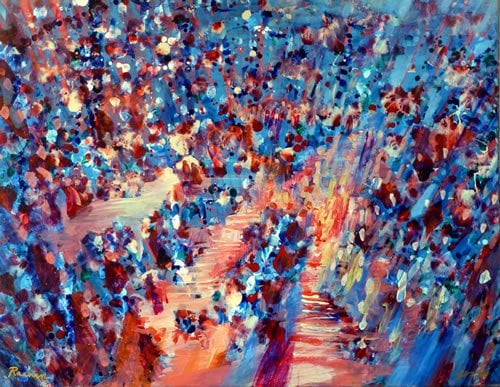
In Parashat Mishpatim, we move from the heights of Sinai and the grand laws given by God to Moses to the granular details of civil law. The shift teaches that a righteous society is built not on abstract ideals but on the daily, impartial application of the Rule of Law.
Mishpatim introduces three pillars essential to our current struggles:
Our institutions are threatened as society’s trust in them erodes. Mishpatim reminds us that an orderly society is a deliberate choice, one that requires our involvement and confidence. Our future as a nation and world leader depends on upholding a system in which the rule of law anchors us against the storms of political passion
Bruce Springsteen’s Minneapolis is a battle cry for us to uphold the values we hold dear, the rule of law, the constitutional rights each of us is entitled to, and the dignity and respect for all people.
As we enter Shabbat, we pray for each other and vow to fight for our precious values. We must be better than this.
Shabbat Shalom
I write this, it is Groundhog Day and Tu B’Shvat!
The American Sage, Punxsutawney Phil, has predicted another 6 weeks of winter. It is incredible where we get our news!
More importantly, I would argue that this is the 15th day of the month of Shvat, Tu b’Shvat. This day marks the beginning of the new year for trees.
It is about the rebirth that will come from life that has gone dormant during the winter within the greater cycle of the year. We could not have a more apt metaphor for what is happening in our lives. The brutal and violent transgressions of the Federal Government through ICE and the Border Patrol, as well as the multiple assaults on human dignity and respect, seem to have seeded the birth of a popular uprising against these violations of our rights.
As spring approaches, the trees will blossom, and warmth will fill the air. But the rededication to our ideals requires us to act. Our tradition teaches that we are partners with God in the ongoing work of creation. Now is our time to commit to this sacred task. We must each ask ourselves what we are able or willing to do, and get to work.
In the harshest, coldest, and darkest times, hope arises that something better is coming. The Jewish tradition and the founding principles of our country require us, in the words of Abraham Lincoln, to work to ensure “a government of the people, by the people and for the people shall not perish from the face of the earth.”
Wishing you a happy Tu b’Shvat.
Rabbi David
One Day
Mattisyahu’s song One Day is our hope – but it will take a our concerted effort to realized the dream of peace. Shabbat is our taste of what it could be, Now more than ever we must commmit to making our dream a reality.
Trying to rewrite history cannot deny its truth.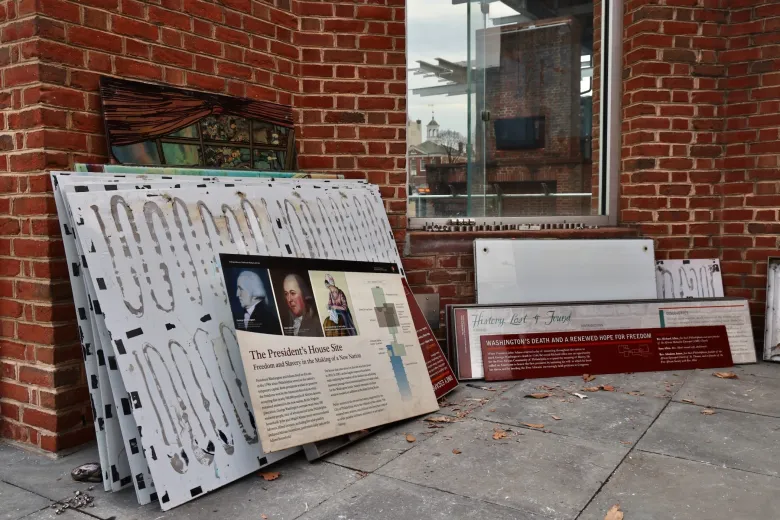
Slavery is a moral stain on the United States. No matter how much bleach we use, we cannot scrub it out, nor can we pretend the stain doesn’t exist. Removing historically accurate plaques that teach the fullness of our history at the President’s House exhibit on Constitution Mall, the paradox of Freedom and Slavery, does not make the events they depict any less true. The attempt to deny our past keeps us from learning and growing from it. Our challenge is to rise above it, not to define ourselves by it and remain mired in it.
The fear of some who see this as an attack on our country and turn a blind eye is baseless. I am ashamed of slavery and the hatred it embodies, while remaining proud of the aspirations our vision embodies. We have a long journey ahead of us to right the wrongs and heal the lingering pain and injustice. But we are better off when all are better off. When every person is treated with justice, dignity, and respect. These are the principles of this nation, principles we must remain dedicated to championing.
When we hide from things that make us uncomfortable, we miss the chance to engage with and learn from them. We are better than slavery. It is our history. But it does not have to be our legacy. We are better than that.
The Shvesters share their rendition of a poignant Yiddish song Vi Iz Dus Gesele, Where is the little street? A song of longing, nostalgia, and lost love.
It is a way to help us perhaps enter this Shabbat. Given the current turmoil, we seek a better time. May we work to see that time come soon.
Wishing you Shabbat Shalom.
We share the prayer Shabbat Shalom, A hope for peace and completeness.
U2’s I Still Haven’t Found What I’m Looking For is a longing for that prayer to be fulfilled.
As we enter Shabbat, Playing For Change shares that yearning and the return of those who are not with them. And we include Ran Gvili. We pray for peace and wholeness.
#BringThemHome
Shabbat Shalom
One of the most theologically challenging chapters of the Exodus narrative that Pharaoh’s heart is “hardened.” Where is the moral choice or free will that characterizes Torah? If God hardens Pharaoh’s heart, how can Pharaoh be held responsible for his refusal to free the Israelites? How can punishment be just if repentance has been removed as an option?
This reading loses sight of the metaphor at work and the timeliness of the teaching. This is not merely a portrayal of an obstinate ruler; it is about how entrenched systems of power function, how the primary focus becomes remaining in power, how moral authority is lost, and how meaningful change to the system that maintains that power is resisted, ultimately doomed to collapse under the weight of its own corruption.
Pharaoh is that political system.
As the plagues begin, Pharaoh himself refuses to change. As the plague of frogs subsided, Pharaoh’s heart hardened when relief came. This was a political reflex, not Divine intervention. The system reasserted itself once the pressure on it was alleviated. The relief was the excuse to revert to the status quo, a squandered opportunity for repentance.
When the text starts using the phrase that “God hardens Pharaoh’s heart, “ the Rambam comments that persistent injustice can erode and stop the capacity for repentance itself . As choices become character, character hardens into destiny.
Ibn Ezra reinforces this structural reading. Commenting on God’s declaration that Pharaoh’s heart will be hardened, he emphasizes that Pharaoh’s political role makes concession impossible. Releasing the Israelites would dismantle the economic foundations of Egypt. Pharaoh’s refusal is therefore systemic self-preservation rather than mere personal obstinacy.
Torah reinforces this interpretation through metaphor. Pharaoh’s heart is described not only as hard but as heavy (‘kaved’). Weight creates inertia. A system burdened by injustice loses its ability to pivot, respond, or change course.
This imagery reaches its climax at the Sea of Reeds. Pharaoh’s chariots sink “like lead in the mighty waters.” Collapsing under its own weight. Egypt falls not because God waged war, but because the structures that sustained its dominance render it incapable of survival in a transformed moral landscape.
Midrash sharpens this idea through the principle of measure-for-measure. Shemot Rabbah teaches that just as Pharaoh hardened his heart, so God responded in kind. The plan to drown babies in the Nile creates the punishment of the drowning of the chariots and army in the Reed Sea. Power collapses according to its own internal logic; the methods used to preserve control become the mechanisms of downfall.
The prophets later universalized Pharaoh into an archetype of political absolutism. Ezekiel depicts Pharaoh declaring, “The Nile is mine; I made myself.” This arrogance and pride further erode any legitimacy of that power. Once power views itself as self-originating, accountability disappears, and reform becomes inconceivable. Seen in this light, the hardening of Pharaoh’s heart is not a theological puzzle but an enduring warning, repeatedly ignored yet played out throughout human history and confronting us today.
The Torah does not ask why Pharaoh did not repent; it teaches that power becomes incapable of repentance. Redemption comes not because unjust systems change, but because they cannot endure and ultimately collapse. The Reed Sea does not defeat Egypt—it simply allows Egypt to sink beneath the weight it chose to carry. These stark lessons are warnings for all of us.
We are horrified that Temple Beth Israel in Jackson, MS, was firebombed. It is a violent act of hatred targeting Jews. As antisemitism continues, we find ourselves vulnerable and seeking support.
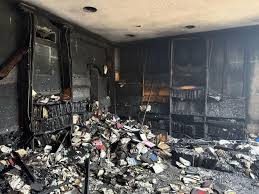 The community of Jackson, MS, has rallied around its Jewish community in wonderful ways. Many of us, however, feel abandoned by others across the country who have not expressed support for their local Jewish communities amid escalating threats. This is counterproductive, creating divisions and exacerbating tensions where they should not be.
Sadly, there is too much violence and hatred. It is impossible to respond to every incident. The Jewish communities could not meet that standard either. We would spend substantial time issuing statements of outrage and comfort instead of devoting ourselves to the important work of uniting against these blights and working toward changes in our society to create a safer space for all.
Too many understand the pain, often through lived experience. We need solidarity and action, not just words.