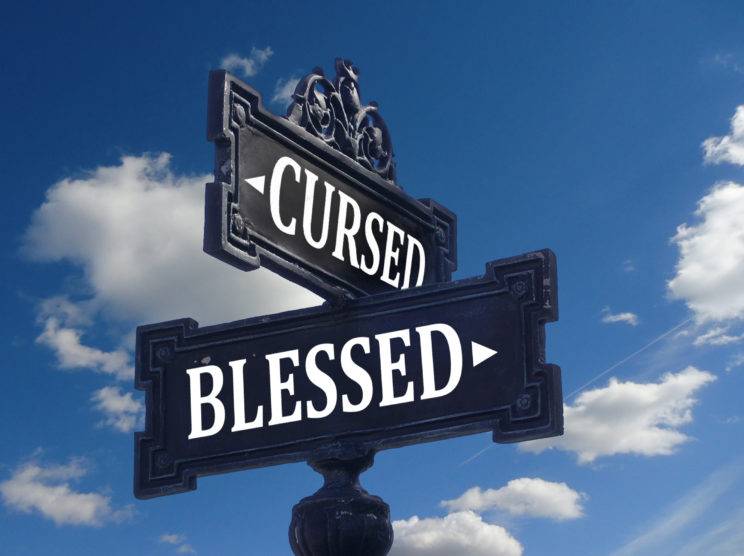
My father kept one of those hokey maxims framed on his office wall: “When you are up to your a** in alligators, it’s hard to remember that your initial objective was to drain the swamp.” I used to smile at it and move on. Lately, I can’t. This week, Moses stands before the people and does something that should stop us cold. He says, Re’eh, See. And then he sets before them a blessing and a curse.
See. As if seeing were the easy part.
The parasha opens with the Hebrew imperative re’eh: look, perceive, take it in with your own eyes. Not sh’ma, hear, the verb that opens the great declaration of faith. Moses is not asking the people to accept a teaching on someone else’s authority. He is asking them to see for themselves, to recognize blessing and curse when the two stand right in front of them. Arguably, that is the hardest thing he asks of us in the whole Torah.
Because in the moment, we almost never can. Blessing and curse do not come labeled. They arrive tangled together, wearing each other’s faces. The job that looked like a curse turns out to be the doorway. The relationship that felt like blessing slowly hollows us out. We are down in the swamp, swinging at alligators, and the reason we came has vanished from view. Moses says, “See,” and honestly: from here? I can barely make out my own hand.
I have to be honest about what the text does, because it does not obviously agree with me. Moses plants the blessing and curse on two mountains, blessing upon Gerizim, curse upon Ebal (Deut. 11:29). When the ceremony plays out, the labels are fixed in advance. The Levites call each curse and the people answer amen (Deut. 27). Nobody is squinting across the valley, agonizing over which mountain is which.
So let me name my own leap rather than smuggle it in. I want to ask what this ceremony means for those of us who never get the labels in advance. Here is what I notice: Moses does not send one lonely seeker up the mountain. He gathers the whole people into the valley and assigns half to each height, and the words travel back and forth across the divide, out loud. The seeing is not solitary. It happens in the space between us.
Which lands me in a contradiction I would rather hold than hide. The command is re’eh, see for yourself, take no one’s word for it. And the surprise is that I cannot. I am too deep in my own swamp to trust my own eyes about it. The only way I reach the view “from thirty thousand feet” is to turn to you, on the other mountain, and let you tell me what I cannot see: that thing you call a blessing, look again. That thing that feels like a curse, stay with it. The verb is see. The practice turns out to be sh’ma, to heed another voice. I can only see through you.
Which brings me back to the title. O say, can you see? The anthem asks it at dawn, straining to see whether something precious survived a night of thunder and rockets and glare. That is the honest condition. We are all peering through the smoke of our own night, unsure by ourselves whether what we love is still standing. The miracle was never in the thunder and the lightning. It is in people sheltering one another from the storm, calling across to each other at first light so no one has to read the sky alone.
I still cannot always tell the blessing from the curse in the moment I am living it. I have stopped expecting to. But I have learned who to ask.
So, since you can see a valley of mine that I cannot: who is standing on your far mountain, and what have you not yet asked them to help you see?