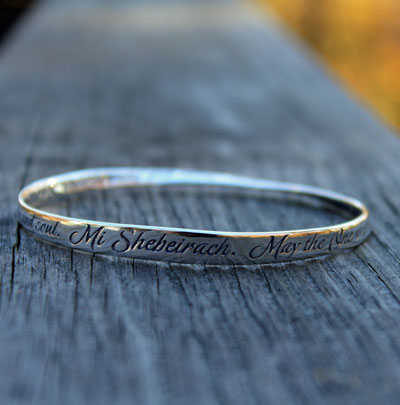
Let’s move into Shabbat together with Rabbi Geela Rayzel Raphael.
Wishing you peace and wholeness this Shabbat.
Let’s move into Shabbat together with Rabbi Geela Rayzel Raphael.
Wishing you peace and wholeness this Shabbat.

We mourn the loss of Hillel Yaffe Ariel, brutally murdered while asleep in her bed. Hatred, violence, and murder of children do nothing to further the cause of peace or coexistence. Indeed often hardens the heart making the future for two people even more difficult.
Let us take this time to grieve for this innocent child and refuse to let anger and hatred consume us.
May her memory be a blessing.
There is a TV commercial that distinguishes between simply monitoring and actively preventing identity theft. A violent bank robbery is in process. The monitor surveys the situation as the customers fall to the floor imploring this uniformed man to take action. He responds that he is merely a monitor; taking action is not his job. And yes indeed, there is a bank robbery underway.
The story of the spies in Parshat Shlach seems similar. Twelve men were selected and sent out to survey the land of Canaan and report back. They did what was asked and reported what they believed they saw. An insightful rabbi taught me that the answer to a question depends on the question you ask. It also depends on the nature of the respondent.
These were twelve men, “…one man each from his father’s tribe; each one shall be a chieftain in their midst” (Num. 13:2). They were leaders within their respective clans, but were they capable as conquerors? The Hebrew word is Nasi, or Prince. They were princes of the individual tribes but not necessarily the top dog, or the General of the Army to use a military term. So were these spies conquerors or bureaucrats, men of action or fearful men of complacency and conservatism?
Had the idea of freedom and freedom’s responsibilities permeated this new Israelite society? It

seems not; for only two spies, Caleb and Joshua believed they could actually overcome their foes and possess the land. It is possible that a deliberate selection of strategists and warriors as the twelve spies would have yielded a unanimous joining of Caleb’s assessment that they could vanquish the Canaanites. However, the spies’ ability to sway the people indicated that the Israelite people were not yet ready to enter the Land and receive the promise and responsibilities that go with it.
We also, both individually and collectively, need to ask ourselves which are we? Are we agents of change like Caleb and Joshua, or agents of the status quo? Are we willing to find ways to achieve lofty goals or fearful of the risks and unwilling to reach for more hoping to preserve what we have? Often, trying to maintain the status quo is riskier than taking the chance to make something better. Although we should always be grateful for what we have, when it comes to values such as human rights, peace, justice, equality, and security, we can always aspire to something greater. The question remains, Are we willing to take the risk?
Shalom Aleichem, the welcoming of Shabbat and the Angels of Peace, sung to Bob Dylan’s “Don’t Think Twice, It’s All Right” by the wonderfully talented Rabbi Andrew Hahn, the Kirtan Rabbi.
Shabbat Shalom
So many of us are rooting for Representative John Lewis. An icon of the civil rights movement and leader in the House of Representatives, he has stood up to injustice by sitting down. We applaud Mr. Lewis for galvanizing other members of the House to declare that Congress can no longer ignore its responsibilities.
Our government, as Abraham Lincoln noted, is extraordinary because it is ‘of, by and for the people’. The overwhelming popular frustration with our government is largely because it lost sight of this value and has been serving particular special interests, be they political, economic or personal. The violence that pervades our land is like cancer, insidiously growing and infecting our society, killing off vital parts, threatening to metastasize and destroy this great place we call our home.
We are desperately seeking some relief from this disease. And although a cure remains elusive, we see an opportunity to curtail the ability of the outlaws of our society to use weapons to inflict carnage. For the Love of God and our own children, the commonplace slaughter of people with these weapons needs to be curtailed. Curtailed, because sadly we cannot stop all gun violence. That does not permit us to do what we can to at least reduce the ease with which these horrific events take place.
Sensible and responsible rules to regulate access to guns and ammunition is not an attempt to repeal the Second Amendment or its current interpretation that citizens have a right to bear arms. There is no inexorable slippery slope leading to complete removal guns from society. But there is a desperate need for us to enact and enforce responsible access and use of firearms.
The extraordinary action of Representative Lewis on the House floor is welcomed by a nation filled with heartache and despair. I pray that Representative Paul Ryan as the leader of both his party and the House of Representatives finds a way to join forces with Mr. Lewis and guide this nation with the vision and leadership we so desperately need.
We have lived through another horribly difficult week where hatred and violence scarred us deeply. With Shabbat let us find comfort and the strength to rise above these things and work for a time when we can live in safety and love, security and peace.
Ufros Aleinu Sukkat Shlomekha, taken from the Hashkiveinu prayer, Spread over us Your Shelter of Peace.
ופרש עלינו סכת שלומך Ufros Aleinu Sukkat Shlomecha
Spread over us your canopy of peace
ותקננו בעצה טובה מלפניך Vetaknenu B’aytza Tovah Milfanecha
And repair us with good council before you
והושיענו Vehoshiaynu
And rescue us
This was another difficult week. Terror and hatred scarred Tel Aviv leaving four innocent people dead and many others injured and victims. Our hearts and prayers reach out to those that suffer. We also pray for the day when people learn to live together in peace.
The piece I share is Rabbi Shlomo Carlebach singing Al Eyle Ani Bochyah – For these things I cry. Even through the tears, we hope for a new and better day.
Shabbat Shalom
A Carlebach Kabbalat Shabbat by a capella troupe Kippalive.
Wishing you Shabbat Shalom
The Death of Harambe
It is sad that this beautiful silverback gorilla was killed. Let’s move on. I am dismissive of the groups expressing outrage and seeking to hold someone “accountable” for this “horrible act of injustice”; if you are truly appalled by this event you must ask yourself, where have you been all this time?
The child falling into the gorilla’s area precipitated the deliberate decision to kill the gorilla. A great ape was sacrificed to ensure saving the life of a human being. The real underlying issues are twofold:
First, is it right for zoos to hold these animals for our amusement/education? Shouldn’t wild animals be allowed to live in the wild rather than Disneyesque approximations, what do we gain by the study or entertainment/observation of these creatures that is worth their captivity?
Second, given that so many of these creatures live in threatened habitats, why aren’t we more active in protecting them in their native environments on the land and in the sea? Rhinos, elephants, tigers, gorillas, the list goes on and on, are in an existential struggle to survive as species. Without public awareness, money and human staffing the outlook for these creatures is bleak. The loss of a single gorilla pales in comparison to the disappearance of these animals from the planet. Until these activists are ready to commit to the cause it is difficult to do other than dismiss them.
Protesting to achieve “Justice for Harambe” is not about justice. Unfortunately, it is about the hollow ease with which someone can jump on a bandwagon without thought as to the underlying cause. We can too easily click an icon on a social media page or electronically add our name to a petition and consider our obligation fulfilled. But such inaction does little to actually affect change or address an injustice. Margaret Mead once said, “Never doubt that a small group of thoughtful, committed citizens can change the world; indeed, it’s the only thing that ever has.” To truly express moral outrage is to take a real stake in the process of change through financial contribution and more importantly personal action. To champion a cause requires more than noticing injustice, it requires combatting injustice.