Romemu- Let’s sing to honor the Divine
Craig Taubman’s wonderful music brings this idea alive with an enchanting melody that will dance in your head all Shabbat.
Shabbat Shalom
Romemu- Let’s sing to honor the Divine
Craig Taubman’s wonderful music brings this idea alive with an enchanting melody that will dance in your head all Shabbat.
Shabbat Shalom
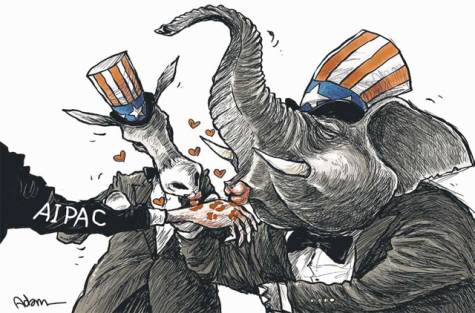
Candidates at AIPAC
I am troubled by the pending appearances of the presidential candidates at the AIPAC conference. It is important to hear from them. However, the value is in the substance of the presentation, not the celebrity surrounding it. We do not need a beauty pageant. I am concerned about the substance.
Candidates appear in venues like AIPAC order to get votes, hoping to share a message that appeals to the group. Unfortunately, in these constricted spaces it is unlikely that they will deliver a complete message and will instead present little more than some populist pandering to the voting block represented by AIPAC. I expect that each candidate will offer some rhetoric about his/her commitment to a strong and secure Israel. But we need more than words. Each candidate needs to elaborate a thoughtful policy of both a strategic and tactical process to strengthen the relationship between Israel and the United States and secure stability in the region. A single speech at the AIPAC conference cannot do this. Platitudes and promises whether eloquent or crass are worthless.
We in the rabbinic community are struggling with Donald Trump’s appearance in particular at the AIPAC conference. The Union for Reform Judaism (URJ) and Central Conference of American Rabbis (CCAR) have taken a stand to express deep discontent with the hatred, bigotry and bullying that seems to characterize much of Trump’s message. The URJ and the CCAR are stating core Jewish principles. But this statement raises important overall questions about appearances at the AIPAC conference by the candidates.
The last time Mr. Trump publicly referenced Jews, we saw anti-Semitic canards played out on the public stage in the form of jokes. Jews in the room laughed nervously and uncomfortably at the joke, but it was not funny. Such words combined with other inflammatory divisive speech leads me to reluctantly conclude that this forum is not the appropriate place for Trump or his rhetoric. But such a position stands in direct opposition to my belief in free speech and the open exchange of ideas.
It is unrealistic to call upon AIPAC to rescind the invitations to the candidates. AIPAC needs to remain nonpartisan and promote its pro-Israel agenda. Conference attendees should be respectful of all speakers. No one, however, should be swayed by a single speech. It is critically important we look to the individual’s corpus of speeches and the existing records of each candidate to truly determine where they stand on Israel as part of a cohesive vision of American leadership and on the fundamental principles that we hold sacrosanct. Then we all must vote.
Yehi Shalom
A wish for peace performed by Neshama Carlebach and Josh Nelson.
~Shabbat Shalom
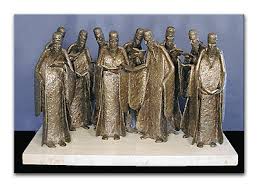
I recently went to pay a Shiva call. Among the small group was an orthodox rabbi. We chatted and waited for a minyan to arrive. We made a couple of phone calls as the minyan was not materializing. To the surprise of some people in the room, the orthodox rabbi announced he was leaving. How can he do something so outrageous, someone demanded to know of me? It is so disrespectful; just who does he think he is anyway? On the contrary, I answered. The rabbi is acting with respect for the mourners. How can you say that? Because I continued, the rabbi cannot share certain prayers absent a minyan and he cannot be counted in a minyan unless it includes only men. We will only have a minyan if we count the women, so the rabbi did the only thing he thought he could do under the circumstances, he left and essentially gave us permission to proceed. It might seem strange to some, but he was being respectful of both his beliefs and those who were in mourning. In that moment, he found a way to uphold both.
 There is room here to reflect on whether the decision was the correct one. Could not the rabbi have permitted himself to be counted for our purposes, never considering for himself that he has fulfilled his obligation? Wouldn’t his presence as a close family friend as a source of comfort override his interpretation of his obligation to his particular personal practice?
The important point is he found a workaround that in his mind upheld his competing duties as he understood them. Then it was up to me to be respectful of the decision whether I agreed or not. Here was a moment that could have created separation as easily as it could create community. It required both “sides” of the conversation to decide which one it was.
On March 2, Steven Colbert and the cast of Fiddler on the Roof got together for some fun on the set of The Late Show. It’s a fun way to welcome Shabbat.
Shabbat Shalom
Modesty and a seat too far
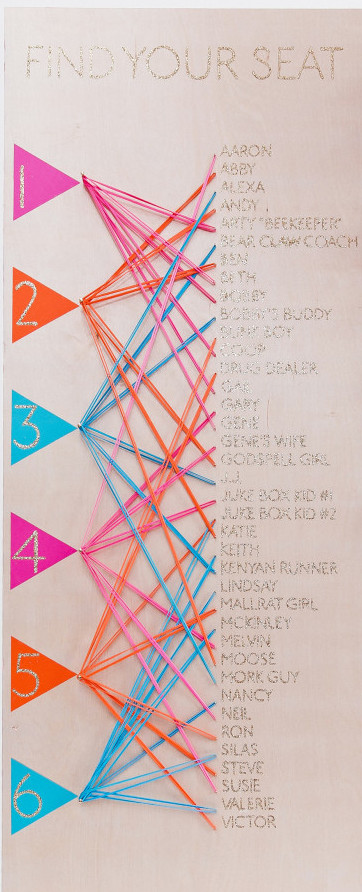 The current seating spat aboard El Al planes reminds me of seating elsewhere in the Jewish world. When planning the wedding, the seating chart seems to rank as important as the Chuppah. Aunt Sophie wont sit with Uncle Benny who would be upset if he didn’t sit next to cousin Terri who is rooming with Sophie’s daughter. The brouhaha about certain men refusing to travel next to a female other than his wife on a plane seems easy enough to overcome long before there is a confrontation on the airplane. This on board argument helps reinforce the old expression that EL AL was an acronym for “Every Leaving Always Late” and is an unfortunate commentary on our ability to get along.
This is an issue for the men in question, not the rest of the passengers. The easiest solution is for men who have this need to be required to buy the seat(s) adjacent, if other 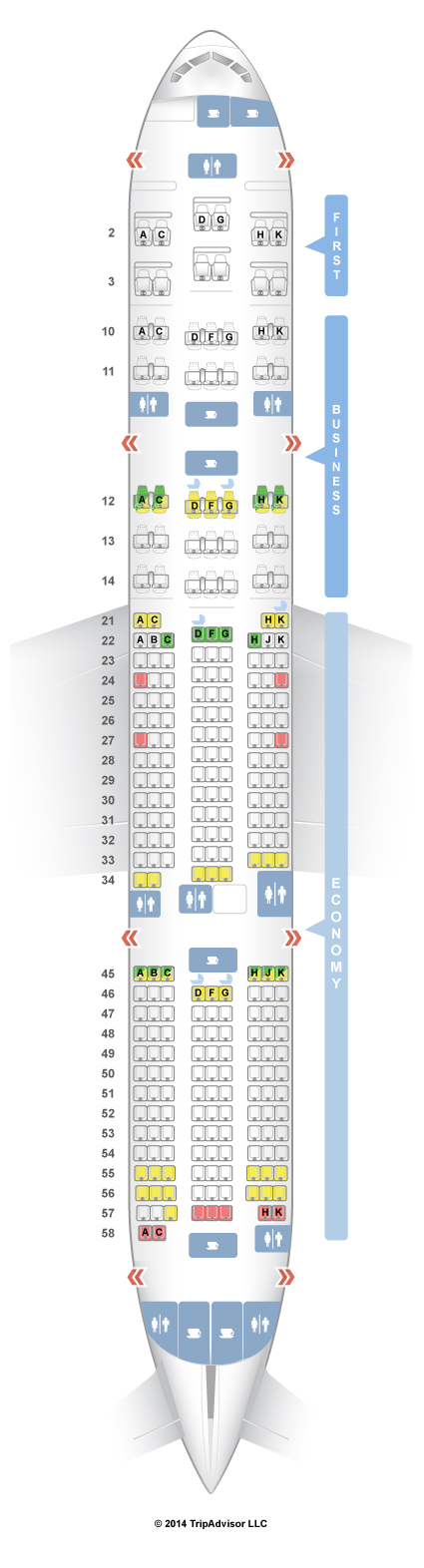 such observant men do not also book seats. Preflight booking can ask if this seating issue exists. If the yes box is checked, then a new level of scrutiny is developed. If the box is not checked, there is not consideration. The seating chart can be developed using computer algorithms. Alternatively, sections can be set aside for the observant. If seats are not available, the section can be expanded or the plane listed as sold-out for that section. Maybe business class could be reserved for all women who find they are bearing the brunt of this bad treatment. Maybe we do a first come first served approach. The balagan that is the El Al boarding process would look much the same as it does now.
There seem to be a multiplicity of solutions available long before boarding takes place. For a land touted as among the technology centers, this problem seems far from daunting. To create an argument on the plane or make some passengers feel unwelcome seems to be the worst possible alternative. My guess if that if the airline were held accountable, a workable solution would be quickly found. Maybe the pending lawsuit is the needed catalyst.
Nisiyah Tovah!
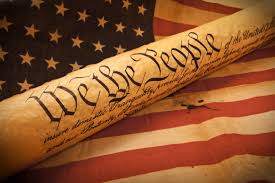
The presidential political season is in full swing. I resist the temptation to shout, but anyone who grew up with Looney Tunes, Bugs Bunny and Elmer Fudd, knows exactly what I want to yell. And the smile this thought gives me is part of the overall good feeling I have about this season.*
American Politics seems to be alive and well. The stakes have never been higher. Deeply passionate feelings and hungry candidates are vying for votes. There is deep discontent in America and with good reason. Problems only seem exacerbated in the current climate of a paralyzed partisan Washington. Americans feel great pressure; threats abound from the outside world and within our borders. Divisiveness in the government has brought governance to a grinding halt. But the beacon of hope is that our system permits, even encourages debate- often raucous and vociferous debate and the capacity to make a change. The system, our system, is one of the few places where such a process is encouraged. In our recent history however, there has not been too little demand for accountability and change.
On the eve of “Super Tuesday” it appears that the Democrats will likely nominate Hillary Clinton and the Republicans Donald Trump. This is after a series of knock down drag out fights to whittle the Republicans and Democrat fields down to the nominees. Town halls, debates, shouting matches and personal visits by the candidates have given the people a chance to speak in primary votes and caucuses.
Interestingly, one of our worst fears has not come true. Many feared the Citizens United opinion would drive such lively debate out of the system. The money would overwhelm the speech of the common American. Refuting this most notably is the failure of Jeb Bush to win. Ironically, it is the common American that has propelled a rich man to the Republican nomination.
We the People have not had our final say. That occurs on November 8, 2016 as we go to the ballot box and exercise the sacred right/rite of voting. All of us need to exercise this privilege to decide who will serve as President of the United States. Those seeking power know the stakes are high and will use almost any means to get the necessary votes. It will be up to us the voters to decide which one of the starkly different candidates we will choose. The office of President then will be transferred peaceably to the one that we have selected. Only with our participation and then the on-going demand for accountability will the new President fulfill our will. It is time for all, particularly the frustrated and the often silent, to join the epic fight for our democracy. First each must cast a vote and then each must to continue to demand that our voices be heard in the halls of power.
Trump or Clinton; A government Of, By, and For the People or a government for special interests, the choice still remains ours. And if we exercise our power, I will continue to feel pretty good.
* It’s Wabbit Season!
Kaddish led by the amazing Rabbi Andrew Hahn, the Kirtan Rabbi.
Shabbat Shalom
Kaddish is a doxology, a praise of God. It has become a central part of Jewish liturgy appearing in various versions within our services to mark special places along the way. The most common form of Kaddish is Kaddish Yatom, the mourners Kaddish, shared in a congregation (minyan) by those in mourning.
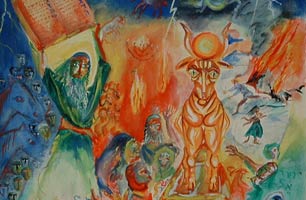
The relationship between Trust and Fear is very close. They are locked in a dualistic battle for supremacy.
Ki Tisa contains the story of the Golden Calf. Ex 32:1, When the people saw that Moses was late in coming down from the mountain, the people gathered against Aaron, and they said to him: “Come on! Make us gods that will go before us, because this man Moses, who brought us up from the land of Egypt we don’t know what has become of him.”
Rashi explains that the people expected Moses to return in 40 days. He was delayed according to Rashi’s reading of the texts by 6 hours. 6 hours delayed after a 40-day encounter with God, and the people rebel. What an extraordinary level of fear that possessed the people to turn against the trust of God and Moses, the covenantal relationship that took the people out of Egypt, crossed the Red Sea and brought them to the moment of revelation, all the Trust undermined by a six-hour delay.
We learn how difficult trust is to build, how important it is and how quickly it can disappear. We embrace trust as a foundation. We speak of trusting in ourselves so that we can make decisions along our way. We believe trust is the basis for any intimate relationship, that we will be cared for and held securely and safely by another and create a deep meaningful relationship permitting ourselves to be vulnerable because we feel protected. And it is precisely in this place that Fear can exercise its damaging power. In a moment, in a blink of an eye, or in this case six hours, Fear can take all we thought we had and burn it down. Rashi suggests that it is Satan who acts to confound the people. Satan is the fear we each carry inside.
It is in the realization that we carry Fear as a primal instinct that we can understand its place. Fear resides inside, maybe a protector from an earlier era in human development. It may have helped us survive certain threats, but it shackles us and keeps us down. Only when we consciously use Trust to defeat it, can we overcome Fear and permit ourselves to be vulnerable, creating bonds and relationships with others upon which we can build. However, these two things need to coexist. Fear continues to protect us from threats and tempers Trust. Trust likewise keeps us from becoming paralyzed by Fear. Each is a part of us and we need both to be whole. But when one takes over the other things fall apart.
Arguably we could say that the people should have trusted in God absolutely. But we know that for most of us that is not true. God had yet to reveal, that was why they were at Sinai and Moses was the man they followed, making God even further removed. Their trust was tested and the relationships were not strong enough. The fear was able to creep in and crush this new relationship.
Trust needs to be nurtured and reinforced to withstand the tests fear makes it endure. The story of the Golden Calf is the story of all of us.
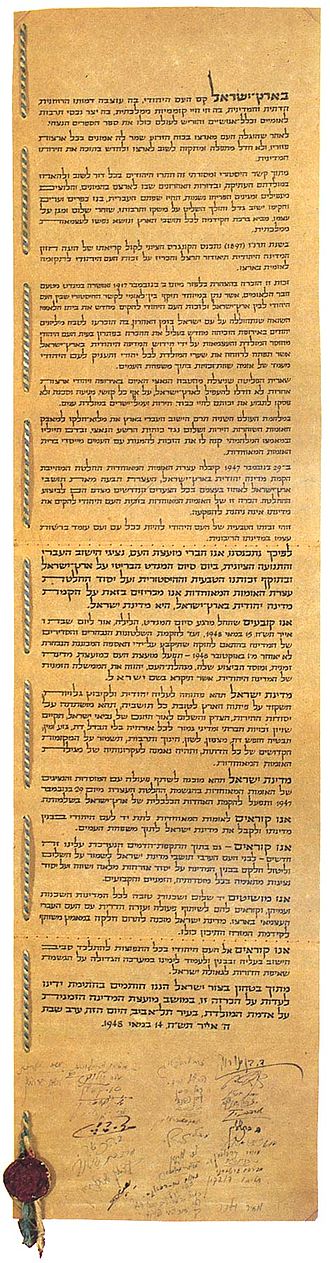 Israel is a strong Jewish Democracy filled with promise for her people and for the world. She must continue to strive to remain so. However, Israel is engaged in a two-pronged war that challenges this. One front is BDS (Boycott, Divest, Sanction). The other front is manifested by the wave of individual stabbing assaults taking place in the streets. These fronts are critical but they are not the places where the war will be won.
BDS is a clever maneuver in the public space to demonize Israel in the world of public opinion. Although BDS appears to be struggling to gain acceptance by national governments, it is resonating with the young on the college campus and other groups who want to support those they believe are the downtrodden and persecuted. It is part of the war for the hearts and minds of the public at large and it has become a force to be reckoned with.
The second front is on the streets of Israel. There is a de facto guerilla war underway. Individuals are arming themselves with any weapon they can: knives, guns and cars, attacking wherever and whenever, creating fear on the streets. This too is a shrewd campaign to inflict maximum damage with limited resources. Each knife-wielding individual creates a bit of terror. And every one, whether caught and imprisoned or killed, is a soldier sacrificed for the cause.
Two sets of actions are required, one tactical and one strategic. The first is to combat the immediate crises effectively arguing against BDS and containing the violence. These undertakings are necessary to promote the safety and welfare of the people of Israel. However these are tactical in nature; stopping the violence with better patrols, containing the violence by encouraging vigilance and raising the profile of law enforcement to preempt the violence. Unfortunately there is an insidious component to the tactical responses to the fear and terror.
In its efforts to protect itself, Israel ironically becomes complicit in the war to undermine itself. Israel undermines its promise of a democratic state by curtailing rights to citizens and non-citizens, it promotes a culture of animosity, seeing the other side as strictly an enemy who does not want peace, the Knesset considers punishing MKs without any consideration of “due process,” internal debate is squelched and not encouraged. The democratic and Jewish underpinnings of the state are compromised. Reacting this way to the situation actually plays into the hands of the adversary. Beyond tactics there is an urgent need to engage strategically, stepping back to consider the root causes of these offensives and how to grapple with the source of the discontent. This is the critically important second set of actions.
Strategically, Israel needs to take the actions that only a strong powerful nation can and take the risks to build a society within the Palestinian people that gives hope. A future of prosperity and peace is far better than the hopeless squalor and disenfranchisement now suffered by most Palestinians. In Gaza, economic development such as the proposed port is a concept to be seriously considered. A decision on the West Bank is required. Whether it is the pullback of the Israelis to permit a Palestinian state, or the annexation of the West Bank into Israel, the State of Israel can no longer pretend the status quo, with its continued expansion of settlements, is viable. Which of the two choices is the subject for intense and deliberate debate. But after 50 years, Israel cannot pretend this situation is temporary or the disenfranchised people living in the land will simply become satisfied with it.
The risks of maintaining the status quo are arguably even greater than the risks of taking bold actions toward resolution of the conflict. Israel is strong. Its people are energetic and innovative with a deep love and commitment to their land. With this solid foundation, Israel can build and move forward. It is an incredibly hard needle to thread, but it can be done. Watching Israel help Syrian war victims demonstrates Israel’s ability to do just that. Israel is at war and the threats are quite real. But Israel can still forge the way toward peace.