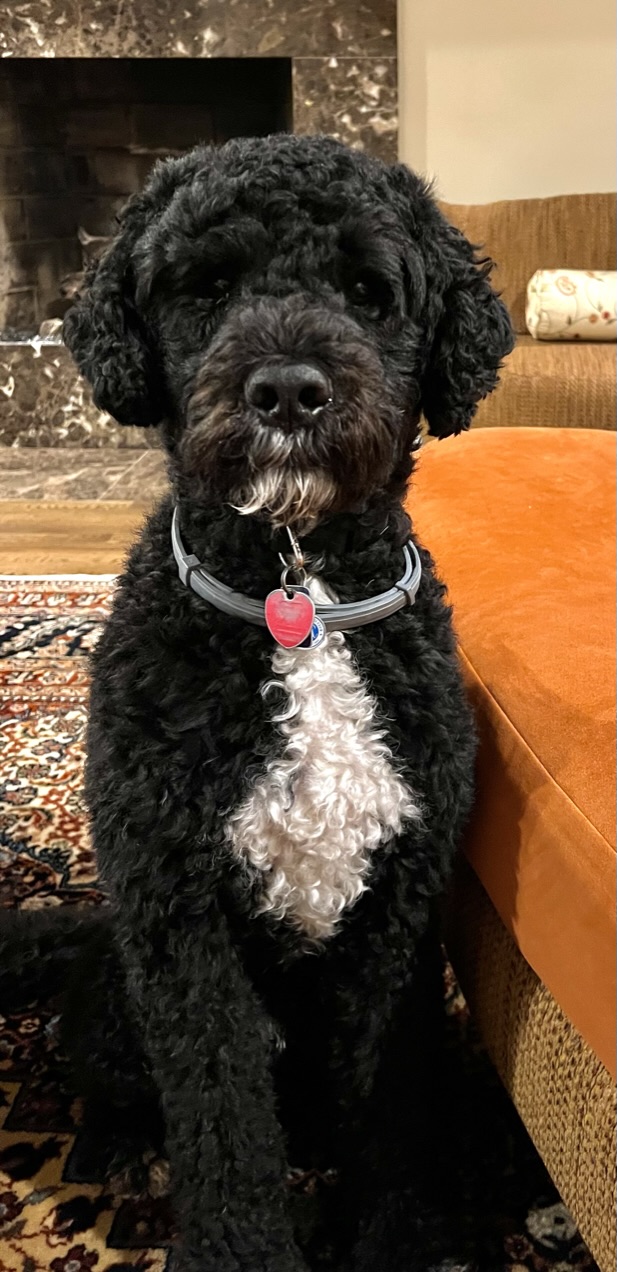
 I have a wonderful dog. His name is Rashi (if you know, you know), and he holds his post on the sofa in my study, keeping watch over the road and the property below. He announces the mail carrier. He announces every delivery truck, the refuse trucks, every dog on the sidewalk, and every neighbor who dares to walk past on our sidewalk or the one across the street. Heaven help the car that turns into our driveway without a written invitation he has personally endorsed, which is to say almost never. It would be admirable, this loyalty, if it did not arrive with a force capable of waking the dead. I sit at my desk, holding a fragile thought together, when Rashi decides the moment has come to alert the household to a squirrel. I have started to suspect he is in league with my cardiologist, testing whether my heart can survive the shock. So far, so good.
This morning I looked at Rashi, whom I am fairly convinced understands English when it suits him, and asked whether he might practice a little discernment. It is not, in this house, an unreasonable request. My wife and I have spent years studying Mussar, and discernment is a word Rashi has heard often enough to have an opinion on.
He did not have opinions. He barked at a falling leaf.
Here is what I did not say to him, because a dog cannot be expected to absorb a full teaching between barks. Discernment is not a demand for silence. It does not ask Rashi, or any of us, to stop noticing the world. The instinct that makes him bark at the mail carrier is the same instinct that makes him a genuinely good dog: alert, loyal, unwilling to let anything on this property pass unremarked. Mussar has a name for the discipline I was actually asking of him. Zehirut, watchfulness, is the first rung Rabbi Moshe Chaim Luzzatto builds in Mesillat Yesharim, and its claim is modest. Before you act, look. Examine your ways, whether they are good or not, rather than moving through the day on reflex. The word shares a root with azhara, meaning warning, which tells you something about its purpose. Watchfulness does not exist to shut the alarm off. It exists to ask, in the half-second before the alarm sounds, whether this is actually the moment for it.
That half-second is the whole of it. Discernment lives in the gap between the thing arriving and the response leaving your mouth. It asks you to be present enough in that gap to notice what you are about to do, what it will cost the person standing in front of you, and what it will cost you, too, if you are willing to admit it. There is an old line, usually credited to the Stoic Zeno of Citium and just as often misattributed to Epictetus, about why we have two ears and one mouth: so that we might listen twice as much as we speak. I have always found it easier to quote than to practice. It does not tell you to say nothing. It tells you where the ratio ought to sit.
If you imagine Rashi without the bark at all, you have not pictured a wiser dog; you have pictured a stuffed one, and I would miss the real animal, alarms and all. What I actually want from him, and from myself, is smaller than silence. It is the pause. The moment when you are self-aware enough to feel the bark forming and to ask whether this squirrel, this comment, or this reply typed in anger needs to leave you right now. Some of them do. Most of them, in my experience, do not.
We are in Elul, walking toward the Yamim Noraim, and the season brings a familiar instruction: look back at where you fell short. I want to offer a different use for looking back. Not an accounting of what you got wrong so much as a record of what you learned and where you might pause next time, so that the person you are becoming in 5787 carries slightly better judgment than the one writing this sentence. That is the real work of Teshuvah. Not punishing the self you were, but training the self you are still becoming.
I have not figured out how to ask this of myself in all the moments it actually matters, at my desk, mid-sentence, mid-argument, mid-life. I suspect I am not alone in that. Rashi, for what it is worth, slept through the entire writing of this essay. No comment on the squirrels.
Wishing you all a year sweetened by a few more pauses than the one behind us.
L’Shanah Tovah u’Metukah
Leave a Reply