Nava Tehila shares Mizmor Shir the psalm (ps92) to welcome Shabbat.
In these tumultuous times, the melodies help us to bring Shabbat Peace into our hearts.
Shabbat Shalom
Nava Tehila shares Mizmor Shir the psalm (ps92) to welcome Shabbat.
In these tumultuous times, the melodies help us to bring Shabbat Peace into our hearts.
Shabbat Shalom

In Parashat Mishpatim, we move from the heights of Sinai and the grand laws given by God to Moses to the granular details of civil law. The shift teaches that a righteous society is built not on abstract ideals but on the daily, impartial application of the Rule of Law.
Mishpatim introduces three pillars essential to our current struggles:
Our institutions are threatened as society’s trust in them erodes. Mishpatim reminds us that an orderly society is a deliberate choice, one that requires our involvement and confidence. Our future as a nation and world leader depends on upholding a system in which the rule of law anchors us against the storms of political passion
I write this, it is Groundhog Day and Tu B’Shvat!
The American Sage, Punxsutawney Phil, has predicted another 6 weeks of winter. It is incredible where we get our news!
More importantly, I would argue that this is the 15th day of the month of Shvat, Tu b’Shvat. This day marks the beginning of the new year for trees.
It is about the rebirth that will come from life that has gone dormant during the winter within the greater cycle of the year. We could not have a more apt metaphor for what is happening in our lives. The brutal and violent transgressions of the Federal Government through ICE and the Border Patrol, as well as the multiple assaults on human dignity and respect, seem to have seeded the birth of a popular uprising against these violations of our rights.
As spring approaches, the trees will blossom, and warmth will fill the air. But the rededication to our ideals requires us to act. Our tradition teaches that we are partners with God in the ongoing work of creation. Now is our time to commit to this sacred task. We must each ask ourselves what we are able or willing to do, and get to work.
In the harshest, coldest, and darkest times, hope arises that something better is coming. The Jewish tradition and the founding principles of our country require us, in the words of Abraham Lincoln, to work to ensure “a government of the people, by the people and for the people shall not perish from the face of the earth.”
Wishing you a happy Tu b’Shvat.
Rabbi David
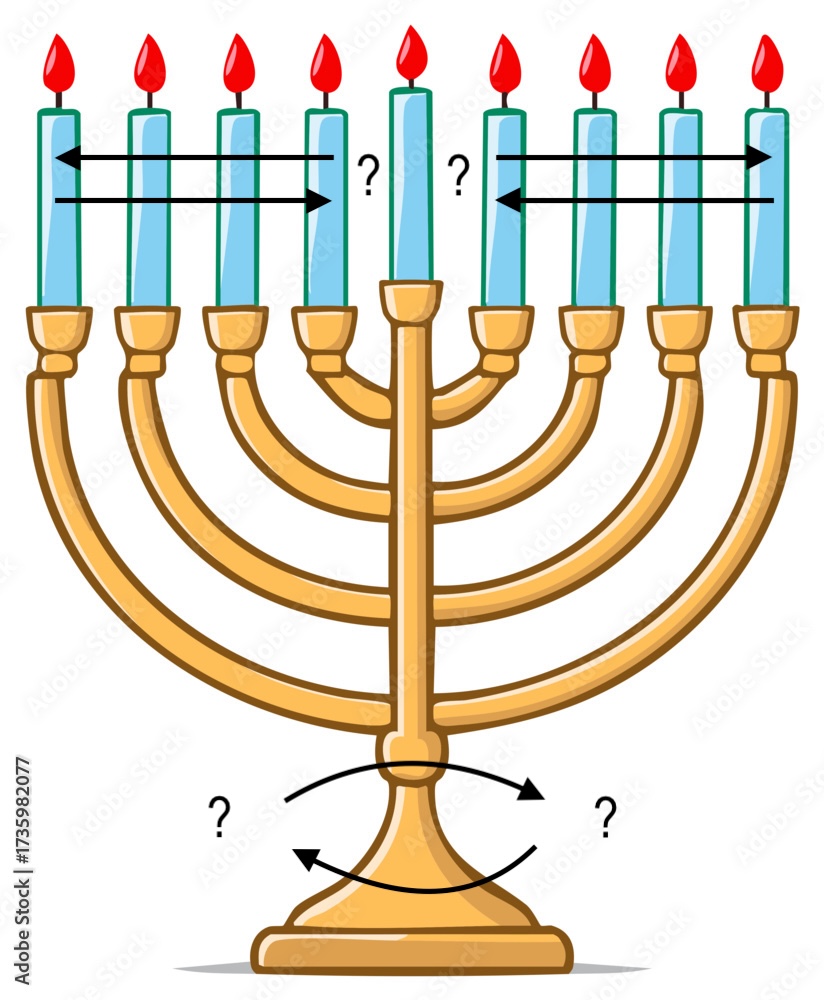
People have been asking me how to light the Hanukkah Menorah, or Chanukiah.
Should you light from left to right or right to left? And is that perspective from the person lighting the candles or from the window where others see it? Who knew it could be so complicated! Of course, this assumes we’ve already answered other questions: do we light all the candles every night or just one additional candle each night? Do we all light the same Menorah, or does each person get to light their own? Oy!
But the answer is that we have our opinion on the proper way for it to be done, which is as follows:
Facing the Menorah, we light the candle for the newest night, then light the rest of the lights. Our tradition says we should say the blessing and then do the thing for which we said the blessing immediately afterward. But because there are at least two blessings (three on the first night), many of us light while the blessings are in process.
But the most important rule of all is that we participate in the Hanukkah celebration by lighting the candles.
So, how do you light the Menorah?
With intention!
Chag Urim Sameach- Happy Festival of Lights
Chag Chanukah Sameach, Happy Hanukkah
We prepare for the first night of Hanukkah, deeply shaken
by the murderous assault on Bondi Beach and at Brown University.
The wanton hatred and violence are almost overwhelming. But we must find a way to gather this evening around our chanukiot, light our candles, place them in the window, and be with each other, letting the miracle of rededication take hold with an additional layer of meaning, overcoming the darkness of the moment and shining a light of love and hope.
Chag Urim Sameach,
Rabbi David Levin
President
The Board of Rabbis of Greater Philadelphia
Lecha Dodi likens Shabbat to the bride and is shared here by Muzika to the melody All of Me.
Shabbat Shalom
#BringThemHomeNow
As we remember the horror of October 7 and the aftermath, the words of Menachem Rosensaft bring us a somber resonance. Let this day of remembrance stir us to mercy for the child, not because we doubt our cause, but because we cherish our conscience.
“the dead child
in gaza city
khan younis
rafah
is cried over
with the same tears
by the same God
the same Allah
the same Adonai
as the dead child
in kfar aza
nahal oz
be’eri
…
and it is
for the not yet dead child
palestinian child
israeli child
muslim child
jewish child
that the killing must end
the war must end
the terror must end
the hatred must end”
—Menachem Rosensaft, from Burning Psalms: Confronting Adonai after Auschwitz (Ben Yehuda Press, 2025)
Psalm 27 is added to our prayers during Elul and through the chagim.
We prepare ourselves for this special time with the prayer that we might dwell in the house of the Divine. May your experience this season be meaningful, filled with reflection, repentance, and renewal.
Thanks to Chava Mirel for this beautiful rendition of Psalm 27:4.
Shabbat Shalom
#BringThemHomeNow
This Hungarian orchestra shares Tumbalalaika.
It is a love song in which a young man seeks a bride who can answer three riddles as the balalaika plays. As we greet the Shabbat bride during Elul, the question perhaps is flipped: Will we be worthy of the bride?
Shabbat Shalom
#BringThemHomeNow
MAN DOES NOT LIVE BY BREAD ALONE- THE MESSAGE OF EIKEV
When life becomes easier and we start to relax, hard-won battles fade into distant memories. We then drift into a new reality, and instead of staying alert and valuing our principles, we relax, enjoying a good life and the rewards of our hard work, daring to believe we’ve earned it and that it will always be ours. The hunger that once motivated us diminishes and we face the consequences. It is human nature to become complacent, but we must not.
This is Moses’s cautionary message to the people in his final speech. He warns them that change is coming. The generation that met God in the wilderness is passing away, and a new generation will take their place and settle in the promised land. Without that personal experience, these new generations risk losing their close relationship with God.
Turning away from God is dangerous. Forgetting how you arrived here and showing gratitude through consistent reverence and practice will lead people to ruin. Just as the current inhabitants who are about to be displaced from the land, you, too, will eventually lose the blessings of this place and be forced to leave as well.
The wilderness has taught you to be strong.
There’s an old story that teaches us tough times build strong people, and strong people then create easy times. Those easy times lead to soft people, who in turn produce tough times again. It’s a cycle that can only be broken by staying committed to God, because God’s gift of the promised land won’t lead us to complacency. It remains a constant challenge.
We see this in our community today. The previous generations worked hard and built a better life for their children and our children. They will inherit wealth that makes life easier. However, they may not fully remember the sacrifices others made for them. We are currently experiencing one of the biggest transfers of wealth in history. Money and property are passed to this new generation to simplify life. But this is only material wealth. The true challenge is how to pass down the lasting core values that emphasize hard work, sharing our abundance, and working to improve the world by carrying forward the values of our tradition for everyone. We face this challenge today just as Moses did then.
I recently spoke with a woman who was worried that her death might come too soon. Although her body was ready, she felt her children were not; they were unprepared to manage without her. The question was more complicated than the answer. Moses, too, is struggling to give final words of advice, admonitions to remember God and follow His word. At the end, it is too late to change the course. We hope that the lives we live and the values we model become lessons learned and embraced.
A midrash about the patriarch Jacob depicts him surrounded by his sons as he nears death, reflecting on whether his children have learned the lessons and will uphold the values or if those values will die with him. The adult children respond, “Listen, Father, we hear you and it shall be,” saying, “Shema Yisrael, Adonai Eloheinu, Adonai Echad.” With his final breath, Jacob says, “Praised be Adonai forever.” Baruch Shem kavod malchuto l’olam va’ed.” (Gen Rab 95)
We would all sleep better knowing everything will work out. We do our best. For Moses, it was to be a prophet, a liberator, a teacher, a priest, a judge, and a man. For forty years in the desert and many years before the Exodus, he showed how to serve his people through his devotion to God. In our own ways, as parents, we also have those same responsibilities. As loving parents, we do our best to nurture and provide our children with what they need to find their way in the world. Then, it’s time for them to stand on their own. We work toward this moment diligently and can only hope it will be enough.