Six13 shares its Jewish version of Defying Gravity.
Wishing you Chag Urim Sameach, Shabbat Shalom and the bringing of peace.
#BringThemHome
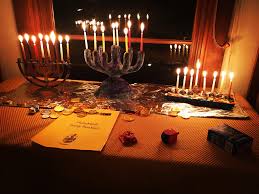
How do you light the Chanukah Menorah?
As you can imagine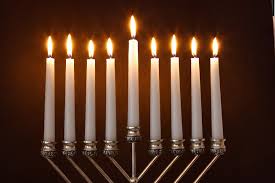 , this was a discussion among the Rabbis. The Talmud famously pits the House of Shammai against the House of Hillel, our preeminent first pair of rabbis.
Do you light one candle the first night and increase another candle every night until all are lit on the eighth day?
Or do you light all the candles on the First day and decrease the number until you reach one candle?
Most of us know Hillel won that argument, so we increase the light with every passing day.
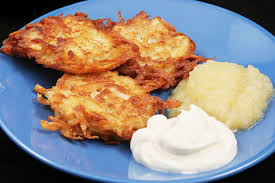 Do you use Applesauce or Sour Cream when you eat latkes? They never decided on this argument, so we do both! (actually, I am pretty sure they never engaged in this discussion- I am making it up)
Do you light one Menorah for the family, or does everyone get to light their own?
Did you know the Menorah we use for Chanukah is called a Chanukiah? (it is an eight-light, plus Shamash, candelabra as distinguished from the seven-armed menorah used in the Temple).
Do you put the menorah in your front window for the community to view?
Why do I always seem to lack the right number of candles?
And when I buy candles on sale after Chanukah, I can’t remember where I put them for the next year.
Last but not least, is it Chanukah, Hannukah, or Channukah, Hanukah, Hanukkah, etc.?
We can get all caught up in both the fun and serious questions as we determine how we want to celebrate our holiday. But remember it is about celebrating the holiday.
It is a time of celebration and rededication. We remember the story of Jewish victory, which instilled pride in our heritage and gave us strength and confidence as we face seemingly enormous challenges today. We spend time with our family, sharing the light’s glow, the pleasure of the food, and the fun of the games. May your Chanukah be wonderous!
Chag Urim Sameach, Happy Hanukah!
Malinda and the Jerusalem Youth Chorus offer a song of love.
Shabbat Shalom
Bring them home
 The manger scene of the Baby Jesus swaddled in a Keffiyeh has created much commotion and attention. Even though the Vatican has removed the display, the consciousness-raising alone means that the image has had the intended effect.
We are talking front and center through religion about the plight of the Palestinian people.
This is not the first time someone has reinterpreted something for their own purpose. I have seen many iterations of Jesus: white, very white, swarthy, black. Many religions that have Jesus at the center of their theology have him displayed realistically on the cross, his body cradled in his mother’s arms, lovingly gazing down upon us in a portrait or looking upwards in an icon. As a babe in mother’s arms, as a man spreading the Word, at a bountiful supper, and as a martyr. And now swaddled in a keffiyeh. We use religious symbols to motivate the audience toward a vision or narrative. This is frequently for good and exemplary purposes and too often for malicious purposes.
The charge that this current manger display is Antisemitic is a particular, not universally shared Jewish perspective. Some deliberately embrace that evil message. I am sure that was not the intent of the Pope or the Church. And if the manger is allowed to be a message of hatred, it will have failed miserably in its mission.
Raising awareness of the plight of the Palestinians is important. Christmas is an essential Christian symbol of God’s love and our hope. Peace on Earth and Goodwill towards men is the universal message of the extraordinary celebration.
Can this awareness-raising symbol be channeled into constructive forces to promote the welfare of the Palestinian people, who have been victimized for too long? It is time for the people of goodwill to lay down their arms and reach out across the divide to each other. May love supplant the hatred that has kept both sides at war for too long. May the promise of Christmas resound in that troubled place of Jesus’ birth so that two people learn to live together in peace and security.
Merry Christmas!
Prayer is universal. It transcends language, culture, and creed, uniting us in our deepest hopes and aspirations. This rendition of The Prayer blends its original message with the Hebrew translation by Rabbi Moshe Pomerantz z”l (1935-2024).
This Shabbat I share the beauty of The Prayer from Park Avenue Synagogue and Cantor Azi Schwartz.
Wishing you Shabbat Shalom.
May the hostages come home!
Greeting Shabbat as the evening comes, we sing a series of Psalms as part of Kabbalat Shabbat. Mikolot Mayim Rabim is a verse from Psalm written by the extraordinary Hazzan Jessi Roemer and performed by the also extraordinary Hazzan Harold Messinger.
Be swept up in the beauty of the sound and the images as we wish Shabbat Shalom to all.
I was sitting with someone recently. He is a Muslim and active in the causes of his people. I am a Jew and active in the causes of my people. We are part of a dialogue group that builds bridges and develops relationships with people we usually do not get to know. But we are engaged, and through this process, a friendship has ensued.
The war in the Middle East is deeply painful for us both. We both know people we deeply care about who are direct victims of this war.
My friend recently celebrated the birth of his child. Mom and baby are doing well. He is so excited to be a father. Like most fathers, he wants to provide for his family and nurture his child with love and a bright future filled with opportunities. I recently celebrated the birth of a grandchild. We are overjoyed to have a new addition to our family and cannot wait for the next opportunity to shower our love. But in this beautiful moment was something chilling; it was an epiphany of sorts. How different would this be if we did not all live here.
If the war between our people never ends, what would become of our children? With the birth certificate, effectively, a death warrant would have been issued as well. Whether warriors or innocent victims, they would be the fodder for hostilities between two warring nations; we bring them into a killing machine. Birth should represent hope- the idea that there is a future and tomorrow promises something good. We do not have children so that they may be offered up, sacrificed on an altar of hate.
My friend and I shudder at this, as do many other mothers and fathers here and there. Birth is a miracle, and peace is no less. It is time to find a path forward together.
Our God and God of our ancestors, with hope and humility we approach Election Day, the day on which We the People will choose the individuals who will govern our nation, our states, and our communities.
You have abundantly blessed the United States of America with freedom, security, prosperity, and the right to democratic self-government. You made it possible for the founders of our country to fulfill the command of Your Torah, to “proclaim liberty throughout the land, and unto all the inhabitants thereof.”
Daily we pray to You to restore our leaders as in former times. On this Election Day, help us to remember that in America we are responsible for choosing our own leaders, and that the survival of our democracy, and the well-being of generations of Americans to come, depend upon the care we take in those choices.
Daily we pray to You for knowledge, discernment and wisdom. On this Election Day grant us those blessings in full, so that we may consider our choices with knowledge and vote with discernment and wisdom, with the best interests of our country and our communities in mind.
Daily we pray to You to subdue the arrogant in our time. On Election Day, and every day, help us to subdue the arrogance within ourselves. Open our hearts and minds to consider the opinions of our fellow citizens, as we call upon them to consider ours.
Strengthen our will to fulfill our duties to our country and to one another. To exercise our precious right to vote. And to do all we can to ensure that every legal vote is counted, regardless of the candidate or party for whom it is cast.
May it be Your will that our decisions this Election Day preserve this country as a wellspring of liberty and a beacon of tolerance and democracy for the entire world.
And let us say Amen.
Naomi Shemer is the poet who created Al Kol Eleh, All These Things, a bittersweet and timely song. As Yonina shares her music, let us continue to pray for the hostages to come home and for peace.
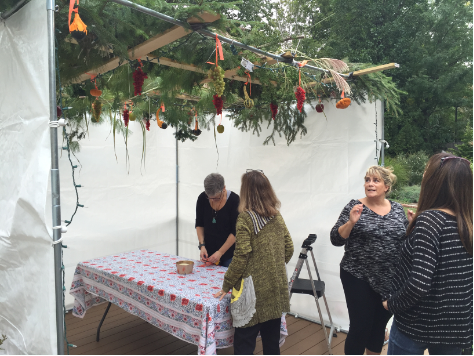 We are about to begin the holiday of Sukkot. From My Jewish Learning, this is an overview of the holiday:
Beginning five days after Yom Kippur, Sukkot is named after the booths or huts (sukkot in Hebrew) in which Jews are supposed to dwell during this week-long celebration. According to rabbinic tradition, these flimsy sukkot represent the huts where the Israelites dwelt during their 40 years of wandering in the desert after escaping from slavery in Egypt. The festival of Sukkot is one of the three great pilgrimage festivals (chaggim or regalim) of the Jewish year.
Here is the link to the full article: https://www.myjewishlearning.com/article/sukkot-101/
By using the Sukkah, we glimpse the experience of our vulnerability.
And this moment of vulnerability requires us to think of those held captive. We pray for and demand the release of the hostages.
We are told to eat at least one meal in the Sukkah. On a lovely fall evening, you can see the stars through the Skach, covering the top. But on cold or rainy evenings, it is another entirely different experience, and we certainly get the message of being vulnerable! (By the way, our great sage, Maimonides, suggests strongly that when it’s rainy, go inside!)
One of the interesting aspects of “dwelling in the Sukkah” is the ritual of inviting the Ushpizin. These are our revered forebears with whom we’d love to talk and glean some of their wisdom. It started with Abraham, Isaac, Jacob, Joseph, Moses, Aaron, and King David. It is extended to include the great matriarchs Sarah, Miriam, Deborah, Hannah, Abigail, Huldah, and Esther. And it is a chance to broaden the guest list even further. I have invited loved ones, particularly my great-grandfather. Who is on your guest list?